Massive 3-tower Moody Centre development advanced by Port Moody council
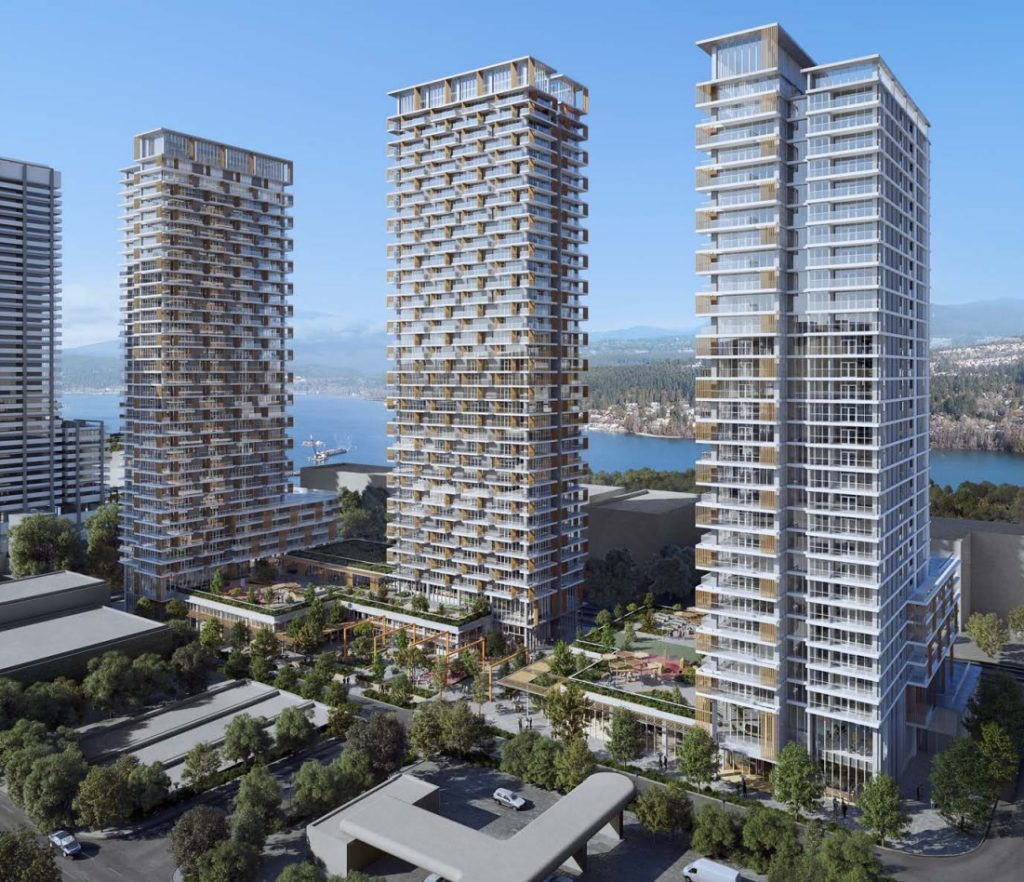
Moody Centre’s second major tower development has been moved forward by Port Moody council.
Beedie Living’s three-tower project in the Moody Centre transit-oriented development (TOD) area was before council for first reading on Tuesday.
Council said there much work needed before any approvals, but the majority opinion was there was “a lot to like.”
Local news that matters to you
No one covers the Tri-Cities like we do. But we need your help to keep our community journalism sustainable.
Coun. Kyla Knowles said that while the provincial mandates had forced density on the city, she believes density is appropriate for Moody Centre.
“Right now, the area is barren, concrete, without much life,” Knowles said. “This area should be vibrant with pedestrians, green spaces, shady spots, walkable stores, new employers, job opportunities, and, please god, some trees.”
The project is the second high-density application submitted for the Moody Centre TOD area; when combined with PCI Development’s two 39-storey towers, nearly 2,000 units are proposed for the neighbourhood.
Beedie proposes building 980 units at one site in 32, 34, and 38-storey towers on Spring Street and Electric Avenue, and between 40 and 50 units in a six-storey women’s transition housing facility at a second site.
In order to develop the main 3.8-acre site, significant amendments to the official community plan (OCP) are being requested.
These include increasing the maximum permitted tower height from 26-storeys, increasing the maximum permitted floor plate size by 10 percent, decreasing the minimum required distance between towers by 33 percent, and moving the eastern boundary of the TOD by one block to the east.
Although both the Beedie and PCI projects far exceed densities permitted in the OCP, council passed a new Moody Centre policy framework in late 2023, which allowed “flexibility” if developments provided significant benefits in the form of housing, amenities and infrastructure.
Although a development agreement has not yet been signed, Beedie claimed to be offering 26.9 million in cash and in-kind contributions to the city.
This includes $2.5 million for the public plaza, $6.6 million for off-site servicing and infrastructure, $11.7 million for non-market housing, $2.4 million for public art, and $2.5 million for community amenity contributions (CAC).
Staff said before the application is referred for a public hearing, a term sheet will need to be drafted laying out Beedie’s obligations.
Coun. Callan Morrison said he wanted more clarity on the CACs and density bonusing provisions, stating the city needs to be able to pay for amenities needed to service its population growth.
“With the addition of 1,800 people being added to our community, obviously they’re going to be wanting more park spaces, more amenity spaces, more access to recreation,” he said. “It’s important that our council is very mindful of what we are able to provide.”
Several councillors praised the significant refinement to the application since it first appeared at early input back in February 2024.
Some of the major early concerns included the lack of employment and childcare space, as well as not meeting the city’s requirements for non-market housing.
The city has set a target of providing space for 2,800 jobs in the Moody Centre TOD area, and Beedie’s main site takes up more than 22 percent of its total developable area.
Beedie had initially offered 46,484 square feet of commercial floor area, space for around 385 jobs – 38 percent short of the target in Port Moody’s guidance framework.
The commercial floor area has since increased 46 percent, bringing the application within 17 percent of Port Moody’s target.
Within that commercial space, Beedie is also planning to include childcare space between 4,000 and 6,000 sq. ft., which could accommodate between 71 and 107 children. Staff said this significantly exceeds the childcare demands of the main site.
In response to the concerns around non-market housing, Beedie is currently negotiating a partnership with Kwikwetlem First Nation, where units would be sold at cost to the nation for the purpose of affordable Indigenous rental housing.
The 8,713 sq. ft. women’s transition facility on Spring Street will be built at the same time during phase one of the main site, and occupancy is anticipated much sooner than the towers. Ownership of the facility will be transferred to BC Housing once construction is complete.
Staff also note that the unit mix of the main site meets or exceeds the city’s requirements for its family friendly policy.
Coun. Diana Dilworth praised the spectrum of housing being added to the community, and the developer’s collaboration with other housing providers.
Not all of the feedback was positive, however.
Coun. Haven Lurbiecki, who was the sole vote against moving the application past first reading, noted that most people in the community oppose the project.
She pointed to previous public surveys on the Moody Centre TOD in which 72 percent of respondents were against adding 12 towers, and now council is planning for 14.
Public engagement for Beedie’s proposal showed that 71 percent of respondents were opposed.
“The findings are reproduced because they’re real,” Lurbiecki said. “Getting elected does not mean council gets to ignore residents.”
Lurbiecki said that while transitional housing was needed, Port Moody should not have to accept towers to secure it, describing it as a “bad business deal.”
She said the most concerning aspect is the loss of industrial land, which is needed for business creation, and adding that industrial zoning was exempt from capture under the province’s TOD mandates.
Lurbiecki said Port Moody’s tax woes will only get worse. “If we lose this industrial land . . . it’s gone,” she said.
Dilworth responded that the city had been considering developing this site for over a decade, and when the SkyTrain was extended to Moody Centre in 2016, there was an expectation that density would be built around it.
“We may see occupancy in five years. That’s ridiculous. This has been a parking lot for the better part of 15 years,” she said.
Several residents had raised concerns that the city is developing too quickly, and is already meeting its provincial housing targets, but Dilworth disagreed.
She said the province is currently developing its 20-year targets, and Port Moody needs to be thinking in decades.
“This is not too much too soon. We are planning for the future,” Dilworth said. “We have a lot more time to hear potential feedback. . . . To say no is irresponsible and it is the wrong thing to do.”
Knowles pointed to a recent release by the mayor’s office calling on the province to help the Tri-Cities’ attain more supportive housing, as well as support for Beedie’s application voiced by BC Housing.
She said it is “completely disingenuous” to suggest subsidized or supportive housing can be secured without developers or senior levels of government.
“Either we intend to provide supportive and low-cost housing to those in need, or we don’t. Period,” Knowles said. “This project provides an opportunity for us to now walk the walk, rather than just talk the talk.”
Author