Despite childcare concerns, council gives mostly positive review to Moody Centre TOD’s second giant tower development
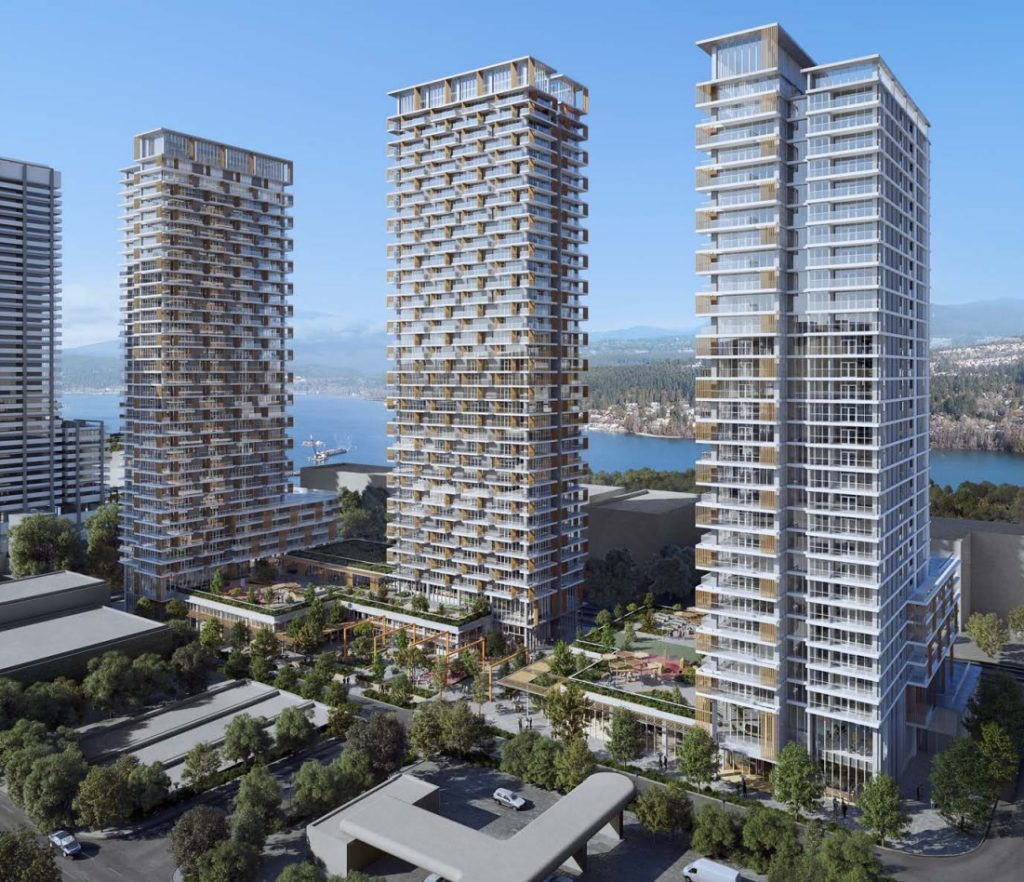
Despite concerns about too few jobs and a lack of childcare, council was generally supportive of the second massive tower project pitched for Moody Centre’s Transit Oriented Development area.
Beedie Living’s application for 32, 34, and 38 storey towers on Spring Street and Electronic Avenue, along with a six-storey women’s transition building on a secondary site on Spring Street, was before council for early input on Feb. 20.
The project’s supportive housing, public plaza design, and unit mix were praised. Critiques ranged from the developer not offering plans for a district energy system, as well as the concern that the amount of density would put Port Moody on a path to becoming unrecognizable.
Local news that matters to you
No one covers the Tri-Cities like we do. But we need your help to keep our community journalism sustainable.
In total, 972 units would be built in the three towers, the vast majority being strata, while 40 units would be built for the women’s transition building. The project falls short of the city’s requirements for non-market housing by 2.2 percent, but the developer has said they will add more affordable units in one of the towers.
Beedie has also pledged to build the supportive housing in the first phase of development, although there are still discussions with the city regarding potential land assemblies to broaden the scope at the secondary project.
“We have a need for that type of housing, and to know that there’s a plan in place that could bring it to fruition within the next five years is amazing,” said Mayor Meghan Lahti.
For the main site, the developer is requesting for four amendments to the official community plan in order to achieve rezoning.
Beedie has asked for 26 storeys more than the Official Community Plan’s maximum allowance, while also increasing maximum floor plate size and minimum distance between towers, and expanding the TOD a block to the east.
It is the second TOD project to be submitted to the city; the first being PCI Development’s 39-storey rental towers, which was reviewed earlier this year.
Both applications have significantly eclipsed the densities permitted in the city’s OCP.
However, council passed a new policy framework in late 2023 to permit “flexibility” in several areas if developers offer up significant public benefits to the city such as housing, amenities and infrastructure.
Beedie claimed the project will bring nearly $26.9 million in cash and in-kind contributions to the city.
The contributions include. $2.5 million for the public plaza, $6.6 million for off-site servicing and infrastructure, $11.7 million for non-market housing, $2.4 million for public art, and $2.5 million for community amenity contributions (CAC).
The city’s land use committee (LUC) voiced skepticism of these calculations, specifically relating to the lack of CACs and developer cost charges. Staff note they are still reviewing the numbers.
Several councillors agreed more clarity was needed.
Coun. Callan Morrison said that, while some of the contributions would have a public benefit, more money would be needed for amenities off-site.
“Simply put, $2.5 million is not enough, and I’d like to be seeing how we can get more,” he said.
Staff and LUC have also raised major concerns over the lack of employment space . In total, the proposal includes 46,000 square feet of retail and employment space, which falls 38 percent short of the city’s target for the TOD area.
Beedie’s main site takes up more than 22 percent of the TOD’s developmental land and provides space for around 385 jobs, approximately 240 short of the city’s target.
Couns. Samantha Agtarap and Haven Lurbiecki both echoed staff’s worries over the current projections, which the latter described as “alarmingly small.”
Both noted the city would be losing light industrial spaces by developing the site, which should be prioritized for retention across the region.
“We do need to try to get the job numbers up, and especially look at opportunities for even light industrial in that area,” Agtarap said.
In response to concerns, Beedie has proposed increasing the employment floorspace on the main site to accommodate 500 jobs in total.
Coun. Diana Dilworth said she found these figures acceptable.
“What (the figures) are not addressing is the number of people that work from home, and I can tell you that number is incredibly significant,” she said.
Given that childcare is a requirement of the TOD area, this proposal’s lack of childcare space was a concern for some on council.
Beedie has stated that childcare space at another TOD project will accommodate the needs of several developments in the area, but staff are still requesting details.
Coun. Amy Lubik said she didn’t think this type of planning is appropriate, as space should be available for the residents of each building.
She added other development may change their minds or designs, and build-out times will vary.
Mayor Meghan Lahti added the Tri-Cities is currently very under-served in terms of daycares, and any space offered would be beneficial for the project.
Beedie’s proposal also has no plans for a district energy system, which has been frequently requested by council for the TOD projects.
Jeff Moi, Port Moody’s general manager of engineering and operations, said that staff have hired an outside consultant to gauge the feasibility of a district energy system from a business lens.
That report is scheduled to come before council in the coming months.
Dilworth noted there are emerging technologies coming out that should also be considered, and Lahti said she would be happy to hear alternatives if they met the city’s climate goals.
Lurbiecki was the sole councillor vehemently opposed to the Beedie’s current proposal.
She pointed to public engagement surveys which showed that 82 percent of respondents opposed the development, and community OCP surveys which showed high density towers were the least preferred option for the TOD.
“There’s just one major problem with this proposal: the community doesn’t want it,” Lurbiecki said. “Our public engagement so far tells us this clear as day.”
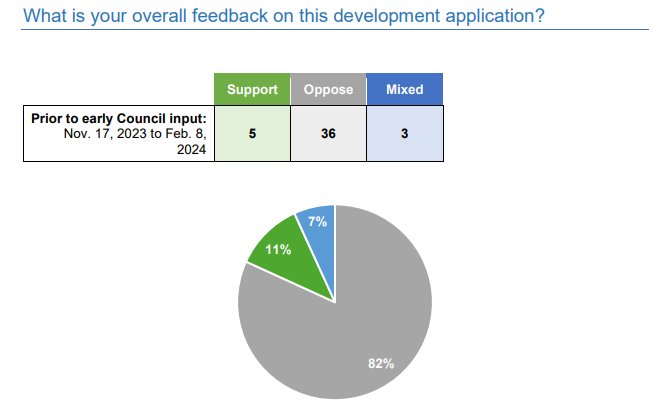
Lurbiecki said approval of the development will put Port Moody on a path to becoming like Lougheed, Brentwood, or Coquitlam centres against the wishes of the residents.
She also questioned why the LUC, meant to represent diverse views in the community, provided unanimous support despite the height and density when there is not broader community support.
Council’s consideration of such a proposal in the midst of updating its OCP and working through new provincial legislation “is just plain wrong,” according to Lurbiecki.
Its density far exceeds provincial requirements, the city is meeting its housing targets, and the units will be so expensive they will not aleve the affordability crisis, she concluded.
Author