Port Moody council provides feedback on tallest towers ever proposed for city; height, density not a concern for most
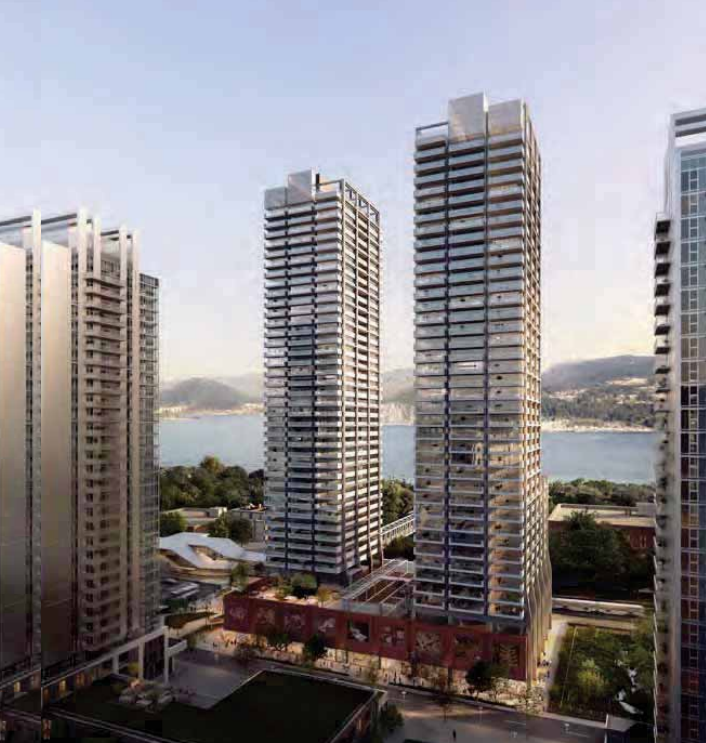
Port Moody council got its first look at the densest and tallest towers ever proposed for the city on Tuesday.
Although concerns were voiced regarding PCI Developments’ two 39-storey rental towers adjacent to Moody Centre SkyTrain Station, the majority of council was not troubled by its height or density.
Coun. Diana Dilworth said she thinks the province set housing targets on Port Moody specifically because it was not creating enough density around Moody Centre and Inlet Centre stations.
Local news that matters to you
No one covers the Tri-Cities like we do. But we need your help to keep our community journalism sustainable.
“I know the height of these towers is a concern for some people. I don’t agree that we’re going to wreck our community, or that thousands of people don’t want this,” said Coun. Diana Dilworth. “I think this is the right time for this development.”
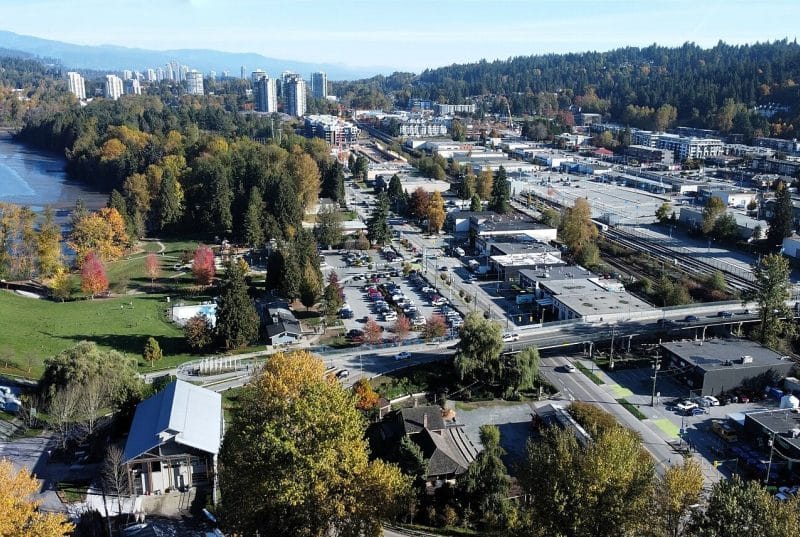
The 857-unit project is the first proposal for the 23-acre Moody Centre Transit Oriented Development (TOD) area, though more applications will be coming to council shortly.
Rezoning and significant deviations from the current official community plan (OCP) are being requested, including increasing the allowable tower height to from 26 to 39 storeys, more than halving the separation between towers and nearly halving the required parking stalls.
Top of mind for many councillors was the recent provincial policy announcement that would mandate the creation of TOD areas in 500-metre radiuses around SkyTrain stations.
The new legislation prescribes a minimum density within certain distances surrounding transit hubs, along with throwing out minimum parking requirements.
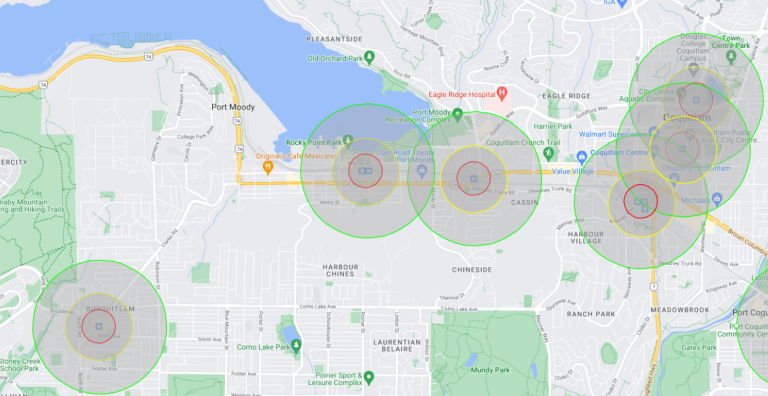
Projects within 200 metres, such as PCI’s 125,000 sq. ft. site, would be required to have a minimum of 20 storeys.
Mayor Meghan Lahti said the province’s aim is not to limit tower heights at the targets, but municipalities will only be able to negotiate when a project goes beyond those targets.
“We will have no say in that,” Lahti said. “I think that we need to sort of focus on the things that we actually have a say in.”
Several on council commended the amount of amenities being offered in the application, which the developer has calculated at more than $23 million.
These include a $12.3 million pedestrian overpass, $3.9 million to daylight Slaughterhouse Creek, $1.25 million for public art and building a transit plaza for $750,000.
A total of 57,000 square feet of commercial space including a large grocery store is being proposed, along with nearly 23,000 sq. ft. of indoor amenity space, and 4,300 sq. ft. for “low-cost artist and studio” space.
Lahti described the amount of amenity space as “quite astounding,” and praised the grocery store, artist space, and energy efficiencies.
Not all the commentary on the project was positive, however.
Coun. Haven Lurbiecki said the height, unit mix, amount of parking spaces, and lack of affordable housing were all “unacceptable.”
She alluded to OCP surveys being used to used to guide the OCP update, which she says show the public does not want this much density in the area.
The first draft of OCP revision is scheduled to be presented to council in early December, but it won’t be adopted until well into 2024, according to staff, adding they trying to review new applications under its framework.
Lurbiecki argued that all SkyTrain stations are not the same, and Port Moody is unique due to its geography and lack of access points.
“We are 10 square miles. We have one road in and out. . . . This is going to destroy our city,” Lurbiecki said. “I can guarantee you if we were to approve 39 (storeys), we’re going to be seeing higher applications coming from here.”
Coun. Amy Lubik agreed there was a lack of affordable housing for a project of this size, stating the developer should be offering a lot more considering the deviations from the OCP.
A total of 43 units (5 percent), mostly one bedroom and studio apartments, would be offered at below market rates.
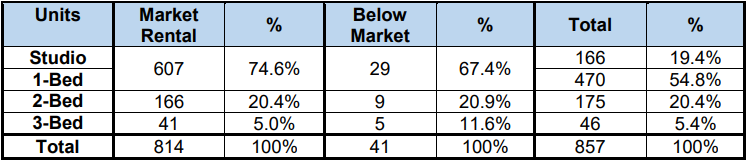
Lahti reminded council rental only buildings are exempted from having to provide any affordable units in the city’s inclusionary zoning policy.
“They are following our policies, in fact, they are going above and beyond our policy to provide an amount of affordable rental units that they didn’t need to,” Lahti said.
Staff noted the developer’s offer for below market units is likely due to the scale of OCP amendments being requested.
Another issue raised by Couns. Callan Morrison and Lubik involved the current architectural design.
A staff report to the advisory design panel brought up numerous issues, including a lack of detail, bulk and massing of the towers, and their appearance on Port Moody’s skyline.
Morrison said the development site is the “marquee spot” of the TOD area. “I would love to see this be a real piece of art in our community,” he said.
He was also concerned about lack of family friendly units, as well as the lack of spacing between the towers and how it would affect other incoming developments to the area.
He said he didn’t want a 28 metre separation between towers to become a precedent.
Coun. Kyla Knowles and Lubik both brought up issues raised at the land use committee (LUC) this month regarding the pedestrian overpass being proposed.
Several members of the LUC had questioned the need of an overpass, considering its expense and proximity to the already existing overpass to Murray Street.
“We may want to use that money for something else,” Knowles said.
Another issue regards the public accessibility of the overpass as it would pass through private property. Lubik said if the overpass was only going to be open during business hours, it could restrict access to the general public.
Lurbiecki introduced a motion for staff to revise the city’s inclusionary zoning policy following discussion on the proposal.
She said there were “serious issues” with the current policy which could be exploited as more applications come into the Moody Centre TOD area.
The motion found near unanimous support, though some councillors voiced concern over adding to staff’s workload.
The original policy made sense for six storey rental buildings, according to Lubik, but the city could be losing out on opportunities to negotiate more below market units with bigger applications.
Lahti agreed it was not envisioned for 39-storey projects, and Dilworth added the housing landscape has significantly changed in the years since the policy was adopted.
Morrison suggested the revision could be worked into the ongoing work to update the city’s family friendly policy.
Author