Port Moody councillor calls for referendum on Moody Centre developer plans; another calls for review of public surveys
Two contrasting motions regarding public engagement were introduced at Port Moody council on Tuesday.
The first, introduced by Coun. Samantha Agtarap, calls for re-evaluating how the city captures, analyzes and uses public feedback; the second, introduced by Coun. Haven Lurbiecki, calls for a public referendum around council’s Moody Centre development vision.
“We have two paths in front of us,” Lurbiecki said. “Do we listen to what the community wants, or do we not?”
Local news that matters to you
No one covers the Tri-Cities like we do. But we need your help to keep our community journalism sustainable.
Council’s discussion followed a report on public engagement related to future recreation facilities in the city, where Agtarap questioned how representative resident survey data is.
While valuable information can be provided from public engagement, the results do not necessarily reflect the views of all Port Moody residents, she noted.
Agtarap said as council faces numerous upcoming decisions where public feedback will be sought, it is important the questions being asked are open ended, and can result in usable data to inform the process.
“I think there’s a broader conversation council needs to have in understanding how we interpret, and how we engage with, the information that’s being provided,” she said. “How are we ensuring that we’re getting good information, and that we’re equally accessing all segments of our population?”
Agtarap requested council bring in a consultant to provide expertise on questionnaire development, design, and analysis on the basis of gathering statistically relevant data.
Coun. Haven Lurbiecki, however, criticized the motion, asserting that it reflects a continuing trend of council to try to discount past surveys related to development.
Lurbiecki has frequently relied on a 2020 community survey, in which the majority of the 1,055 respondents were opposed to the density being planned for Moody Centre’s transit oriented area (TOA).
“I keep hearing over and over at this table, ways to get around what we’ve heard from our community,” she said. “I’ve heard insinuated at the council table that the results of some surveys or forms of public input can’t be taken seriously, or that the results are somehow not reflective of a silent majority.”
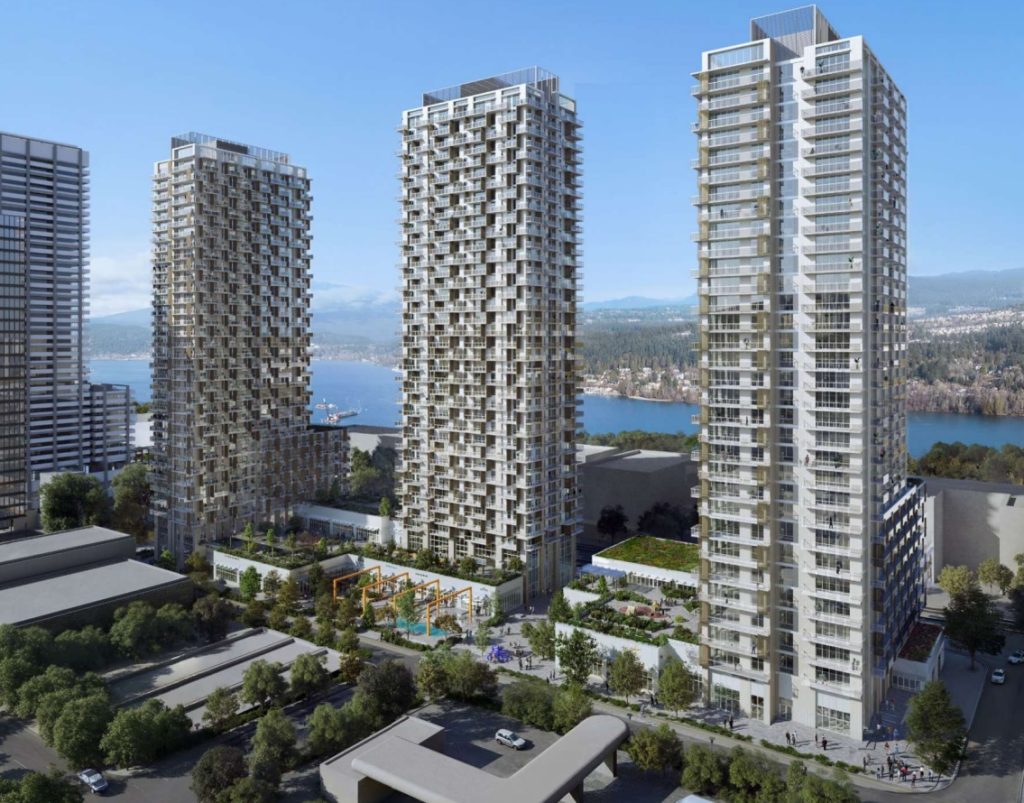
Lurbiecki then introduced her own motion, calling for a community-wide public referendum regarding Moody Centre’s TOA framework, which allows 14 towers up to 40 storeys to the north of St Johns Street, and for decisions related to height amendments or rezoning be deferred until it is complete.
“This needs to happen before we make decisions of such immense consequence and profound impact on our city,” she said.
Beedie Living’s three-tower project – the first of Moody Centre’s two major in-stream developments – is headed to public hearing on Feb. 4.
Agtarap countered that Lurbiecki had a “profound misunderstanding” regarding her motion’s intent, stating she just wants council to learn about best practices.
Couns. Kyla Knowles and Callan Morrison both supported Agtarap.
Knowles said she didn’t understand Lurbiecki’s resistance, stating council needs to better understand surveys, especially considering the “huge decisions” in the coming years.
“It behooves us all to understand what we’re learning from our residents and how relevant it is,” Knowles said. “To look at the data clearly and understand what it is we’re seeing.”
Morrison added he wants to know the limitations of certain ways of information gathering.
“That way, we all know what we can pull from it, and whether or not we should be hanging decisions entirely on surveys, or if there’s other methods that should also be explored.”
Both motions will be discussed at a future committee meeting.
Author