Moody Centre’s second massive tower project headed to public hearing in early 2025
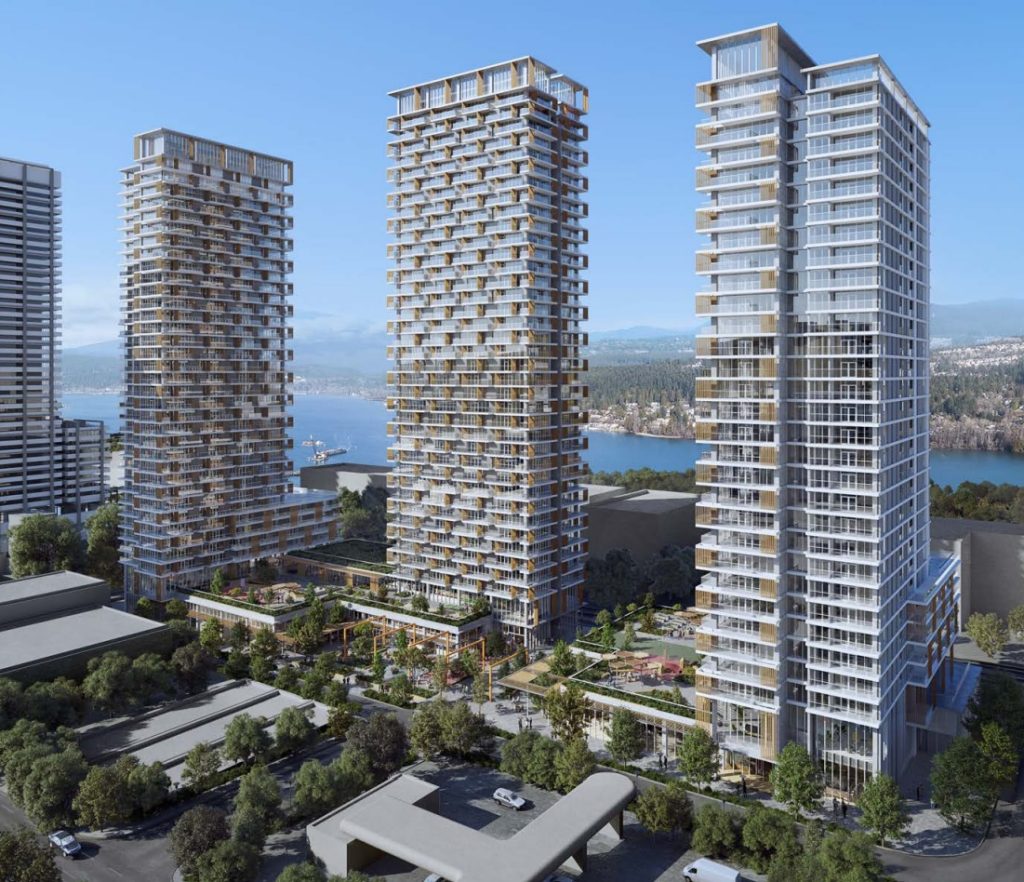
Beedie Living’s massive three-tower project for Moody Centre is headed to what will likely be a divisive public hearing early next year.
The 32, 34, and 38-storey towers on Spring Street and Electric Avenue, along with a women’s transition facility at a smaller secondary site, were both advanced past second reading on Dec. 2 by a 5-1 Port Moody council vote.
Tower height has been a major point of contention to date.
Local news that matters to you
No one covers the Tri-Cities like we do. But we need your help to keep our community journalism sustainable.
Coun. Haven Lurbiecki, who was the sole vote against moving the project forward, pointed to public engagement results showing 72 percent of respondents were opposed to the project.
“People do not want Port Moody to be turned into a sea of towers,” Lubiecki said. “Why is council continuing to ignore the community when it comes to development in the city?”
Beedie’s project is the second major development proposed for Moody Centre’s transit oriented development (TOD) area, where maximum allowable building heights have been upped from 26 to 40 storeys by the current council.
It follows PCI Development’s twin 39-storey rental towers, also advanced to public hearing, where engagement surveys also produced deeply divided results.
Lurbiecki further pointed to broader community surveys, completed by thousands or residents, which showed that an “overwhelming majority” were against even allowing 26-storey towers.
“I feel like I’m in the Twilight Zone. I feel like this council is trying to sell something to our community,” she said.
Significant amendments to the city’s official community plan (OCP) are required for the Beedie project to proceed.
These include increasing the maximum tower height, increasing the maximum floor-plate size, decreasing the minimum distance between towers, and extending the eastern boundary of the TOD area by one block.
While both of Moody Centre’s tower projects have densities and heights far higher than what the OCP permits, council passed a new TOD framework in late 2023 allowing developer’s flexibility if certain housing, amenities and infrastructure benefits are provided.
In total, the Port Moody would receive $27.8 million in community amenity contributions, development levies and charges, and density bonus payments from Beedie’s project.
Major features of the development include up to 72,000 square feet of commercial and office space, providing job space for between 520 to 555 people; a large outdoor public plaza allowing recreation and social interaction; 21,000 sq. ft. of indoor amenity space; and a childcare facility able to serve 70 and 110 kids.
Coun. Callan Morrison said new provincial legislation has forced the city’s hand on building heights. In order to rake in density bonus payments, he said council needs to build higher than the 20-storeys mandated around transit areas.
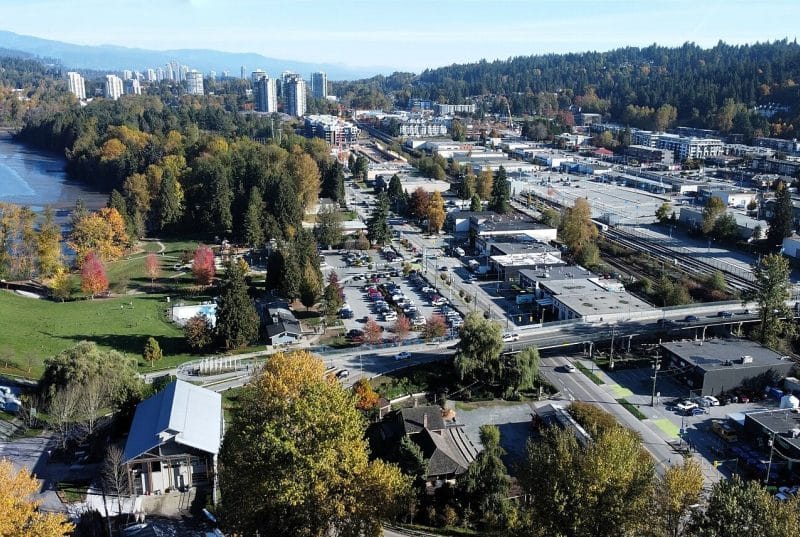
He and several other councillors remarked that Moody Centre is currently underutilized, and barren of any green space.
“There was a comment made tonight about the charm of Port Moody completely leaving us. I disagree entirely,” Morrison said. “Right now it’s solid concrete.”
Coun. Amy Lubik added the goal of the TOD framework is to ensure view corridors are preserved, public amenities like the plazas are built, and green space is preserved. Without it, she said Moody Centre would end up looking like Burnaby’s Brentwood Centre.
“I understand that this is a big change, and it can seem like a lot,” Lubik said. “I don’t want a wall of towers, and that was what the original proposal for Moody Center was.”
A total of 981 housing units are being proposed at Beedie’s main 167,000 sq. ft. site, along with 40 to 50 affordable units at the second 8,700 sq. ft. site.
A handful of changes have been made since the first reading, the most significant being 58 studio apartments being completely cut from the unit mix, resulting in an increase to the number of larger apartments.
Staff noted that 51 percent of the units fall under Port Moody’s definition of family sized units, significantly exceeding the 35 percent policy recommendation.
Tower floor plate sizes have also slightly increased, which, when combined with some design alterations, has upped the average unit size by 3.2 percent.
Morrison applauded the added unit sizes and space, noting council frequently raises concerns over the overabundance of microsuits and studio units.
Beedie has also provided more clarity on the project’s affordable housing component.
Negotiations are taking place to offer 20 units, at cost, to Kwikwetlem First Nation (KFN) for affordable Indigenous rental housing, making up a two percent gap to meet the city’s inclusionary zoning requirement.
Staff, however, said KFN has indicated it may be unable to operate the units. While Beedie is still pursuing a partnership, they are asking for another bylaw amendment to increase density at the women’s transition facility, allowing for a nine-storey building where the city’s affordability requirement could be met.
Coun. Diana Dilworth called Beedie’s application “exceptional,” commending the subsidized housing, and commitment to working with First Nations.
She also noted it had been eight-years to the day since the Moody Centre SkyTrain station opened its doors.
“I am pretty excited that we are finally actually planning for some development around the TOD area,” Dilworth said. “We are looking at new homes, businesses, a grocery store, parks and daylighting of a creek, and trees on what has been concrete for decades.”
While acknowledging that height was an issue for some community members, Dilworth said she wanted to hear from a broader sample size through the public hearing process.
Coun. Samantha Agtarap agreed, challenging the narrative that most community members don’t support Moody Centre development, stating that people she speaks to are in favour.
She noted that Newport Village and Suter Brook Village also were also divisive developments, and council needs to focus on ways to mitigate the growing pains.
“We need to provide constructive criticism, but we also need to provide solutions and ideas to move forward, recognizing that we won’t always agree,” Agtarap said. “I truly believe that we are better positioned to tackle these challenges by working together.”
Three amendments were introduced by council, all passing unanimously.
The first, introduced by Lubik, requested the developer consider giving first-time homebuyers priority regarding unit sales.
Lubik said she was concerned about Stat Canada data showing that 30 to 50 percent of new condos in B.C. were being purchased as investment properties.
The second amendment was introduced by Agtarap, requesting various colour and landscaping features be explored, and for Beedie to engage with local businesses regarding potential tenancy in the new commercial space.
Lurbiecki brought the final amendment, asking for the city’s public hearing notice to be sent to every household in the city.
The public hearing is likely to be held in January, 2025.
Author