Coquitlam to receive $25 million in federal funds to help cut ‘red tape’ around development
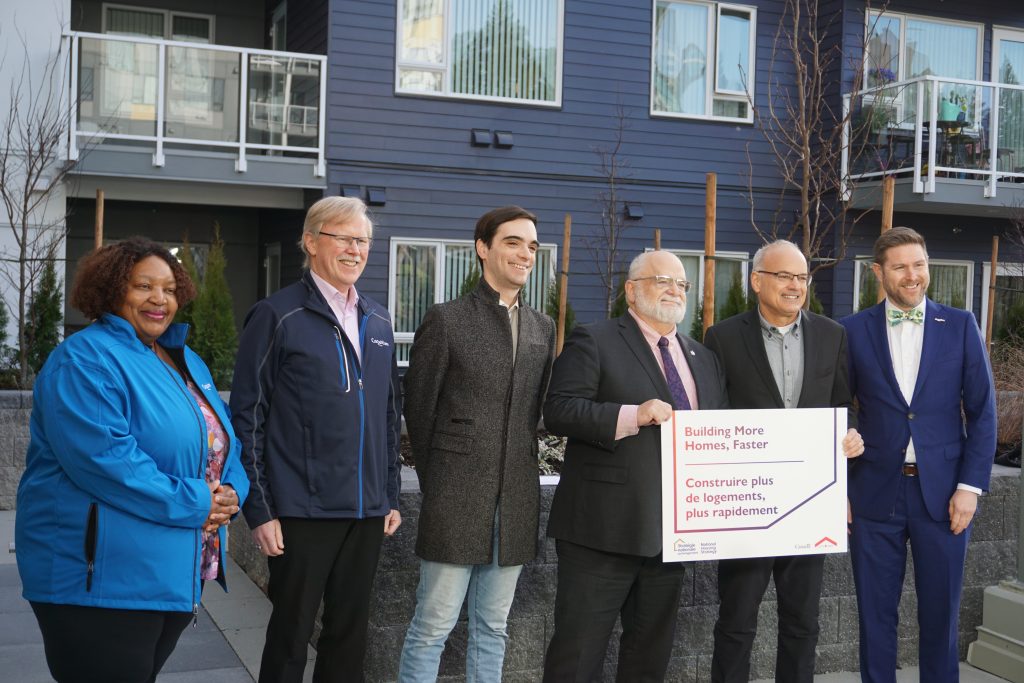
Coquitlam will be receiving $25 million from Ottawa to help cut “red tape” around its development processes and speed up the delivery of housing units.
Coquitlam-Port Coquitlam MP Ron McKinnon made the joint announcement at Robert Nicklin Place on Friday, Feb. 9, alongside Mayor Richard Stewart and city councillors.
McKinnon described the changes as “fundamental” to tearing down “barriers and stumbling blocks” to more housing construction.
Local news that matters to you
No one covers the Tri-Cities like we do. But we need your help to keep our community journalism sustainable.
“What we need is bold action and systemic change to how we build homes for this country,” he said. “Systemic change here in Coquitlam looks like modernizing and updating regulations and bylaws to reduce the time between ideation, and getting shovels in the ground.”
The subsidy is being delivered through the Canada Mortgage and Housing Corporation’s (CMHC) Housing Accelerator Fund (HAF), a $4 billion pool meant to assist local governments in streamlining development processes.
A press release from CMHC stated the funding will ensure an additional 650 housing units are built in Coquitlam over the next three years, along with 2,800 more over the next decade.
The Crown corporation estimates that local regulatory changes resulting from HAF will allow 100,000 more homes to be built across Canada by 2027, and 550,00 new homes by 2034.
Coquitlam submitted its application for HAF funding shortly after it was announced in April, 2023.
The city’s action plan lays out seven initiatives, required to be completed over the next two years as a condition of CMHC’s funding.
The city is aiming to streamline its development application procedures to improve processing times through digital upgrades, while undertaking reviews of its city’s zoning bylaws, minor variance permitting process, urban design guidelines and citywide parking requirements.
It also intends to expand its rental incentive program to induce developers to build more affordable and rental housing, and form partnerships with non-profit housing providers to foster projects on both city and private lands.
Lastly, the city wants to explore development opportunities in Southwest Coquitlam, specifically focusing on “missing-middle” such as townhomes and rowhouses, near transit.
Coquitlam City Manager Raul Allueva said the federal funds will be delivered to the city in installments over the next three years.
He said staff have not confirmed how they will allocate all of the funds yet, but noted the federal cash can be used in variety of ways. “(CMHC) understands local governments have a variety of pressures over different times,” he said.
Spending programs range from business improvements and staff resources, to buying sites for affordable housing, according to Allueva, adding some of the funding could potentially be put towards a local housing project.
Housing-related infrastructure and public amenities are also being considered as funding items, according to a staff report.
Mayor Stewart said reviews of the city’s development processes have been a “top priority” of council for years, and it has already improved in numerous areas, significantly shortening wait times.
A Metro Vancouver report released at the end of 2023 recognized Coquitlam as having the highest growth of housing starts in the region from 2021 to 2022.
Stewart said Coquitlam was already a regional leader among Metro Vancouver municipalities.
But the city will have to keep that momentum up, as CHMC has set growth targets on the city requiring it to issue permits for 6,443 housing units by the start of 2027.
It averaged 1,861 housing starts annually between 2018-2022, and the city aims to increase that figure to 2,195 units over 2026, according to a staff report.
The federal targets also require 79 percent of these housing starts to be multi-unit housing units near rapid transit, and 5 percent to be affordable units.
Stewart said the city has been trying to incentivize the creation of more rental housing since 2008 using tools like its density bonusing program.
He touted that 12,000 new units of purpose-built rentals, and 2,300 below-market and non-market rentals currently in-stream in the city.
“This housing crisis actually started in the 80s and 90s, when we stopped building rental housing as a region,” Stewart said. “The crisis we face today is much more daunting.
“As a lifelong Coquitlam resident, I want to ensure that my children and my grandchildren can stay in our community, and can own a home here and can prosper here.”
Metro Vancouver housing data shows that Coquitlam is in need of more non-market and purpose-built rental units.
Non-market rentals accounted for two percent of Coquitlam’s total housing units in 2023, while purpose-built rentals accounted for 6.4 percent of total units in 2022.
In addition, the city saw a net loss of its purpose-built rental stock by 6.8 percent between 2013 and 2022.
Coquitlam staff note there is a small risk that the city will not be able to meet CMHC’s growth targets due to the “regulatory uncertainties” resulting from recent provincial legislation regarding transit-oriented development areas.
“Coquitlam successfully pioneered a balanced-growth approach, emphasizing housing affordability, new amenities, and infrastructure enhancements,” the report says. “TOD areas are going to impact this successful model, as well as the city’s work plan and the HAF Action Plan.”
Author