Port Moody approves $2.8M Barnet overpass widening to ease congestion
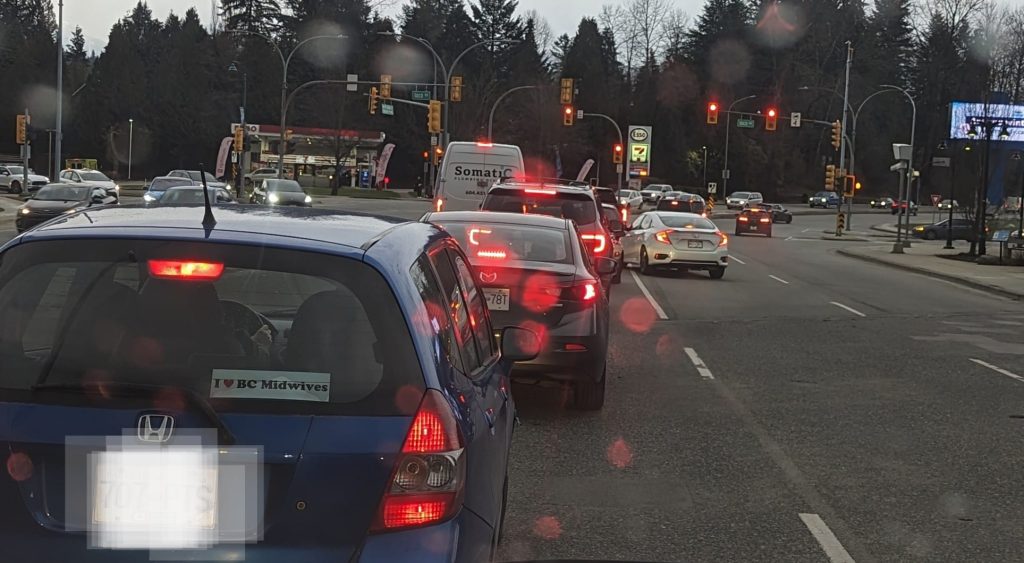
Port Moody has endorsed a plan to widen the eastbound Barnet Highway rail overpass and immediately open a new traffic lane in an effort to tackle one of the city’s most persistent congestion bottlenecks.
On June 16, council unanimously endorsed a plan, despite staff recommending a phased approach that would have prioritized active transportation first.
Mayor Meghan Lahti argued that while staff’s preferred option aligned with the city’s transportation planning principles, it failed to address the immediate reality facing commuters.
Local news that matters to you
No one covers the Tri-Cities like we do. But we need your help to keep our community journalism sustainable.
“This is something that has been identified by our taxpayers as a number one issue for them,” she said. “We’re in a situation now where we have the type of congestion that is untenable.
“I get that this flies in the face of staff’s recommendation, but I just could not look the taxpayers in the face and say that that was something that I agreed with.”
Staff have been directed to proceed with the project that would widen the bridge, add a fourth eastbound lane and expand the existing sidewalk from roughly 1.2 metres to about two metres. The project would be completed alongside a planned seismic retrofit and deck rehabilitation work on the structure.
The decision rejected staff’s preferred option, which would have widened the bridge but initially used the new space as a protected multi-use pathway until future growth in Moody Centre warranted converting it into a traffic lane.
Staff warned that immediately opening a new vehicle lane could attract additional regional traffic through “latent demand” and eventually reduce the congestion-relief benefits.
Lahti questioned whether a cycling connection on the south side of Barnet Highway would materialize any time soon, noting her understanding that Coquitlam’s plans for the area focus on future residential development on the north side of the highway and business and industrial uses on the south side.
“I cannot, in good conscience, agree to spending taxpayers’ money to increase the carrying capacity and widen this bridge, and not open it immediately for traffic,” Lahti said.
The overpass is a critical transportation link carrying eastbound traffic over the rail corridor.
Council has been exploring widening options while preparing for required seismic upgrades and rehabilitation work.
Staff identified an option that separated vehicle traffic from a future dedicated active transportation bridge, reducing construction complexity and costs compared with earlier concepts.
The debate focused on how quickly any new traffic lane should be opened.
Coun. Kyla Knowles said the discussion needed to remain “very focused” on the specific congestion issue the project is intended to solve.
She noted staff data showed approximately 1,500 vehicles travel through the corridor during peak periods while about 800 vehicles are trying to make the northbound left turn into Port Moody.
Knowles described the proposal as a relatively affordable project that could deliver noticeable results quickly while simultaneously addressing seismic concerns.
“This has the potential to make a real change in the lives of our commuters in a very short period of time, for a pretty reasonable price.”
Coun. Diana Dilworth also backed the motion, saying the issue has frustrated commuters for years.
“It really shows that we have been hearing our residents, and we have been actively working on issues related to the afternoon commute eastbound,” she said.
Dilworth said residents would likely be unhappy if council widened the bridge but left the new lane closed to vehicles.
“If we created a new lane and didn’t open it for traffic, I think we would have a mutiny of our residents on our hands.”
Several councillors emphasized the plan does not necessarily eliminate the possibility of constructing a separate multi-use pathway bridge in the future.
Coun. Callan Morrison said the two projects can be considered independently.
“Right now there’s nothing to connect it to but a normal sidewalk down the side of the street,” Morrison said of the proposed active transportation bridge.
He argued the project is primarily intended to address traffic backing up toward Moray Street and beyond.
“This is the first actual project in a very, very long time that is going to have a significant improvement on our actual driving infrastructure in the city that our residents have been begging for.”
Coun. Haven Lurbiecki said the project should prioritize local residents rather than regional commuters.
“Our priority is residents of Port Moody and making sure that we’re investing in projects that get them home to their families sooner,” she said.
Not all councillors were fully convinced.
Coun. Amy Lubik expressed concern about the well-documented phenomenon of latent demand, where additional road capacity eventually attracts more traffic, citing research suggesting congestion can return within several years after new road capacity is added.
“My worry is that with our particular choice, we will solve the problem for a little while and potentially . . . we may end up with the same amount of traffic and congestion that we have now.”
Lubik also argued that building safer cycling and walking infrastructure can encourage more people to shift transportation modes.
Coun. Samantha Agtarap likewise raised concerns about preserving future active transportation opportunities.
She pointed to Coquitlam plans that identify both Barnet Highway and Dewdney Trunk Road as near-term priorities and questioned whether future growth could arrive sooner than expected.
“If there’s a way that we can keep that option of the secondary bridge, the separate multi-use path, open . . . I think that would be wise,” she said.
Agtarap also sought assurances that cyclists and micromobility users would be safely accommodated once the south-side sidewalk is narrowed to about two metres.
Staff confirmed the replacement sidewalk would be too narrow to function as a shared multi-use pathway and active transportation users would likely need to be routed to facilities on the north side of the corridor.
According to the staff report, the approved plan carries an estimated project cost of $2.8 million, compared to $7.2 million for the staged approach recommended by staff.
The project will be considered through the city’s 2027 capital budget process.
Author