Mayor Meghan Lahti voices concern over loss of municipal control baked into new provincial housing bills

Port Moody Mayor Meghan Lahti is the second Tri-Cities mayor to voice trepidation over a slew of new provincial housing bills.
Following the presentation of the city’s 2023 highlights on Dec. 12, Lahti reflected on the growing pains that may come with the groundbreaking legislation.
“To be clear, the province has removed much of our authority as it pertains to how we densify,” she said. “In my view, these changes will have a profound impact on how we do business here . . . I think there’s going to be some bumps in the road.”
Local news that matters to you
No one covers the Tri-Cities like we do. But we need your help to keep our community journalism sustainable.
The B.C. NDP government has rammed through four bills this fall and released regulatory and policy manuals for municipalities to start implementation. Municipalities are required to adopt the changes into their Official Community Plans (OCP) by June, 2024.
A total of 293,000 new housing units could be built over the next decade as a result of the legislation, according to the province.
Three of the bills – Bill 44, 46, 47 – will take away many local government controls over the development process.
Lahti said the method in which the city plans neighbourhoods is going to be stripped away as minimum densities become “non-negotiable.”
“That is by design,” she said, adding council will only be able to negotiate amenities when developers request density beyond what the province has mandated.
Coquitlam Mayor Richard Stewart has also recently expressed concerns over the impact the changes will have on municipalities.
Bill 44 will upzone all single family properties to allow secondary suites, duplex, triplex laneway housing. Three to six housing units will be permitted on each property, depending on lot size and access to transit.
The bill will also phase out public rezoning hearings for housing projects that are aligned with the Official Community Plan (OCP).
Lahti warned the “blanket rezonings” could potentially be expensive for the city, noting many of its single-family neighbourhoods are not well serviced and will require upgrades.
She added she has “many outstanding questions and concerns” pertaining to the scrapping of municipal public hearings and rezoning powers.
Stewart said that local residents will be losing their voice in the development process.
Bill 46 will overhaul how municipalities take in fees via developer cost charges (DCC) and community amenities contributions (CAC).
CACs, often negotiated during the rezoning stage in exchange for added density, are being replaced by a new tool called amenity cost charges, which will be an upfront cost.
While DCCs, used to pay for infrastructure upgrades, are expanding to include services like waste and recycling, and police and fire departments.
Critics have argued the province is downloading costs on to municipalities while restricting how they collect fees from development – all while mandating housing targets.
Stewart said the loss of density bonusing funds will mean that development will no longer pay for needed infrastructure and amenities to accomodate new residents.
Lahti voiced similar concerns, stating the city has always taken the approach that development should pay for growth.
“The way that the new structure has been put in, it’s going to put more of an onus on us,” Lahti said. “It’s going to be a difficult transition.”
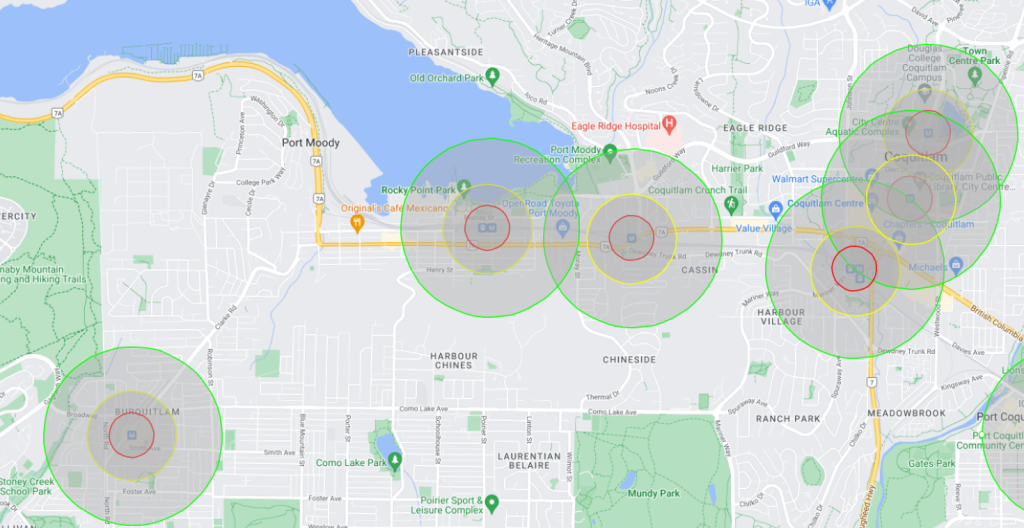
Bill 47 requires municipalities to create transit oriented development (TOD) areas around SkyTrain stations to centralized density around transit hubs.
A minimum of 20-storey buildings must be permitted within 200 metres of stations.
While the city has prioritized development around its TOD areas, Lahti said council needs to ensure developments meet the city’s criteria.
Lahti said one issue of concern is how much consideration the province has put into the legislation’s impact on local school and hospital capacity.
“I’m not sure that I have a great deal of confidence going forward that those have been really carefully thought though,” she said. “We just have to continue to lobby to make sure that our community doesn’t get left behind.”
Lahti said the council and staff will need to consult with the city’s legal team to understand their statutory obligations.
Author