Port Moody scales back affordable housing expectations amid market slump
Port Moody is scaling back expectations for what developers can realistically provide in affordable housing and community amenities as the city grapples with a weakening condo market.
Councillors argued the new provincial housing legislation has significantly limited municipal leverage over growth.
“The one thing that is becoming clear to me is that some of the maybe well-intended housing legislation has actually handcuffed municipalities,” said Coun. Samantha Agtarap.
Local news that matters to you
No one covers the Tri-Cities like we do. But we need your help to keep our community journalism sustainable.
Council unanimously approved a new two-phase approach to update the city’s density bonus bylaw and maintain its current inclusionary zoning policy on May 12, directing staff to prepare official community plan and zoning bylaw amendments for future readings.
The changes are required to comply with the province’s 2024 Housing Statutes Amendment Act, known as Bill 16, which forces municipalities to update density bonusing systems by June 30, 2026 and limits what cities can collect from developers in exchange for additional density.
But a financial feasibility analysis presented to council showed Port Moody’s current housing market has deteriorated so sharply that many projects are now struggling to remain financially viable even without an affordable housing requirements attached.
Staff told council lenders typically require developers to achieve profit margins of roughly 15 percent before financing apartment projects.
“What this is showing . . . is that we’re not getting there in these scenarios,” staff said. “That’s a function of today’s difficult condominium market.”
The report found six-storey wood-frame strata buildings were essentially the only development form that could still support a modest affordable housing component under current market conditions, while highrise concrete projects performed significantly worse because of construction costs.
Coun. Kyla Knowles called the findings “terrible news.”
“My goodness, how quickly things change,” Knowles said. “Two years ago, market rentals were the safest thing to build, and it’s really quite extraordinary where we are today.”
Knowles added public discussions about density bonusing often overlook the complex financial analysis required to determine whether projects are feasible.
“Nothing about what is done in the planning and development stage in this city, or any other for that matter, is just guesswork,” she said.
She also argued the province’s transit-oriented area density legislation had: “badly kneecapped the city in terms of what we can now achieve in terms of bonus densities.”
Under the proposed framework, Port Moody would establish new density bonus tiers tied to provincially mandated transit-oriented area minimums. The city would allow additional density above those thresholds in exchange for affordable housing contributions.
The proposed structure would allow developments closest to SkyTrain stations (tier 1) to increase from a base density of 5.0 floor area ratio (FAR) to a maximum of 6.0, while tier 2 projects projects could rise from 4.0 FAR to 5.5 FAR.
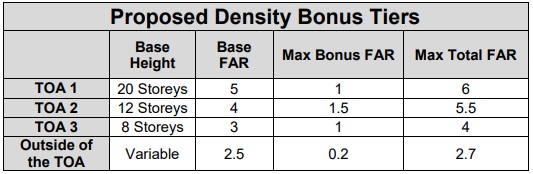
Staff said the province’s legislation significantly reduces municipalities’ ability to collect amenities through density bonusing because cities can now only seek contributions above provincially mandated minimum densities and cannot duplicate items already covered under new Amenity Cost Charges.
Coun. Amy Lubik said council initially believed the new legislative framework might create more opportunities to secure affordable housing, but market conditions shifted dramatically.
“When we started this, we actually thought we might be able to get more affordability,” Lubik said. “Things have changed quite a bit.”
Still, Lubik supported maintaining the city’s current inclusionary zoning policy targets – which seek either 15 percent below-market rental units or six percent non-market rental units in qualifying projects – even though most developments currently cannot meet them financially.
“I think it’s important that it’s aspirational, and we are signaling that this is something that’s really important to us,” she said.
The report notes only one project since the policy was adopted in 2022 – Beedie Living’s major Moody Centre redevelopment – has fully met the city’s inclusionary zoning requirements.
A major part of that project’s affordability component, a six-storey building for women’s transition housing, recently had its funding pulled by the provincial government.
Coun. Haven Lurbiecki argued the city needs a more integrated long-term approach that combines development cost charges, amenity cost charges, affordable housing policy and density bonusing into a single system.
“The best offered is usually the first to be taken away, and that tells me our system is not working,” Lurbiecki said. “Community amenities should be predictable, not negotiable.”
She pointed to recent setbacks involving childcare spaces, rent-to-own housing and the funding issues in Beedie’s project.
Coun. Callan Morrison also referenced the collapse of funding for the city’s planned women’s transition housing project, saying even projects backed by partnerships can unravel unexpectedly.
“We thought we had reliable funding through that partnership,” he said. “Trying to deliver on these things within the spectrum of the rules that have been placed, in the laws that have been placed, is a challenge and we’re trying to navigate that.”
Mayor Meghan Lahti said municipalities across the region are facing the same pressures.
“We are meeting a moment in time,” Lahti said. “It really lays out the dire situation that we’re in, that the industry is in, and from all accounts what every municipality is facing.”
The city plans to consult with the Urban Development Institute later this month before bringing draft bylaw amendments forward for first and second reading on June 9. A public hearing is scheduled for July 7.
Author