Public engagement on Port Moody’s new OCP to begin this spring, after year-long delay
After being delayed for a year, Port Moody is gearing up for public engagement on its new official community plan (OCP) this spring.
But with several massive tower projects in Moody Centre nearing final approval, one councillor claimed the public’s trust that council will listen to feedback is low.
“How can we have people actually take this seriously if major decisions have already been made?” Coun. Haven Lurbiecki said. “No amount of kind of graying this out up here is going to change these facts.”
Local news that matters to you
No one covers the Tri-Cities like we do. But we need your help to keep our community journalism sustainable.
The City of Port Moody unveiled a draft of its 2050 OCP on Dec. 5, 2023, and council approved an engagement strategy a month later. Adoption of the OCP was initially slated for fall 20204, but the new provincial housing legislation sidelined the process for a year.
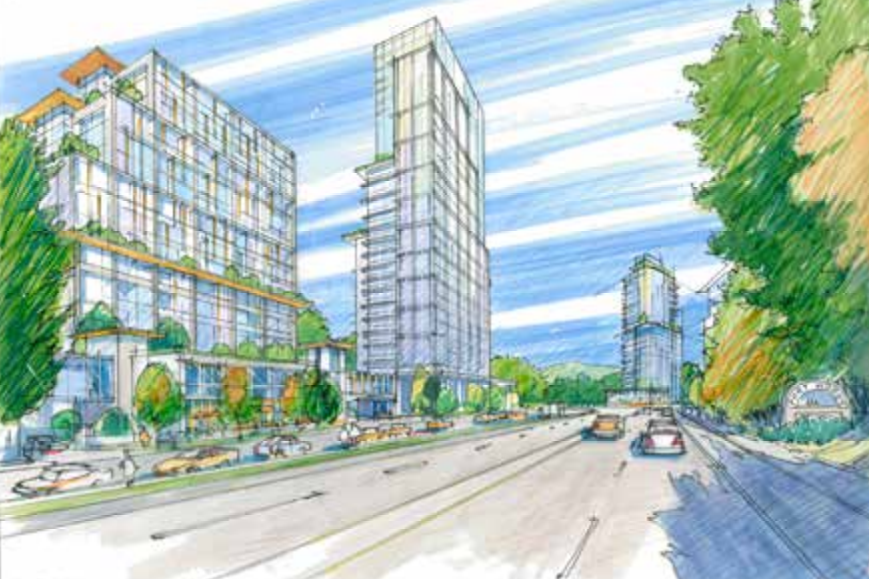
As city staff worked to implement changes associated with the provincial mandates, development streams in Moody Centre’s transit oriented area (TOA) continued under a higher-density framework released alongside the draft OCP.
The framework allows for construction of up to 40-storey towers – 14 storeys higher than what is permitted in the current OCP – provided specific amenities are delivered to the city.
Lurbiecki called the lack of public consultation ahead of the framework’s approval the “elephant in the room.”
She pointed to a 2020 community survey question related to Moody Centre’s development plans, in which 57 percent disagreed with allowing even 26-storey buildings in Moody Centre, and 59 percent said the active proposal at that time was their least preferred option.
“We have left the public behind in these plans,” Lurbiecki said.
Mayor Meghan Lahti, however, countered that the public hearing is the tool council will use to weigh input on these projects, adding the OCP and TOA planning are not mutually exclusive.
She said while former councils tried to put “roadblocks” up, the current council decided to proceed with Moody Centre development under the guidance framework.
“We can’t stop applications from coming in, we cannot just say you’re just going to have to wait,” Lahti said. “That’s not how we operate, that’s not good faith, and landowners have the right to bring forward applications.”
Coun. Kyla Knowles said that while the TOA framework allows for 14 towers in Moody Centre, that is the maximum amount, and there is no guarantee they will ever get built.
She said it is “alarmist” to act as if the build out will occur in the next decade, considering the financial strain on the development industry.
“A lot of the developments that we’ve even approved, they’re not seeking building permits. They will never be built. We know this,” Knowles said. “This is going to be a long build out, done thoughtfully with the input and engagement of our community.”
Coun. Amy Lubik said she was happy the Moody Centre framework was in place, although she agreed with the frustration over the OCP’s engagement delay.
“I know that these are going to be challenging conversations and potentially somewhat polarizing,” Lubik said.
Lubik introduced a motion, which passed unanimously, directing staff to look into strategies to help guide constructive conversations between community members.
She said that a lot of education and consultation with the community will be needed, especially considering the new provincial mandates.
Staff have revised the city’s engagement approach, incorporating new information related to the impacts of the provincial legislation on the draft OCP.
Public engagement is slated to run from March to May, and will cost an $50,000 on top of the $21,000 earmarked in the original OCP budget.
Engagement is set to include a townhall meeting with all council members attending; informational videos; walking tours in impacted neighbourhoods; three information and feedback sessions; a youth engagement session; an online survey; and public outreach at future community events. Results will be published online and reported to council at its conclusion.
A revised version of the 2050 OCP draft is targeted for completion in June or July.
OCPs are long-term planning documents, which detail policies and land use guidance a municipality uses to achieve its economic, social, cultural and environmental objectives. Port Moody’s current OCP was adopted in 2014, and the update began in 2020.
Author