‘Growth is here’: First towers for Moody Centre approved by council
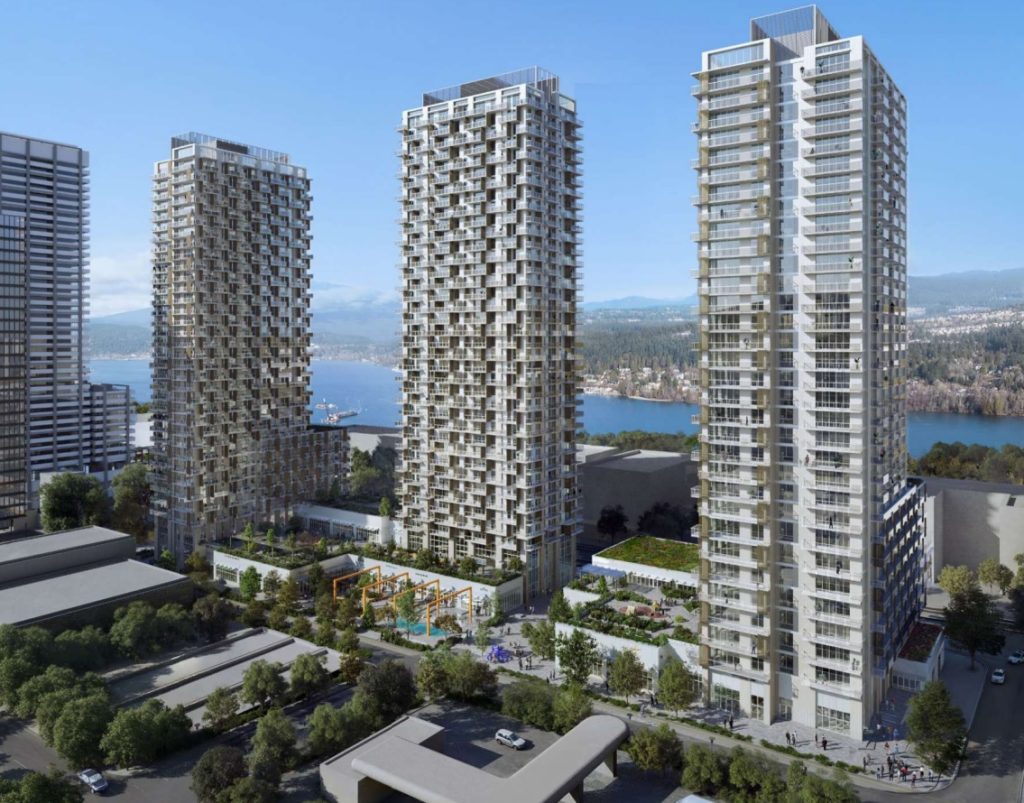
Port Moody council has officially approved the first towers for Moody Centre, beginning a new era of densification of the city’s old downtown core.
Following a nearly four-hour public hearing on Feb. 4, city council voted 6-1 in favour of Beedie Living’s proposal to build more than 1,000 units on two sites on the north side of St. Johns Street.
Mayor Meghan Lahti said community division over such projects is inevitable, recalling significant opposition to towers in Newport Village, Suter Brook Village, and Klahanie.
Local news that matters to you
No one covers the Tri-Cities like we do. But we need your help to keep our community journalism sustainable.
“I challenge anyone sitting in this room . . . to consider what would have happened had the council of the day given up on their vision,” Lahti said. “I think as we move forward, the community will embrace this new development – and there will be more to come.”
Beedie Living’s project – three towers ranging from 32 to 38 storeys on Spring Street and Electric Avenue, along with a six-storey women’s transition facility on Spring Street – is the first to be greenlit for the Moody Centre transit oriented area (TOA). A second project, PCI Development’s twin 39-storey towers, is headed to public hearing next month.
But Moody Centre’s future has been dogged by disagreement over what the community wants, and whether council has listened to public input.
At its heart, public dissent revolves around the size of the skyscrapers. A new TOA framework was passed by council in late 2023, upping allowable tower height to 40 storeys.
Coun. Haven Lurbiecki, who cast the sole vote against approval, claimed that framework subverted the ongoing OCP process and past public engagements, noting it was passed without any feedback from residents.
She reiterated her call for a referendum on the city’s plans for Moody Centre.
“Every single piece of broader community engagement we have ever undertaken so far has shown an absolute lack of support for anything like this,” Lurbiecki said. “We need to get a clear mandate from the community before we move ahead.”
Following Tuesday’s vote, Beedie’s project attained significant amendments to the OCP, allowing for the added height, increased floor-plate size, decreased distances between towers, and an eastward TOA extension.
Nathaniel Stuart, senior development manager at Beedie, said the development embodies a visionary approach to family centered living, and will integrate public and private amenities to connect the neighbourhood.
“Port Moody needs new homes and businesses to support them. This project will make a positive and meaningful contribution to both,” Stuart said. “We know large land-use changes can often be challenging, and so I would like to recognize the courage that this takes.”
The project will generate more than $97 million in benefits to Port Moody, and will expand the city’s tax base by $2.1 million by the time build out is completed in approximately 10 years, according to Stuart
A total of $27.8 million will flow into city coffers by way of development levies, density bonus payments, and community amenity contributions.
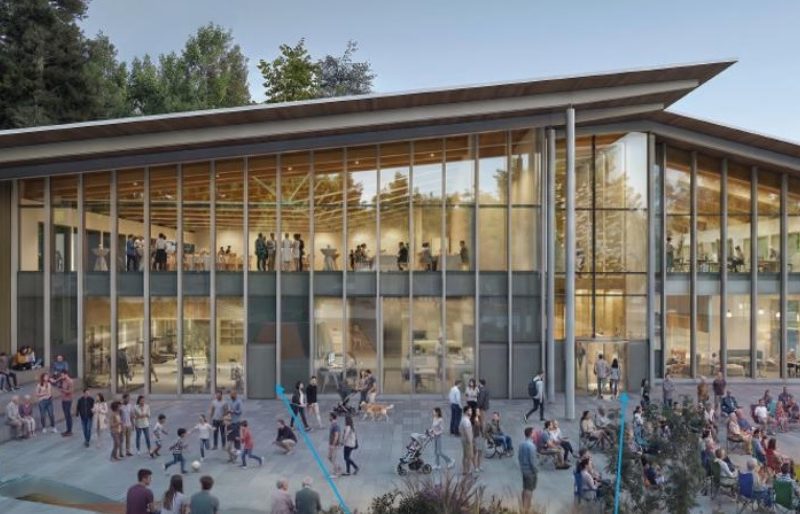
The development will include up to 72,000 square feet of commercial and office space, providing job space for between 520 to 555 people; a 20,000 sq. ft. outdoor public plaza; 21,000 sq. ft. of indoor amenity space; and a childcare facility able to serve up to 110 kids.
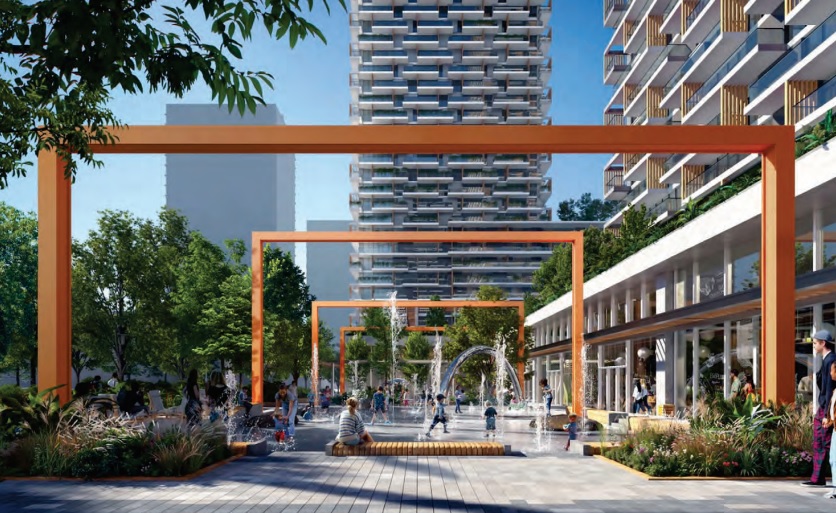
Beedie’s towers will contain 981 units, with 20 offered at cost to the Kwikwetlem First Nation; while the secondary site (to be gifted to BC Housing upon completion) will contain 40 to 50 deeply subsidized units for women and children fleeing violence. The average unit size is more than 740 sq. ft., with over 51 percent containing two or three bedrooms, and zero being studio units.
The public hearing brought out 47 speakers, with 31 people in favour and 16 opposed; six written submissions were in favour, seven were opposed, and three voiced concerns; out of 86 comments received through Beedie’s public engagement process, a total of 79 percent were opposed.
Detractors have also pointed to past official community plan (OCP) surveys on Moody Centre’s development, where a majority of respondents were opposed to even a 26-storey-height limit for towers in the TOA.
Residents supportive of Beedie’s proposal praised efforts to revitalize Port Moody’s decaying light-industrial lands, expansion of business activity, and increase of both market and non-market housing supply.
Like the mayor, many speakers drew comparisons to other major developments in Port Moody’s history, which they said have evolved the city into a desirable place to live.
Resident Jake Healey said that while the community does not need to approve of every application, it needs to have an open mind when a project “checks nearly every item on our list.”
“When places like Suter Brook, Newport Village, and Klahanie were proposed, I know there was pushback,” Healey said. “Now, sitting here today. . . . They are some of the most beloved and sought after neighborhoods, not just in our city, but in the entire Lower Mainland.”
Freedom of the City Award recipient, Robert Simons said the underutilized land has been pondered over for 20 years, adding if development had taken place sooner, such stark densification would not have been needed to make the project financially viable.
“When I came here, it was a much smaller community. It’s much bigger now, and I still enjoy living here,” Simons said. “It’s a wonderful place to live.”
Almost every speaker opposed to the Beedie project qualified they were not wholly against development, but were concerned about the tower height and shadowing, loss of industrial lands, and impacts to infrastructure.
Many felt that council was ignoring public opinion, with the term “gaslighting” being repeated throughout the meeting.
Port Moody resident Lorrie Ablitt said that everyone knows that development needs to occur in the TOA, but the amount of density will set a precedent for all future projects.
“You’re cramming such high towers down our throat, and they’re not even required by the government,” Ablitt said, in reference to the province’s 20-storey-minimum policy around transit hubs. “You’re supposed to be our voice. You’re supposed to stand up to the profit orientation of developers.”
Another resident, Mark Kunzli, said he thought the discussion on the project had created a “false narrative.”
“This false choice being presented is that you either support this project or you’re against housing, against progress and against helping vulnerable people. That’s not the case,” Kunzli said. “Does it actually align with the community’s needs?”
Although they acknowledged the divisiveness of the issue, city councillors objected to the notion that public concern was being ignored.
Lahti said while public input is an important factor, council needs to consider the totality of information, including its objectives, vision, and potential alternatives.
She added that while change can be difficult, the housing they are building is for future generations. “This isn’t about us. This is about future residents,” she said.
For decades, Port Moody councils have been “hand wringing” about how to generate investment in the Moody Centre area, and that outlook did not change until the SkyTrain arrived in 2016, according to Lahti.
“The truth is, we never envisioned that Moody Center would have this opportunity,” she said. “We never thought it was possible.”
Coun. Diana Dilworth agreed, stating she wished development had taken place sooner, stating that smaller towers are not feasible today due to costs associated with land, labour, supply, and financing.
“We will have trade-offs,” she said. “We would all love to see 12-storey or 26-storey buildings on this site, but no one . . . can build that with the levels of amenities and non-market housing that is included in this application.”
Coun. Amy Lubik added that without building taller, the city would not be able to protect view corridors and would end up with the dreaded “wall of towers” effect.
Additional density was also needed because of the “extremely harsh” provincial housing legislation, which has reduced density bonus payments below mandated heights, according to Coun. Callan Morrison.
He added the council has fought hard to negotiate more family sized units and larger unit sizes, which could only be done through good faith and open negotiations with the developer.
“We are not going to solve the housing crisis with this one project, nor are we going to solve it with this TOA, but it is a step in the right direction,” Morrison said. “This is a win for our community.”
Coun. Samantha Agtarap said many of the infrastructure concerns voiced at the hearing are outside of the city’s control.
Adding traffic lanes would just cause more drivers to take Port Moody routes, and school and hospital capacity issues are the province’s jurisdiction, she said.
“Where some see challenges or obstacles. I see solutions and opportunities,” she said. “None of what I’ve read or heard tonight is insurmountable.”
Coun. Kyla Knowles described the industrial lands being developed as “dilapidated and empty, concrete buildings with no life.”
She noted the barren space is being replaced with 48,000 sq. ft. of green space, and at least 72 new trees with 21 percent canopy coverage.
“It’s important we begin to prioritize putting this community’s long-term future needs ahead of short-term concerns about growth, which this city cannot control,” Knowles said. “Growth is here. I want to house it the smartest way possible.”
Author