Life in Port Moody is good but for many it’s getting worse, survey says
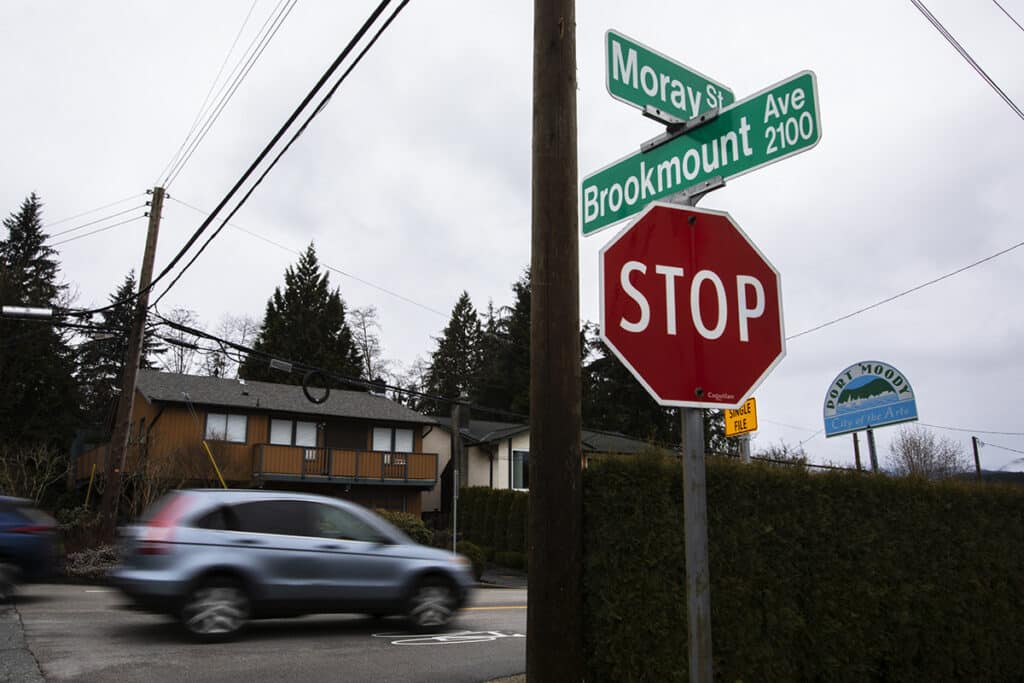
Port Moody residents overwhelmingly approve of the quality of life in the city, according to a recent survey, but nearly half say it has worsened over the last three years.
The results of the city’s 2024 Community Satisfaction Survey was presented to council on Tuesday, showing transportation and growth issues are top of mind for many local citizens.
Councillors’ interpretations of the survey data, however, stood in stark contrast. Some pointed to external factors outside of the city’s control, while one councillor stated the city should be slowing its rate of development.
Local news that matters to you
No one covers the Tri-Cities like we do. But we need your help to keep our community journalism sustainable.
“There’s different ways that we can evaluate the information we receive,” said Coun. Callan Morrison. “Maybe (the quality of life) wasn’t as good as it was before and it’s come down. There are a lot of different reasons why that could be.”
The survey has been conducted every two years since 2012 to gauge public perceptions of city performance and services, and help guide council’s planning, budgeting and decision making.
Conducted between July 19 and Aug. 16, 2024, a total of 1,118 residents responded to the survey out of 8,000 invites randomly sent out across the city.
Overall, 94 percent of respondents rated the quality of life in Port Moody as very good or good, but 42 percent of respondents reported their quality of life had declined, 36 percent reported it had stayed the same, while only 12 percent said it had improved.
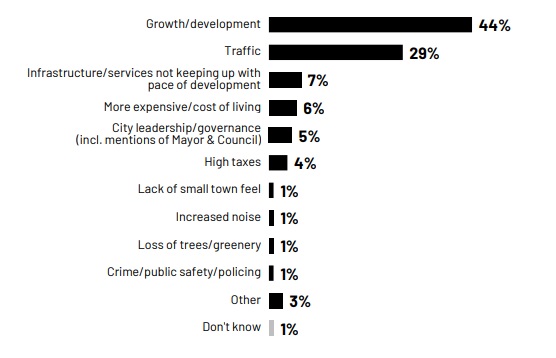
Among those respondents who said it had worsened, 44 percent primarily attributed this to growth/development, 29 percent listed traffic, 7 percent said infrastructure and services were not keeping up with the pace of development, and 6 percent listed more expenses/cost of living.
Coun. Haven Lurbiecki was the most outspoken about the survey results.
She warned that indicators related to quality of life, concerns around transportation and growth, and satisfaction with council are all trending downward compared to the 2022 survey.
“You know what this survey shows? Most people feel that most things are getting worse since this council took office,” Lurbiecki said. “We need to start listening and taking action, real action, to address their concerns, and it starts with making better decisions around growth and development.”
On the other hand, of respondents who said that their quality of life had improved, 15 percent listed growth/development as the top reason, followed by 14 percent listing access to more retailers, 13 percent listing parks/trails/greenspace, and 10 percent listing city leadership.
Coun. Kyla Knowles said there are many things affecting residents’ quality of life, including inflation, interest rates, and the cost of living.
“It is very, very difficult right now for many of us to be able to afford anything,” Knowles said. “It’s a bit honestly offensive to me to blame everything, any sort of drop in quality of life, on development. I think that’s completely unfair.”
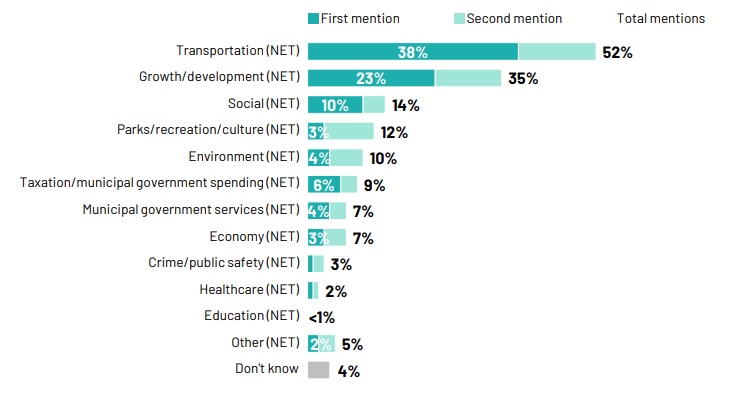
By far, the top issues for the community related to transportation, with 52 percent mentioning it on an unprompted basis, and 39 percent listing traffic congestion as the number one issue.
Coun. Amy Lubik acknowledged that while the city can do more regarding traffic calming, most of the congestion within the city is from through-traffic from other communities.
She cautioned against the urge to expand Port Moody’s road infrastructure, stating it will just cause more drivers to travel through.
“We’re right in the middle of everything with two roads, so even if we stop all development today, it will not stop traffic from getting worse,” Lubik said.
Growth/development was the second most mentioned issue, with 35 percent of respondents bringing up the subject.
A total of 15 percent of respondents had concerns with the pace of development; 9 percent mentioned density concerns/too many towers; and 5 percent mentioned the impact of growth on city infrastructure, services and livability.
Coun. Callan Morrison said that while he appreciated these concerns, he said council inherited all its applications for towers from the previous council, and none of them have broken ground.
He added that many of these concerns are beyond council’s control, citing the provincial housing policy and inflationary effects, and adding that neighbouring municipalities are likely facing these same issues.
“Are these answers really going to be that different from anywhere else in the region?” Morrison said. “I don’t think they are, I think it’s going to be very similar.”
Social issues were listed as the third most important theme with 14 percent of mentions (11 percent of respondents mentioned a lack of affordable housing); 12 percent mentioned parks/recreation/culture; and 10 percent mentioned the environment.
Notably, there was a demographic distinction amongst respondents on a number of these top themes.
While transportation was the number one issue for both homeowners and renters, mentions were higher for homeowners (54 percent) versus renters (40 percent).
Mentions of the growth/development issue was higher among those living in single-family properties (40 percent) than other types of housing (33 percent), as well as homeowners (37 percent) compared with renters (22 percent).
The longer a resident had lived in Port Moody was also likely to impact how they viewed growth/development: 42 percent of those who had lived in the city for 21 years or more mentioned it as an issue, compared to just 29 percent of those who had lived there for less than 10 years.
Knowles acknowledged the added frustration from residents who had lived in the community longer, adding that while growth comes with challenges, it also brings amenities and new retail opportunities.
“Change is hard, I understand that,” Knowles said. “There are good and bad sides to everything . . . I recognize it’s a balance.”
A majority of respondents (56 percent) said they were satisfied with how the city was being run, compared to 26 percent who reported being not satisfied.
Respondents were more satisfied with city staff than council, however; with 44 percent approving of council, 31 percent reported being unsatisfied, and 25 percent stating they did not know.
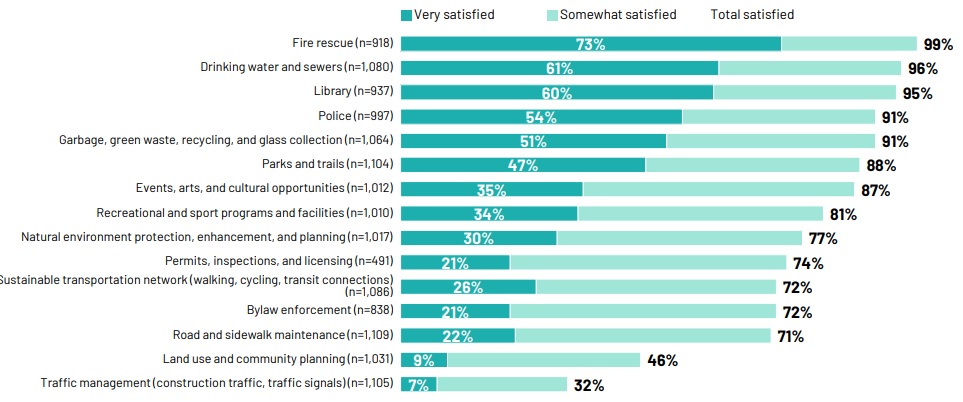
The city’ services were generally highly rated, with 85 percent of respondents reporting being satisfied. However, the lowest rated services were traffic management (39 percent approval rating) and land use and community planning (55 percent).
Overall, 66 percent of respondents said they received good value for services from their taxes and utility fees, while 29 percent reported poor value.
The three most mentioned suggestions to better services included swimming pools (13 percent), parks/greenspace/trails (13 percent), and recreation (11 percent).
Author