Port Moody endorses next phase of climate plan, estimated at $1.1 million over 2 years
The City of Port Moody has endorsed the second phase of its climate action plan (CAP), with actions estimated to cost $1.1 million over the next two years.
Council unanimously approved staff’s recommendations without comment on Feb. 14.
“For Port Moody to achieve the Climate Action Plan vision, action needs to start now,” the staff report stated. “Bold action will need to begin as soon as possible to avoid significant effort and cost in future years.
Local news that matters to you
No one covers the Tri-Cities like we do. But we need your help to keep our community journalism sustainable.
“The sooner actions are underway, the better prepared our community will be for responding to climate change.”
The 10-year plan aims to make all new and replacement heating and hot water systems emission free, reduce building and construction carbon content by 40 percent, reduce emissions from civic buildings by 80 percent, and minimize landfill waste.
One of its goals is to have 40 percent of local residents using an active form of transportation for trips. The plan also envisions EVs accounting for 40 percent of passenger vehicles and 25 percent of all commercial vehicles.
The CAP was adopted by council in 2020, to provide an “integrated community-wide plan” that would put the community on the path to becoming carbon neutral.
The first phase began in 2021 and closed at the end of 2022. It consisted of 23 actions – 59 percent have been completed – with five accomplished and 18 still being implemented.
Council passed several resolutions in 2021, earmarking $150,000 for a review of the transportation master plan, $80,000 for transportation management strategies, $98,000 for policy planning, and establishing various reserves and grants related to climate action.
Phase two is more ambitious, with 45 new actions planned over the next two years, most of which will require immediate funding.
Many of these actions build upon the planning developed in phase one, such as the 2022 Climate Ready Homes and Buildings Plan, and the 2022 Extreme Weather Resilience Plan.
In order to make progress, investments will need to be made into managing projects related to pedestrian priority zones, updating design guidelines, and a green infrastructure strategy, according to city staff.
Over the next two years, the city is set to focus on “a mix of quick wins, best bets, and major projects that will provide the greatest potential to achieve climate action targets and goals,” according to the staff report.
Some of these actions include:
- Accelerated adoption of the BC Energy Step Code
- A retrofit programs for buildings
- A revised demolition permit to increase recycling of construction materials
- Streamlining of permits for low carbon buildings
- Mandatory building energy benchmarking and disclosures
- A zero emissions and waste policy, for municipal buildings and events
- Public awareness campaigns
- Establish extreme weather safety protocols
- A water metering plan
- Developing a new strategy around parkland acquisition
Staff predict a “major impact” on greenhouse gas reduction, the city’s climate resilience, and job creation as well as better air quality.
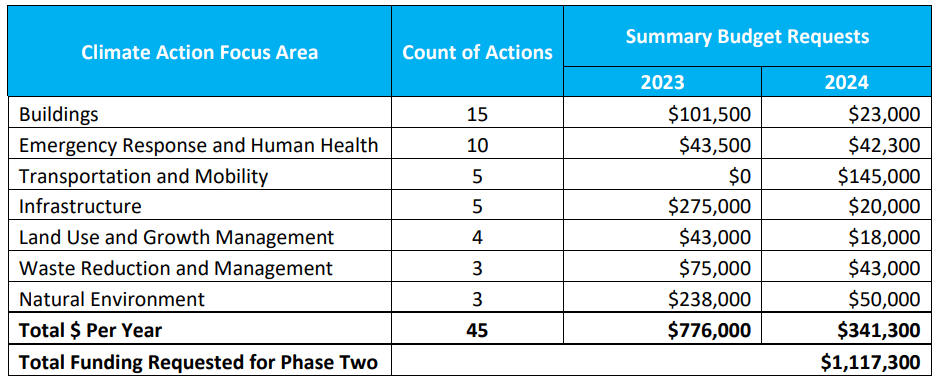
A total of $1,117,300 will be incurred to the municipality in 2023 and 2024. Grants being pursued could offset these costs by $803,995.
While the city currently receives provincial grants for environmental initiatives, staff are uncertain of continuous funding to local government or what it will amount to.
Further funding challenges are foreseen in acquiring grants, which staff characterize as highly competitive and time consuming.
Key performance indicators monitoring the execution of these actions will be tracked using software, and compared against targets and climate data. Annual updates will be given to council.
Author