New Express jerseys close out unique story arc, designer says
Coquitlam’s 6-1 victory had extra meaning for Lucas Gates, designer of the club’s two themed jerseys

Lucas Gates knew how the story ended before his first hit was ever unveiled to the public.
Last year, Gates, a self-taught artist from Vancouver, designed autism-themed uniforms for the Coquitlam Express. The inaugural jersey featured an old-school locomotive, neurodiversity symbols, and colours that reflected the team’s Coquitlam and Burnaby roots.
Prior to its release last February, he workshopped ideas that could follow up the collection — regardless of whether the club asked him to design another set of uniforms in the future. Having detailed a portion of the club’s past, Gates envisioned a new set of threads that would look towards its future.
Local news that matters to you
No one covers the Tri-Cities like we do. But we need your help to keep our community journalism sustainable.
“I was thinking, do I want to make it Doc Brown’s time machine from Back to the Future?” Gates said. “Coquitlam is the closest team to Michael J. Fox’s place of birth, Burnaby, so I guess you could say, ‘Where we’re going, we don’t need tracks.’”
In December, the Express formally asked him for another design ahead of their fourth annual Autism Acceptance Game. Last Sunday, the Express skated to a 6-1 victory in the threads, which featured infinity symbols — a marker used to represent autism acceptance — and a futuristic high-speed train logo as the crest.
“Lucas, two years in a row, has certainly wowed myself, my staff, my players,” said Tali Campbell, general manager of the Coquitlam Express, after the game.
Gates never knew the next design would also help him overcome a childhood fear.
There are approximately 600,000 neurodivergent adults across Canada, a broad term that encompasses people who have dyslexia, ADHD, or are on the autism spectrum.
In B.C., specifically, there are about 70,000 people with autism in B.C., and roughly one third are under the age of 19. In recent years, municipalities, police forces, and sports teams like the Express have taken steps toward creating sensory-friendly spaces and resources for people who are neurodivergent.
Ahead of the 2023-24 season, there were sensory-friendly resources at six arenas in B.C., including the Poirier Sport and Leisure Complex.
That growth can be credited to the increase of Autism Acceptance-themed nights in junior and professional leagues, Campbell said. The game is one of the club’s most popular theme nights, where people who may not normally attend a game can do so with reduced music volume and no goal horn.
The Vancouver Canucks, Victoria Grizzles, and Chilliwack Chiefs, among many other local teams have hosted similar events in recent years. Campbell added that artists like Gates are pushing the envelope further with jerseys that serve as physical representations of the event.
“Being able to add touches like the jerseys adds to the overall experience,” he said.
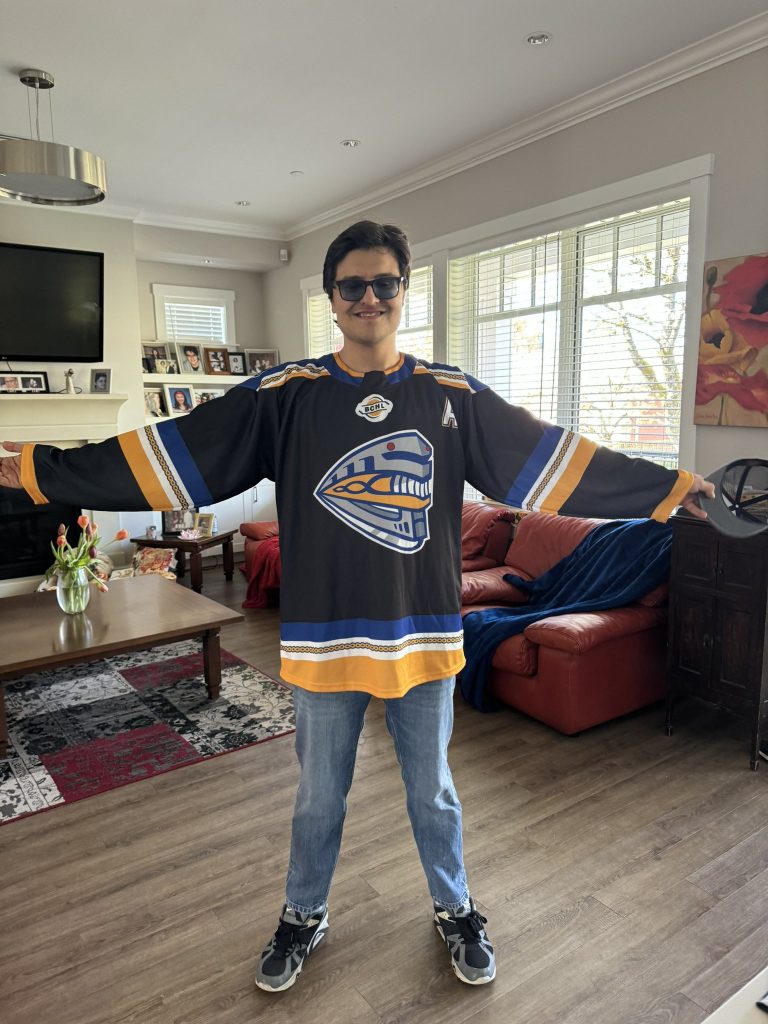
Gates hopes the recent victory got people talking about the invisible disability he has battled his whole life. He does not have a design in mind for next year, but Campbell expressed interest in making his designs part of their annual tradition.
Designing jerseys is a labour of love for Gates, who works full-time in autism advocacy. As a kid, he grew up sketching mock jerseys of his favourite team, the Vancouver Canucks.
He believes that uniforms — even if only worn for warmups or a single game — can inspire and represent a larger theme. Gates credits his inspiration for the Express storyline to Trevor Lai, an artist who designed Lunar New Year kits for the Canucks. His multiple jerseys placed a spotlight on the animal of the new year.
“He totally said it was all story-based, he did three in a row, like a story arc. Last year was the dragon, this year is year of the snake,” Gates said.

Ahead of last year’s contest, Gates watched from the press box. When the final buzzer rang, he observed players stay on the ice — in uniforms he designed — and skate with others on the spectrum as part of a family-friendly post-game event.
Gates, 31 at the time, had not touched the ice in more than 20 years. Skating in a large group of people with music blaring was too daunting and difficult, he said.
“I pretty much just gave up,” he said. “A kid on the spectrum, you have so much to work with. It’s a lot.”
Following this year’s game though, Gates walked down to the ice in the final seconds. When the visiting team cleared and families were invited onto the ice, he found a nearby pair of skates.
For the first time in over two decades, he wanted to skate. Sporting one of his own uniforms, he put the skates on one at a time, wrapping the laces around each ankle and stepping onto the ice.
“I said, ‘frick it,’ I’m just going to give it a shot,” Gates said.
Author