Port Moody puts neighbourhood energy utility plans on hold
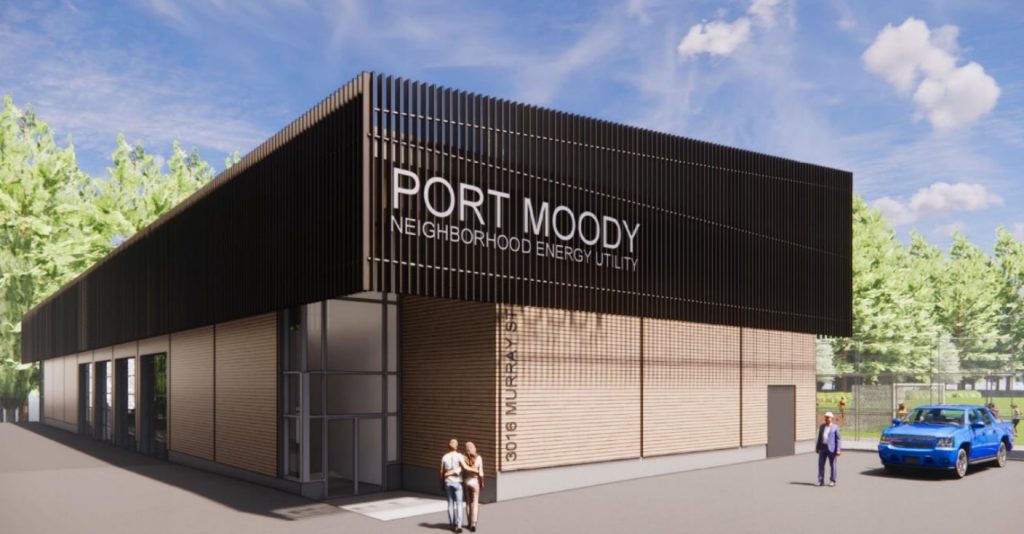
Port Moody is putting the brakes on plans for a neighbourhood energy utility (NEU) in Moody Centre after a new business case found the financial benefits are currently too small to justify moving ahead.
Council voted unanimously on Sept. 29 to cease further work on the proposed utility in the short term, while keeping the door open to reviving the project if development, costs or technology change.
Coun. Samantha Agtarap said she agreed with shelving the project for now, noting it can easily be revived if market circumstances become more favourable.
Local news that matters to you
No one covers the Tri-Cities like we do. But we need your help to keep our community journalism sustainable.
“I’m really supportive of keeping this sort of like on the stove, so to speak,” Agatap said. “It’s there, it’s simmering away, and if conditions change and opportunities arise, we’re ready to go.”
The city will continue requiring developments within the Moody Centre transit-oriented development area to be built “NEU-ready” and connect to a future system if one is eventually constructed. Council also authorized up to $30,000 from the Green Municipal Fund, if the city’s application is successful, to develop connection guidelines and establish a connection policy and service-area bylaw.
A NEU is a centralized system that provides heating to multiple buildings rather than having each building rely entirely on its own heating equipment.
The proposed project would use heat recovered from a Metro Vancouver sewer main to provide district heating to developments in Moody Centre. The business case examined three possible ways of developing the system over a 25-year buildout.
While the city’s original “base scenario” produced an estimated $7 million in savings compared with individual building-scale systems, approximately $5.5 million in additional costs to the city would reduce that advantage to just $1.5 million.
Those costs include staff and consulting expenses as well as the opportunity cost of using the city-owned property at 3016 Murray St., assessed at $5.28 million, for the energy centre. Staff concluded the remaining savings were relatively small compared with risks including slower development, escalating costs, staffing needs and uncertainty around the availability of sewer heat.
Coun. Callan Morrison said the narrow financial margin was not enough to make the project worthwhile under current conditions.
“The $1.5 million buffer there, personally I think by the time you hire staff, you’re taking the cost of that site into account, and the loss of future use of that site for other purposes . . . it doesn’t make sense at this time,” he said.
Morrison also pointed to uncertainty surrounding development in Moody Centre, saying the size and timing of future projects could be different from what was previously anticipated, potentially changing the amount of energy demand available to support an NEU.
That uncertainty was a recurring theme around the council table.
Coun. Haven Lurbiecki questioned how much the city had already spent investigating the proposal. Staff said approximately $470,000 had been spent from the pre-feasibility stage through completion of the business case.
Lurbiecki said she supported the concept of producing local energy but argued the project had become too closely tied to assumptions about the scale of future development in Moody Centre.
“Now we’ve spent that much money out of our climate action fund that we could have put elsewhere,” she said.
Lurbiecki nevertheless said the work had produced useful information and suggested the city look for other potential ways to make use of the concept, including additional businesses downtown or Eagle Ridge Hospital.
Staff have already met with Eagle Ridge Hospital about the possibility of eventually joining the network and said further discussions could take place as the hospital develops its master plans over the coming years.
Other councillors defended the money spent on the studies as an investment that could allow Port Moody to move more quickly if the economics improve.
Coun. Amy Lubik said the work leaves the city prepared if an NEU becomes feasible in the future and argued there could be different applications for the system as Moody Centre evolves.
“I think, especially as we consider energy sovereignty, this is a really important amount of work that’s been done, and now we’re ready for when it is feasible, if it becomes feasible,” Lubik said.
Coun. Diana Dilworth similarly said uncertainty in local and global markets made a pause appropriate but defended the work completed to date.
“Whether an NEU comes in 10 years or 15 or maybe even 25 years, we’ve now already made a very strong investment in our community’s energy future,” she said.
Mayor Meghan Lahti, who said she had been cautious about the proposal from the beginning, agreed the current business case does not warrant proceeding but said the studies were worthwhile.
“I think that the work that’s been done is going to put us in a position down the road where we can pull the trigger when we need to,” Lahti said.
Under the business case, the proposed utility would have been wholly city-owned but delivered and operated through a long-term agreement with a private utility partner. The system was envisioned as eventually shifting to sewer heat as its primary energy source once sufficient development had occurred in Moody Centre.
For now, staff’s recommendation effectively preserves that possibility without committing Port Moody to building the system. The city will revisit the NEU if its economics, technology or development conditions change.
Author