Port Moody among top resolution senders at UBCM, finding success in most of its submissions
[CORRECTION: The article has been significantly changed. The initially article erroneously stated only one Port Moody resolutions was passed, with another rolled into another package. It stated the city had “mixed results” as most of its submissions had stalled. In fact, two passed after debate, while three others were withheld from debate due to time constraints.]
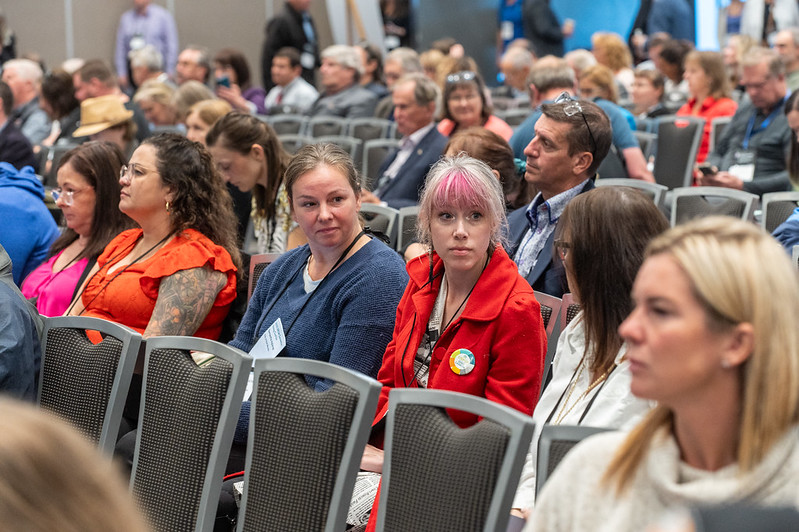
Port Moody was one of the most active municipalities at this year’s Union of BC Municipalities (UBCM) convention, submitting eight resolutions – more than any other B.C. municipality.
The city succeeded in getting four of those resolutions endorsed, one was rolled into another larger package of submissions, while three others failed to make the debate floor due to time constraints.
Local news that matters to you
No one covers the Tri-Cities like we do. But we need your help to keep our community journalism sustainable.
“We actually were quite successful,” said Coun. Callan Morrison. “There were a lot of resolutions, which speaks to the fact that municipalities are looking for help from the province.
“We’re looking for support, help, changes in policy, or even money to help fund these challenges and to push back against the downloading that is occurring.”
For a city of just over 38,000 residents, Port Moody has continued to be one of the busier participants at convention – often outpacing larger municipalities – showing the council is willing to flex its influence on provincial policy markers on a range of issues. The next most active municipality, the City of Burnaby, submitted a total of seven resolutions.
At last year’s convention, Port Moody managed to get seven of its eight proposals endorsed.
The annual conference, held from Sept. 22 to 26 in Victoria, fields hundreds of resolutions sent by municipalities each year.
Successful resolutions
Out of Port Moody eight resolutions: one was outright endorsed by the UBCM Resolutions Committee; five were put into the “no recommendation” category; one was absorbed into a larger referral package; and one was recommended to not be endorsed.
Port Moody’s call for the province to work with the Youth Climate Corps was its only submitted outright endorsed without debate on the floor.
Councillors framed the resolution as a way to both lower household utility bills and give young people practical skills in the green economy. The proposal envisioned the province funding youth climate corps teams to retrofit homes, install heat pumps, and improve efficiency for low-income households.
Another headline-grabbing resolution, which called on the province to recognize housing as human right, ended up being referred into a package of similar resolutions from larger cities including Vancouver, Burnaby, Victoria, and Langley.
In June, Port Moody councillors argued that provincial recognition would give municipalities more leverage when demanding provincial and federal action.
At the time, Mayor Meghan Lahti called it, “a statement of principle” that reflected the city’s own struggles with affordability.
Five of Port Moody’s submissions ended up no recommendation from the UBCM Resolutions Committee, leaving them to live or die on the convention floor.
This often occurs if resolutions propose a new or untested policy idea with no precedent in past UBCM positions, they are controversial or divisive among members, or the committee feels there isn’t enough information to support or oppose.
Two of Port Moody’s resolutions in this section ended up being passed in some form.
The city’s call for provincial reform on school planning passed with strong support, according to Morrison. The resolution highlighted the growing mismatch between rapid housing approvals and the slow process of securing land for new schools. Councillors said reforms were critical as thousands of residents are expected to move into new towers in Moody Centre and Coronation Park before 2030.
Port Moody’s resolution asking the the province to strengthen its BC Poverty Reduction Strategy was separated into different components, but the ask to test a universal basic income trial to its poverty plan was passed. Submitted by council in January, the resolution pointed to success stories from pilot programs in Ontario and abroad, framing universal basic income as a way to simplify support programs and reduce poverty traps.
The one resolution not recommended to not be endorsed by the UBCM Resolutions Committee, ended up being passed after receiving enthusiastic support on the debate floor.
Port Moody called on the province to provide support in securing affordable space for family doctors and nurse practitioners, citing the mounting “affordable space crisis” facing community clinics.
Although UBCM’s committee determined it was inconsistent with UBCM policy, the resolution found support from the BC Divisions of Family Practice, which sent representatives to speak on its behalf.
Three resolutions stalled
Three of Port Moody’s resolutions failed to reach the stage due to time constraints. Out of the 122 resolutions in the “no recommendation” section, only 68 ended up making the floor.
These included:
- Mobile Live Animal Programs: Following the city’s February ban on mobile petting zoos, council pushed for provincial regulations to extend protections across B.C. The resolution sought rules limiting or prohibiting the use of live animals in educational and entertainment programs.
- Equitable Distribution of Non-Casino Gaming Revenue: Port Moody has repeatedly pressed for a major change in the distribution of gambling revenues. Currently, only municipalities hosting casinos receive large transfers, leaving others at a disadvantage. In March, council argued that small and mid-sized cities like Port Moody should benefit as well, but the Lower Mainland Local Government Association had already rejected the idea before UBCM considered it.
- Supporting Housing Affordability Through Taxation Changes and Financial Commitment: Introduced in July, this resolution asked the province to consider tax reforms, including commercial rent caps, to help struggling small businesses. Council described these measures as a way to counter the “fear of unpredictable rent” faced by shop owners in Port Moody and other growing municipalities.
Author