Illegal meeting or informal gathering? Last-ditch attempt to derail Port Moody’s Coronation Park Development wades into murky municipal rules
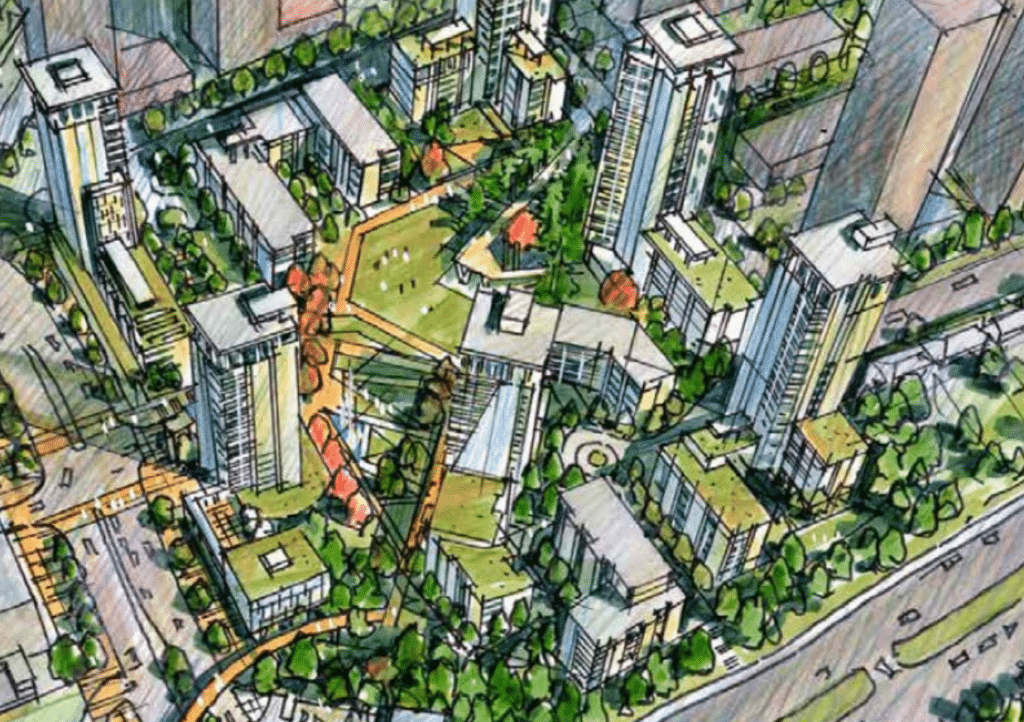
The Coronation Park development may have passed rezoning, but opposition is not dead.
Calls for an investigation into an alleged illegal meeting, held between a majority of council and the developer, have been made in what may be a last-ditch effort to halt Wesgroup Properties’ six-tower project.
Supporters on social media see it as the opposition’s final death rattle.
Local news that matters to you
No one covers the Tri-Cities like we do. But we need your help to keep our community journalism sustainable.
The allegation was first raised at the public hearing on Oct. 3 by resident Jeff Poste, a supporter of the former council’s slow-development slate. He stated he had emails showing four members of council illegally met with Brad Jones, Wesgroup’s senior Vice President of Development in November 2022.
Poste said he was disturbed by what he described as a “secret, off-the-books” discussion which demonstrated a “gross violation of public trust.”
“You can’t just get together in private and decide the direction of a city. This is a democracy,” Poste wrote in an email to the Dispatch.
It is unlawful for a quorum of council to meet and discuss city business outside a formal recorded meeting. This latest controversy in the Port Moody development world revolves around the definition of a meeting, and whether what took place meets the criteria.
Coun. Haven Lurbiecki – who has been the sole voice on council staunchly against moving the project forward – walked out of the meeting prior to the rezoning vote after her motion to defer until an investigation could take place was voted down.
The mayor’s office released a statement the following week, reaffirming the meeting’s legality.
Lahti said the city sought external legal advice on the matter, and determined the gathering did not constitute a formal meeting.
“Given this, there is no further investigation necessary,” the statement read.
At the latest meeting on Oct. 10, Lurbiecki called for a third-party investigation, introducing a motion to lobby the provincial government to reform “dangerously inadequate” municipal oversight, and establish an office of the Municipal Government Ethics Commissioner.
She said larger municipalities have ethics commissioners but their findings are non-binding, and smaller municipalities lack any fair mechanisms to look into complaints.
“Municipal councils are self regulating bodies, judge and jury. That means the truth is whatever the majority says it is,” Lurbiecki said. “If there’s a complaint against a majority, that same majority gets to decide how that complaint is handled.”
The dispute in question surrounds whether any illegality took place when Couns. Samantha Agtarap, Diana Dilwroth, Kyla Knowles, and Callan Morrison attended a developer-led tour of another of Wesgroup’s master planned communities in Vancouver.
Jones, in an email, had suggested councillors would hear Wesgroup’s approaches for Coronation Park, learn about the history of its OCP approval in 2020, and answer any questions related to their application.
In an email to the Dispatch, Jones said the tour was an open invite to all members of council, and the same tour was provided to the previous council in 2020.
Jones added the details of the meeting have been publicly available on our project website since the beginning of this year.
Lurbiecki confirmed to the Dispatch she had received an invite, but had decided early on in her tern to not meet in private with developers.
When the allegation was levied on Oct. 3, Lahti and Dilworth both brushed off any illegality, stating it was simply a site tour where information was received and no decisions were made.
“There was no staff, it wasn’t a meeting, it wasn’t an agenda, there was absolutely no decisions made,” Dilworth said. “It was strictly an opportunity to see some best case scenarios about what Coronation Pak development could look like.”
Lahti added the meeting would only be of concern if decisions were made during the tour.
What is a meeting?
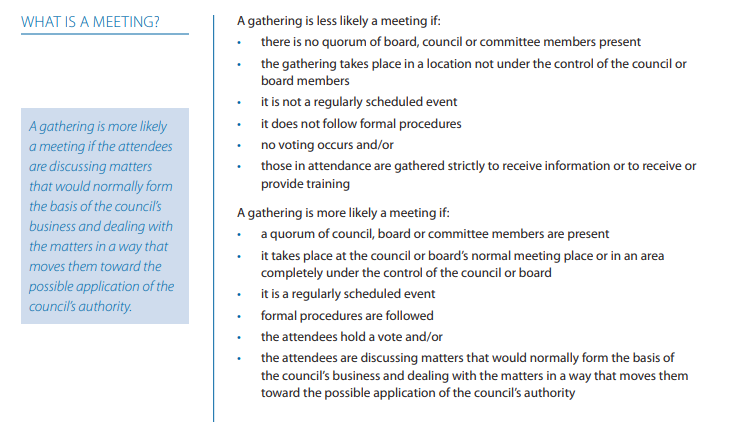
The provincial rules around what constitutes an official meeting, however, have remained somewhat murky for municipalities, according the B.C. Office of the Ombudsperson
The municipal fairness and accountability watchdog released a best practices guide in 2012 to correct some inconsistent practices across the province.
It stated that because the province’s Community Charter does not define the word “meeting,” local governments are often unsure about when informal gatherings are subject to regulatory requirements.
“One of the most frequent challenges identified was determining the point at which a gathering becomes a meeting,” the guide stated.
Some courts have ruled that a “a council meeting is any gathering to which all members of council have been invited; and that is a material part of council’s decision-making process.”
There are two factors that determine whether or not a meeting is taking place, according to the B.C. Ombudsperson: the nature of the group, and the nature of the discussion.
Whether or not a majority of the council has gathered is the most relevant factor for the former, while the latter is determined by the subject matter of discussions.
An official meeting needs to be held if the discussion falls within the municipalities jurisdiction in a capacity that “deprives the public of the opportunity to observe a material part of the decision-making process,” ruled one Supreme Court of Canada judge in 1991.
Any progress in the decision-making process would strongly indicate an informal gathering is, in fact, a meeting.
Where and how a meeting is conducted, such as regularity, procedural format, and location are less significant, but still relevant factors, according to the B.C. Ombudsperson’s guide.
It references the Ministry of Community, Sport and Cultural Development definition of an official meeting as any “gatherings where all council members could be seen to be making decisions, or moving towards making decisions.”
The “heart of the matter” cannot be decided at the gathering, according to another Supreme Court of Canada ruling in 2007, stating it shields information from the public.
David Stuart, who ran on the failed slate which included Lurbiecki and former councillor and mayoral candidate Steve Milani, contended in a letter to the Dispatch that the tour included a presentation and discussion of the financial analysis and policy options for the proposed development.
Speaking during public input on Oct. 10, Stuart stated he filed the freedom of information request referenced by Poste.
Stuart was initially declared the winner of the final council seat during the October 2022 elections, and said he was invited to the Wesgroup meeting before being ousted by Coun. Amy Lubik in a razor thin judicial recount.
He called Lahti’s response “dismissive,” adding he has sought multiple other legal opinions on the evidence he has collected, and all have confirmed to him the meeting was illegal.
“(This) puts decisions arising from it at risk of being overturned in the courts,” Stuart said. “I sincerely hope the mayor will reconsider her decision not to look into this matter, lest the legacy of this council be one of corruption.”
Author