Port Moody seeks its own e-bike and scooter service
Move would force the city to build more active transportation infrastructure, advocate says
Port Moody residents may be commuting with two wheels as opposed to four more frequently.
City council is looking to add an e-bike and e-scooter share service to the streets as soon as this summer, four years after opting not to participate in a pilot program sponsored by the province.
On Tuesday, Feb. 18, council unanimously voted to shop around for an operator, and explore shared programs with neighbouring cities to allow cross-border travel.
Local news that matters to you
No one covers the Tri-Cities like we do. But we need your help to keep our community journalism sustainable.
“I’m really happy we’re going down this road,” said Coun. Samantha Agtarap. “This is a great opportunity to promote more of a sharing economy, reduce the amount of vehicles on the road, and reduce emissions.”
Implementing the e-bike and e-scooter program is a key part of the city’s Zero Emission Stability Strategy, which was endorsed by council in 2023 with a goal of having 40 percent of residents’ trips be made by active transportation modes by 2030.
Nearly every councillor raised a concern over how a share service would handle drop-off and pick-up locations, but all supported testing a program regardless.
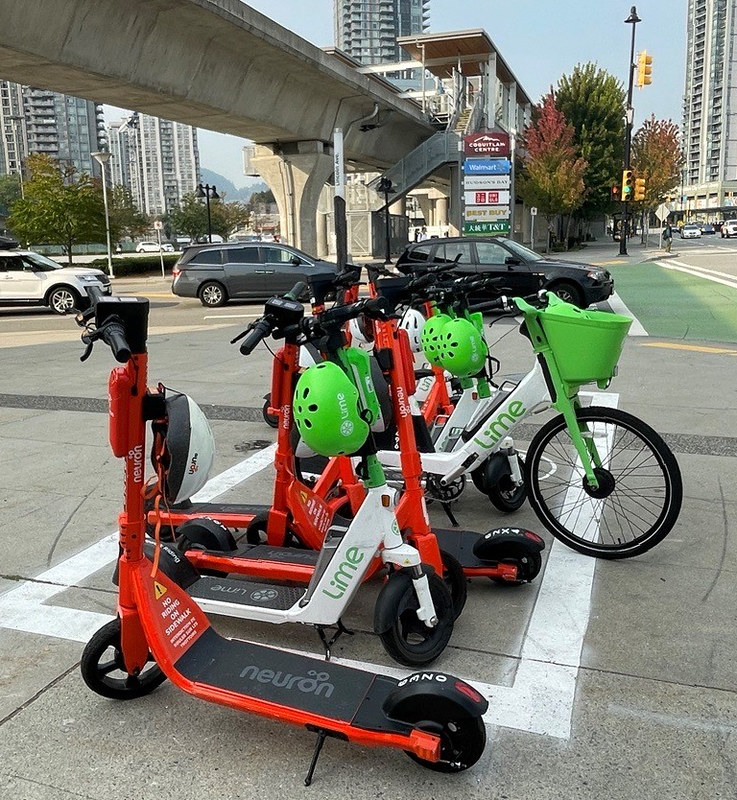
Several councillors pointed to issues with Coquitlam’s program, which allows scooters and bikes to be dropped off anywhere outside of the city centre, leading to users leaving them in inappropriate places.
“We’ve seen them dumped in Coquitlam,” said Coun. Callan Morrison. “You see them just left on the side of the road, or down in a ravine, or in the grass. Some are in the middle of the sidewalk.”
Coun. Diana Dilworth introduced an amendment to ensure any program would require the scooters and bikes must be dropped off in a mandatory parking areas selected by the city.
Staff are recommending designating areas near SkyTrain and bus stops, the Eagle Ridge Hospital, Rocky Point Park and Old Orchard Park, and existing or planned bike routes.
Another amendment, introduced by Mayor Meghan Lahti, qualified that the maximum distance between parking stations should be no more than 500 metres apart.
“The easier and more accessible that we can make these, the better and more successful this (program) is going to be,” Lahti said.
It remains to be seen whether the parking areas will include physical or bluetooth docks. Staff suggested using removable tape or paint to identify parking areas at the beginning of the program, allowing the city to adjust parking locations later if needed.
The bikes and scooters would also be limited to 25 kilometres per hour — the provincially-mandated speed limit — and riders would be required to wear helmets.
Additional speed requirements would be placed on popular routes such as Shoreline Trail. The bikes would be forbidden for use in other areas entirely, including within Rocky Point Park and Inlet Park. (Staff wrote that the designated parking areas and other slow zones would be managed by a geofence.)
A third party would maintain and insure the fleet, and manage the app, similar to how e-bikes and e-scooters are currently operated in Coquitlam and other neighbouring municipalities.
While staff had suggested seeking a shared operator and program with other municipalities, some councillors were hesitant.
Coun. Samantha Agtarap said Port Moody should find whatever program has the best value for the city, while Dilworth said she thought there could be administrative challenges.
Mayor Lahti, on the other hand, argued a shared program with neighbouring municipalities would be ideal. “Having that ability to to cross boundaries . . . is going to be a game changer for us,” she said.
Andrew Hartline, co-chair of HUB Cycling Tri-Cities, told the Dispatch that he agrees. Currently, Coquitlam’s contracted micro-mobility companies do not permit their e-bikes and scooters from travelling into Port Moody, which is something that Hartline hopes will be changed in the future.
“Why do we have two totally separate scooter providers? And there isn’t something a bit more metropolitan for both of our cities?” he said.
In 2023, Coquitlam approved the deployment of hundreds of Lime and Neuron Mobility-made scooters for a pilot program. The city recently extended the project until 2028, despite some reservations about people toppling over scooters, riding without a helmet, among other safety hazards.
Port Moody declined to participate in the 2020 pilot program led by the province for similar concerns. But the city started to change tunes three years later, when Jeff Moi, Port Moody’s manager of engineering and operations, said the services have evolved. In May, Port Moody signed onto the provincial program, making e-scooters street legal.
Hartline said if the program is successful, it will add pressure to build more active transportation in Port Moody.
E-scooters and bikes, which can travel more than 30 kilometres per hour, can create conflicts on multi-use paths that also include walkers and other pedestrians.
“To the extent that it causes the city to build nice, separated infrastructure, it can actually be a positive force,” Hartline said. “But in the interim, there is potential for conflict.”
Chris Brown, Port Moody’s senior sustainability and energy coordinator, acknowledged that share programs do usually lead to complaints in the first few months of operation, but issues generally decline as residents grow used to seeing scooters on the road.
Hartline said he would like to see on-street, separated lanes for cyclists and scooters – particularly on Murray Street, where riders can share the road with motorists and pedestrians can walk safely.
“People who just want to twiddle along with their kid can still go on the multi-use path as long as there’s a stream for that faster traffic that is separated,” Hartline said.
Staff suggested that the fleet operator maintain at least 150 e-scooters and e-bikes for the first six months of operation, before upping the total to 250 within one year.
Port Moody’s contract with an operator is set to last two years, with a one-year option for extension, ending with provincial pilot program in 2028, Staff will be returning to council with a more detailed plan and proposal once an operator has been selected.
Author