Port Moody signs on to province’s E-scooter pilot program, soon legalizing use
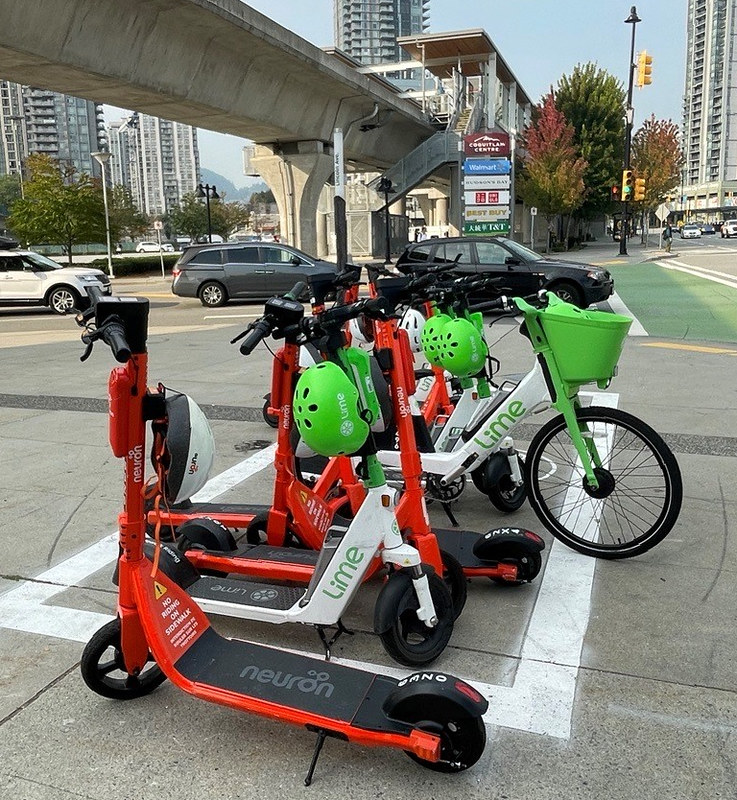
E-scooters will soon be street legal in Port Moody.
City council decided to sign on to the province’s Electric Kick Scooter Pilot program on Tuesday, May 28, which will permit another low-carbon transportation option around the community.
While E-scooters are often seen on Port Moody roads, their use is currently illegal, although that law is not often enforced.
Local news that matters to you
No one covers the Tri-Cities like we do. But we need your help to keep our community journalism sustainable.
“It’s been a bit of a grey area for a long time,” said Jeff Moi, general manager engineering and operations in Port Moody.
The province’s initial three-year phase of the program was launched in 2021, and was renewed on April 5 through 2028 due to its success. Including Port Moody, there are now 21 B.C. municipalities signed up for the program.
Staff recommended joining the program stating it supports Port Moody’s Climate Action Goals encouraging use of alternative zero-emission travel options. The program allows participating communities a chance to conduct research, testing and assessments of e-scooter safety and functionality.
The provincial regulations are similar to the rules around bicycles and e-bicycles.
The battery-powered vehicles will be permitted on designated roads and off-street pathways, or on streets with a maximum speed limit of 50 kilometres an hour in designated cycling lanes or on the right-hand side of the road.
The motors are allowed to be powered by one or more batteries not exceeding 500 watts, with a maximum speed of 24 kilometres an hour.
Drivers must be at least 16-years-old, have to wear a helmet, though they do not require a driver’s licence.
Port Moody considered signing on to the first run of the program, but decided to hold off due to the staff and financial resources needed for implementation. A new legislative framework has simplified the participation process for smaller municipalities, according to the staff report.
Staff said a comprehensive assessment on safety, impact on public spaces, shifts in travel behaviours and community perceptions will take place.
“These insights will be invaluable in shaping future micro-mobility and active transportation strategies,” the staff report stated.
Enforcement will be handled by the RCMP, and drivers will be subject to fines under the Motor Vehicle Act, with penalties up to $2,000 for breaking safety rules, including impoundment of the vehicles.
Bylaw amendments are not required as the city can simply adopt the province’s regulations, however, council may choose to impose their own specific regulations regarding use on municipal roads.
For instance, Moi said Port Moody would be able to set its own restrictions on allowable locations and speed limits.
Staff also recommended exploring e-bike and e-scooter share programs similar to those operating in the City of Coquitlam. Share programs provide a low-cost transportation option, and can cut the upfront costs of purchasing a new vehicle, according to the report.
Moi said there were also opportunities to coordinate with neighbouring cities like Coquitlam on a shared program, so that the E-scooters do not shut down once they cross the municipal border.
“Otherwise, you’d have to get off on your scooter at one boundary and get on to the next scooter,” he said.
Other councillors however, voiced some apprehension about a potential shared program, though they did approve having staff explore options.
The biggest concern was that users would dump the vehicles around the city without properly docking them at appropriate locations.
Coun. Callan Morrison said Coquitlam has had obvious challenges, and Port Moody needs to find a way to prevent E-scooters from being left on sidewalks or environmentally sensitive areas.
He added there should be assigned parking locations, adding he’s seen E-scooters dumped in ditches on the border of Port Moody.
Port Moody’s Climate Action Committee made similar recommendations around having dedicated spaces, according to Coun. Samantha Agtarap.
Staff would return with a detailed model, Moi said, noting Port Moody’s former bike-share program would penalize users if the bikes were not properly docked.
Mayor Meghan Lahti nearly voted against even considering a shared program due to the amount of dumping at the Coquitlam border. She said the company responsible for retrieving them is not doing it daily.
“Every time I drive by that pile of scooters at the border of Coquitlam and Port Moody, I say to myself, ‘Thank god we don’t have that pilot project in Port Moody,’ because we’d be picking up scooters all over the place,” Lahti said. “That is not sustainable.”
Lahti agreed there would need to be some form of docking station, and was adamant that Port Moody not use the same system Coquitlam is using.
Author