Wesgroup proposes significantly more density at Coronation Park site to offset new Metro Vancouver fees, inclusion of affordable housing
Wesgroup approached Port Moody council on Tuesday with a multi-pronged proposal to keep its long-planned Coronation Park development on track – including significant density increases, alternative financial securities, and support tied to a federal financing program.
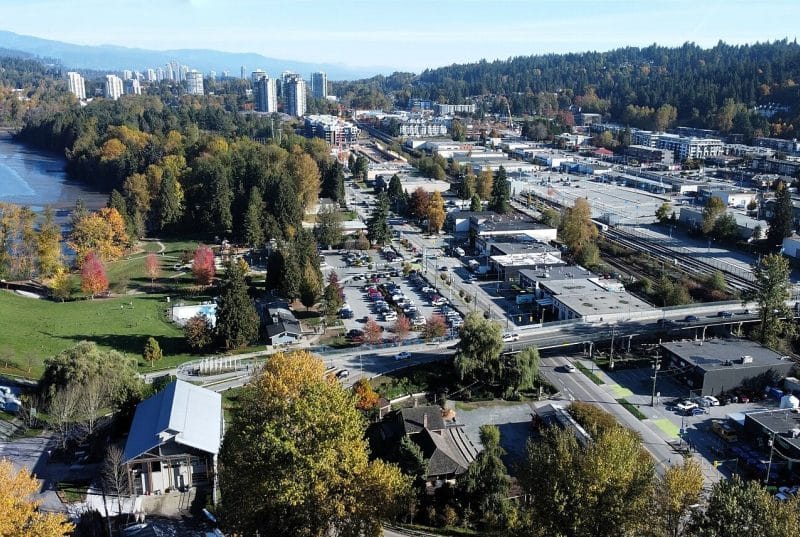
Spanning 15 acres, the development was set to include six residential towers between 26 and 31 storeys and 100,000 square feet of commercial space following council approval in 2023. Of the 2,587 units, 101 were set to offered as rentals.
The May 10 delegation from Wesgroup follows a 2023 letter of intent the developer submitted to explore affordable housing options in exchange for increased density after concerns were raised about the complete absence of below-market units in the project.
Local news that matters to you
No one covers the Tri-Cities like we do. But we need your help to keep our community journalism sustainable.
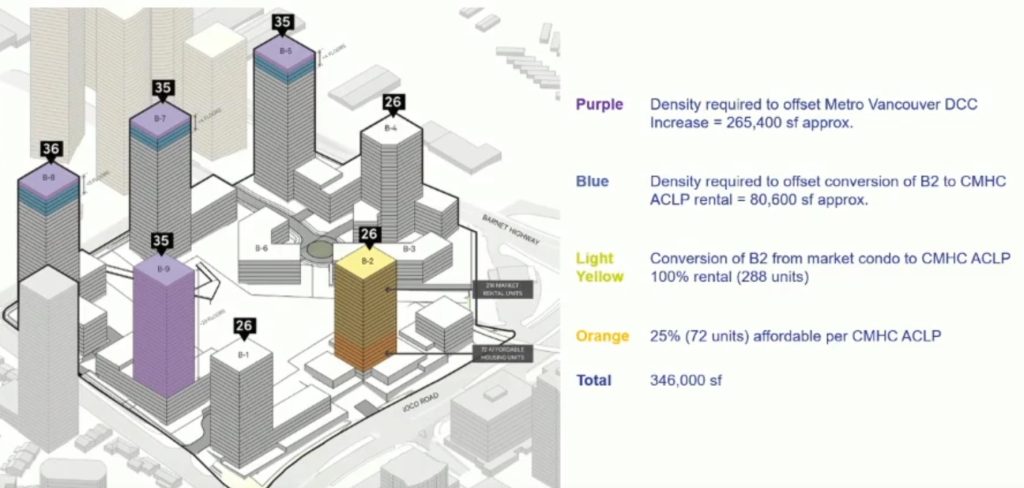
The proposal will require another OCP amendment and rezoning to allow for another tower to be built on site, as well increasing the height of three other towers.
Dean Johnson, Wesgroup’s senior vice president of development, said the amount of density is needed to offset costs related to recent increases to Metro Vancouver developer cost charges (DCCs) hurting the project’s bottom line, and building market rentals under the Canada Mortgage and Housing Corporation’s (CMHC) Apartment Construction Loan Program (ACLP).
“The CMHC’s ACLP is the only viable path forward in today’s financial environment,” Johnson said. “We have two options in front of us: additional density to offset the cost, or decrease the amenity package we previously agreed to with the community. We do not want to go down that path.”
Wesgroup’s proposal would add an additional 35-storey tower, as well as 13 storeys on three other towers. In exchange, Wesgroup would convert one of the 26-storey towers fronting Ioco Road to 100 percent rental housing. Of its 288 units, 72 would be secured at below-market rates for 25 years.
CMHC’s $55-billion ACLP provides low-cost financing to developers in exchange for rental and affordable housing commitments. But the 2025 funds have already been claimed, and the 2026 intake window is nearly full. In order to qualify, Wesgroup needed municipal confirmation that Port Moody supports the project’s alignment with CMHC affordability goals.
While council only received the proposal for information, it unanimously approved the issuance of a “comfort letter” needed to advance Wesgroup’s application to the CMHC.
Offsetting costs
Shortly after Port Moody council approved Coronation Park in October 2023, Metro Vancouver’s Mayor’s Council approved steep increases to regional DCCs, resulting in a $30 million in unplanned fees, according to Johnson.
He said the DCC spike is a significant cost burden on the project, and without the added density, Wesgroup may have to scale back the amenity package approved for the development.
“There was a substantial increase – once in a lifetime, really, for many of us – and this cost is going to be something that we have to deal with on this project,” Johnson said.
Additional density is also needed due to the value difference between market condominiums and market rental.
Most of the additional square footage, however, is being used to offset Metro Vancouver’s DCC increases, which account for approximately 77 percent of the increase in density.
Johnson noted that one of the benefits of using the CMHC program is that both towers facing Ioco Road would be built simultaneously, while much of the density would be added in later phases of the project.
Surety bonds
Wesgroup’s final request was for the city to consider accepting surety bonds as an alternative to letters of credit when developers post financial securities tied to development permits.
A surety bond offers municipalities a secure financial guarantee that a developer will complete their obligations, while giving the developer more financial flexibility compared to traditional bank-issued letters of credit.
“Letters of credit tie up millions of dollars in equity,” Johnson said. “Surety bonds are insured, regulated, and already accepted in municipalities like Burnaby, Surrey, and Vancouver.”
He noted Wesgroup currently faces a $15.8 million letter of credit due in July, which it is seeking to defer until building permits are issued in March 2026.
The company is still in the pre-sale phase and has not yet secured final project financing, making the immediate issuance of such a large letter of credit “challenging,” Johnson said.
Council response
Coun. Haven Lurbiecki was sharply critical of the amount of density being proposed, and questioned whether the CMHC proposal was even related.
She accused Wesgroup of “shifting the goalposts” by asking the public to essentially subsidize an already massive project.
Lurbiecki noted the original plan includes mostly studios and one-bedroom units at a time when the city needs affordable family-sized housing, townhomes, co-ops, four-plexes, and seniors housing.
“Anything but more condos,” she said. “To even consider this request for more density, I just find it irresponsible and inexplicable.”
Other councillors took a more supportive approach. Coun. Kyla Knowles welcomed the affordable housing plan and said the financial pressures facing developers must be understood if homes are to be delivered.
“We need homes. So let’s build the homes,” Knowles said. “If there’s an extra $30 million in DCCs, you could say, ‘Great, the developer makes less.’ But that cost falls on end users.”
She also supported Wesgroup’s request to explore surety bonds as an alternative to letters of credit for financial security deposits.
“Financing has changed. It’s gotten more challenging,” Knowles said. “To not have any understanding of that means you are worsening the crisis.”
Coun. Callan Morrison said he supported the comfort letter but wanted more information before weighing in on the broader density and financial deferral requests. “I appreciate this is going to need a bigger discussion,” he said.
Mayor Meghan Lahti emphasized the comfort letter was only to allow Wesgroup to begin its CMHC application – not an endorsement of all its future asks.
“We may support them sending in the application, but we may not support it at the end of the day,” she said. “This is helping them get to the next step.”
In principle, however, the mayor supported the rental housing proposal.
“If all things were equal, would we be supportive of a CMHC project happening on that site in the second tower? My answer is a resounding yes,” Lahti said. “But obviously, there are multi-faceted levels of conversation that need to take place.”
Staff will return with a report on the broader proposal – including the OCP amendment, rezoning, and requests related to financial securities and density.
Author