Slower streets may be coming to City of the Arts as Port Moody council endorses transportation plan
Port Moody council unanimously endorsed a sweeping update to its Master Transportation Plan (MTP), aiming to ease congestion, lower greenhouse gas emissions, and shift more residents out of their cars by expanding alternatives for getting around the city.
Adopted on June 17, the plan focuses on five “Big Moves” that reimagine how the city approaches road space, speed limits, transit infrastructure, parking, and sustainable travel options.
It marks the most significant overhaul of the city’s transportation framework since 2017.
Local news that matters to you
No one covers the Tri-Cities like we do. But we need your help to keep our community journalism sustainable.
“This is going to be different from the world we all grew up in the ’80s, and certainly different for Port Moody,” said Coun. Kyla Knowles. “But I think it’s the right direction.”
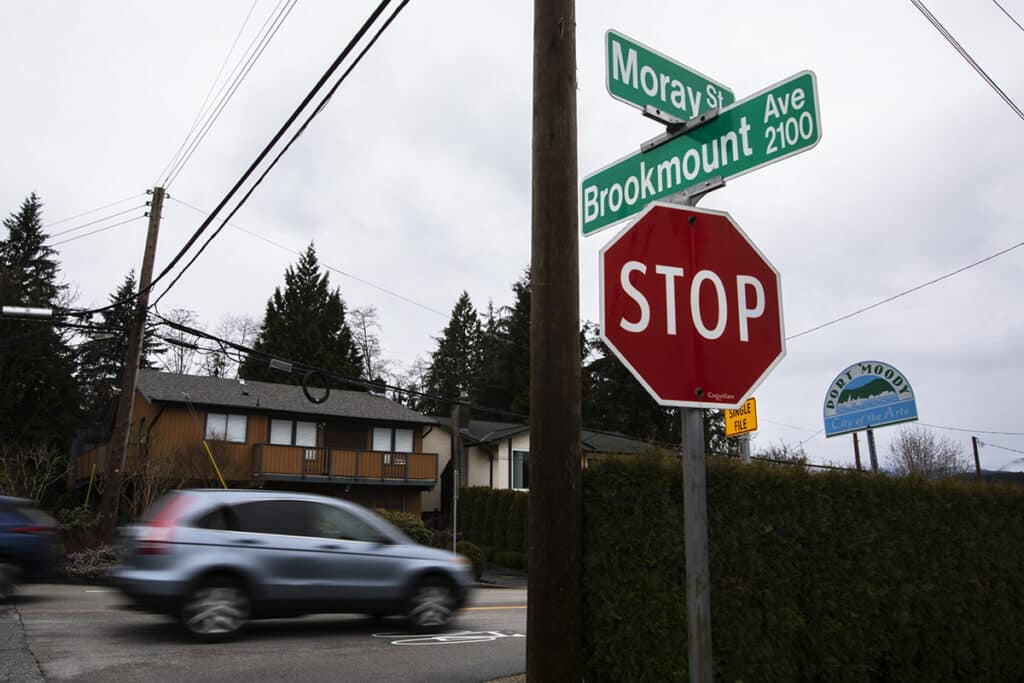
Among the plan’s key strategies is a citywide reduction in speed limits – dropping limits on residential roads to 30 kilometres per hour and exploring 40 kilometres per hour limits on major corridors. Another move calls for reallocating at least 10 percent of current road space from vehicles to green infrastructure, bike lanes, and pedestrian paths.
Other measures include implementing smarter parking policies, investing in transit-friendly infrastructure like new overpasses near SkyTrain stations, and encouraging micromobility options like e-scooters and bike-sharing.
The updates are a direct response to the city’s 2020 Climate Action Plan and come after more than two years of planning, public engagement, and debate.
They follow the widely used “Avoid-Shift-Improve” framework, which prioritizes reducing unnecessary trips, promoting mode shifts to transit and active travel, and improving efficiency of unavoidable vehicle use.
Feedback from the first two phases of engagement showed strong support for prioritizing active transportation, expanding transit options, and improving safety and connectivity for pedestrians and cyclists. Safety, affordability, and accessibility were also recurring themes.
“Many respondents would like to see improvement in vehicle flow, suggesting a reduction in vehicle movements, reallocating road space for vulnerable users and specified uses, and improving access to arterial roads,” the city’s engagement summary stated.
Absent from the strategy is any consideration to widen St. Johns Street.
Coun. Amy Lubik said the solution is not adding more car infrastructure, as regional traffic would quickly return congestion to previous levels.
“That’s called the induced demand phenomenon. What works is to get people out of their cars,” Lubik said.
Jeff Moi, the city’s general manager of engineering and operations, noted that since 2017, studies have shown that any widening project would only provide temporary relief.
Moi added reducing vehicle traffic is linked to guiding development to areas already well-served by infrastructure, such as transit oriented areas around SkyTrain stations.
“Planning growth in the right areas is our best chance at shifting the modes,” Moi said.
Still, several councillors emphasized the importance of communicating the strategy effectively to the public, who have often complained about worsening traffic conditions along the city’s main roads.
Coun. Callan Morrison said the document lacked clarity, and urged staff to do more to explain why Port Moody is not pursuing traditional road widening projects.
“We are constrained and bottlenecked in certain areas, and I don’t know if that has been clearly communicated to the community,” he said. “We could not approve a single thing, and we’re going to have 12 tall towers in Coquitlam. That’s going to add vehicles to the roads – no matter what.”
Coun. Haven Lurbiecki said Port Moody’s traffic woes will ultimately ultimately depend on council’s land-use decisions, and how many parking spaces accompany new developments.
She also emphasized the importance of preserving industrial and employment lands, and aligning transportation with the city’s economic development goals to reduce commuting.
“Putting more condos around a SkyTrain does not mean someone doesn’t have to go downstairs to get to their car to get to work,” Lurbiecki said. “We can do what we can to have walkable amenities so that those car trips are less, but people will still be using those cars, and traffic will still get worse.”
Couns. Samantha Agtarap and Lubik both noted shifting modes of transportation are already occurring, pointing to the rising utility of cargo bikes and car share programs.
“The mode shift, it doesn’t have to mean you always ride your bike or you always walk, it’s just making those trips easier and more desirable for people,” Agtarap said. “It’s very heartening to see that shift already occurring.”
She also supported the speed limit reductions from a public safety perspective, noting Port Moody’s aging population.
The next step is for staff to return to council with a detailed implementation and funding plan. The final cost of projects has not yet been calculated, though the city anticipates drawing on a mix of municipal, regional, and grant-based funding sources.
Information about the plan will be made available on the city’s website, and staff have committed to continued public engagement as implementation begins.
Coun. Amy Lubik summed up the stakes: “When we look at our community surveys, one of the biggest things that people talk about is traffic – and people sometimes forget that they are traffic. So the more people we can get out of their cars, the better.”
Lubik introduced a motion for the staff to report back on potential ways to measure or find data on how many people in transit oriented developments drive versus take transit during the busiest hours of the day.
This would include cumulative demand traffic modeling and driving habit studies of residents living in developments such as Suter Brook, Klahanie and New Port Village.
A second motion was introduced by Agtarap, asking staff to explore partnering with the Society for Children and Youth of BC on the School Streets Initiative, which encourages safe environments for physical activity such as car-free spaces on streets near schools at the start or end of school days.
Author