Port Moody flushes out 1962-era sewer bylaw, launches citywide strategy on stormwater leaks
Port Moody has updated a six-decade old sewer bylaw, unanimously voting to approve a modern plan to stop stormwater from sneaking into the sanitary system – and Metro Vancouver from draining the city’s wallet.
On Oct. 21, council replaced a relic – the 1962 sewer bylaw – which threatened offenders with jail time, adopting a citywide inflow and infiltration (INI) reduction strategy aimed at curbing leaks and cross-connections that are costing taxpayers and stressing local infrastructure.
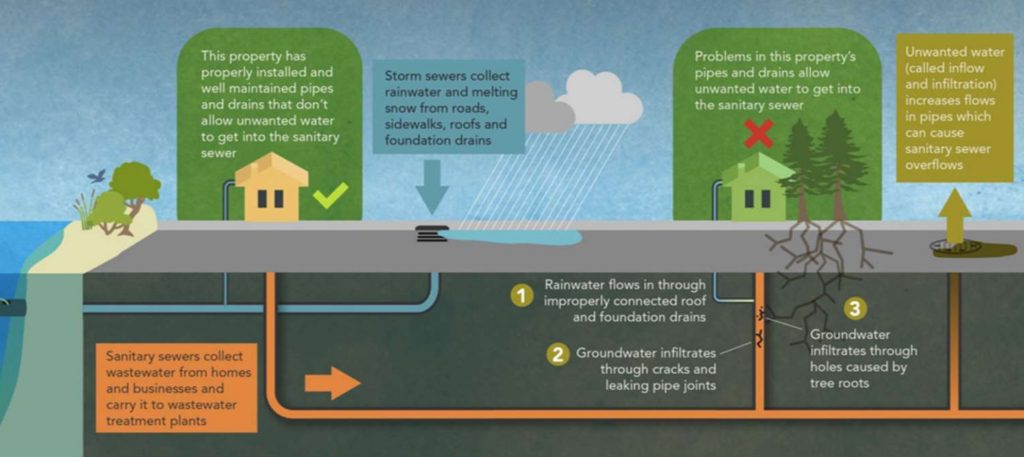
“INI happens when rainwater and groundwater enters the sanitary system through unauthorized connections or cracks and leaks in the system,” said Peter Adams, project engineer with the city. “With increasing size of storms, there’s a lot more flow within the sanitary system, and it can end up flowing into streets and eventually creeks, posing environmental risks.”
Local news that matters to you
No one covers the Tri-Cities like we do. But we need your help to keep our community journalism sustainable.
Metro Vancouver introduced wet-weather pricing in 2024, meaning municipalities are now charged when excessive stormwater enters the sanitary system.
The regional district is implementing its new program over a 10-year rollout, currently only working at around 30 percent of the costs, according to Jeff Moi, general manager of engineering and operations.
However, he said Port Moody had one of the highest INI rates in the region, and could face increasing fees if it lags behind other municipalities, which are also working to tighten the systems.
“So far it has had a pretty minimal effect,” Moi said. “(But) if we don’t keep up with other municipalities, we can start taking on even more costs.”
The new bylaw empowers city staff to regulate both sewer and storm drainage connections, require property owners to fix illegal cross-connections, and enter private property to make emergency repairs if needed.
It establishes fines for unauthorized works, illegal discharges, failure to maintain private systems, and grease interceptor violations, ranging from $100 to $1,000.
Council also endorsed a multi-phase INI reduction strategy that will include neighbourhood-by-neighbourhood monitoring, CCTV inspections, dye testing, and homeowner education programs to identify and repair leaks and cross-connections.
Staff are exploring a grant program to help residents offset the cost of repairs.
Adams said one of the biggest challenges is cross connections – when storm or groundwater pipes are incorrectly tied into the sanitary system, or vice versa.
“Storm and sanitary cross connections are some of the largest contributors to INI,” he said. “Our plan is to actually not fine anyone – we just want to get compliance. It’s not there as a revenue source for the city. We want it strong enough to get people to follow the rules.”
Wet weather pricing has been in place for three-years, but the regional district is still rolling out the system.
“Every bit of stormwater entering the system has a direct financial impact,” Adams said.
The new bylaw empowers city staff to regulate both sewer and storm drainage connections, require property owners to fix illegal cross-connections, and enter private property to make emergency repairs if needed.
The new rules give the city the legal authority it previously lacked to compel property owners to correct those problems.
Coun. Kyla Knowles called the update “really eye opening,” noting the city had gone more than six decades without proper enforcement tools.
Coun. Samantha Agtarap said there’s “a bit of a sense of urgency” to update its system.
“A 1962 bylaw isn’t really going to cut it in the current situation,” she said, adding she wants to see an “educate-first” approach for homeowners before any fines are issued.
Adams agreed, stating staff intend to work collaboratively with homeowners.
“Some people own these properties that are really old, and they’ve bought something that is kind of beyond their control,” he said. “We’re coming from a place of understanding.”
Coun. Amy Lubik asked whether the city might consider a downspout-detachment policy to reduce inflow during heavy rain.
Adams cautioned against it, saying downspout redirection can damage neighbouring properties or building foundations. Moi added that while the city has done it “in some situations,” it must be handled carefully
“You don’t want to disconnect somebody’s downspout and direct it at another property.”
Phase 2 of the INI strategy – covering long-term implementation – is expected to be completed by spring 2026.
Work is already underway in the Glenayre neighbourhood, where flow monitoring, drainage camera inspections, and dye testing have identified cross connections awaiting repair. Similar testing will follow in Heritage Woods and Moody Centre.
Author