Port Moody grapples with Step Code requirements on new buildings
What’s the next step for Port Moody?
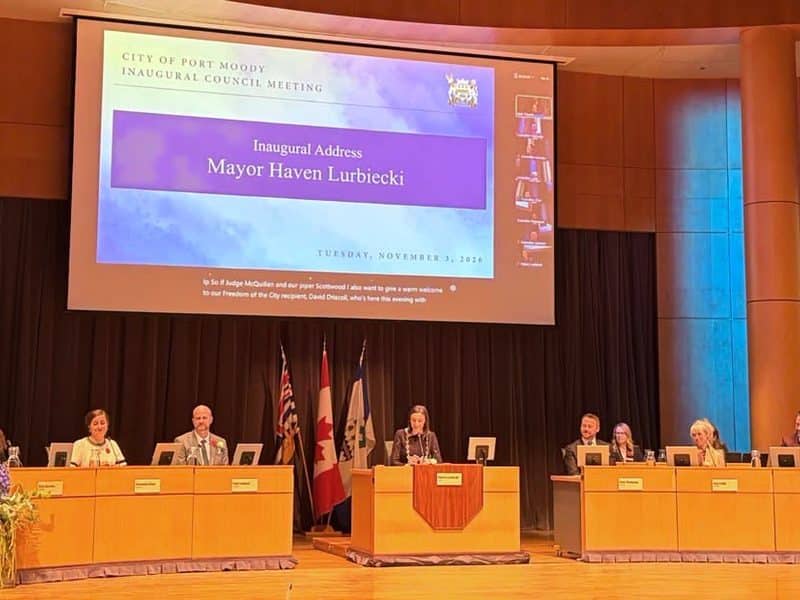
Faced with a housing affordability crisis and a climate disaster, Port Moody council is set to debate pausing – or potentially rolling back – energy efficiency requirements in new construction.
“We have businesses: small, medium, and large, going out of business every single day right now,” said Coun. Kyla Knowles.
Local news that matters to you
No one covers the Tri-Cities like we do. But we need your help to keep our community journalism sustainable.
At its highest level, B.C.’s Energy Step Code and Zero Carbon Step Code call for all-electric heating and cooling systems, low-carbon building materials, and flood and heat resilience.
Noting the city already has “very aggressive” climate targets, Knowles suggested adding construction costs that exacerbate housing affordability may be a misstep.
Rolling back the Step Code may not result in “magical affordability,” Mayor Haven Lurbiecki responded.
The mayor noted that Port Moody has approved a significant number of new condos in recent years.
“I think that the challenge is that the market isn’t demanding that type of housing. I’m not convinced that the challenge is Step Code.”
Knowles noted the new provincial government may overhaul the B.C. Building Code, rendering certain council regulations moot.
While council can offer incentives for projects that produce fewer greenhouse gas emissions, a municipality can’t have energy efficiency requirements that go beyond provincial rules.
Knowles suggested the matter could be solved with a simple compromise.
“We just pause on the targets we’ve given ourselves until the province has provided clarification.”
Knowles noted that residential construction costs have shot up over the past decade, with higher energy efficiency accounting for as much as 12 percent of that increase.
“Port Moody loves to be a leader when it comes to climate change,” she said. “But being a leader in this space brings with it significant additional costs sometimes.”
It’s incumbent on builders facing delays to revise accordingly, Lurbiecki said, noting that the pending standards have been public knowledge since 2024.
The City of the Arts was previously set to implement the most stringent building standard possible for all new construction projects on Jan. 1, 2027. However, amid a sluggish housing market and developers potentially facing significant costs that come with the BC Zero Carbon Step Code, council voted to allow in-stream projects to adhere to previous standards.
The move would essentially grandfather in ten projects totalling 2,426 units, likely resulting in 35 more tonnes of carbon dioxide per year – an increase of nearly 20 percent compared to the emissions produced under the more stringent rules.
The buildings would also use more energy, amounting to 10 percent of the city’s total residential electricity use. The projects would likely represent eight percent of electricity use under the new rules.
The lower standards could result in residents paying more for utilities, with estimates ranging from as low as $75 more per year in a highrise to a maximum of $188 in a low-rise.
However, the added costs of building standards will raise construction costs by more than three percent. For a $900,000 condo, that would result in the asking price going up by about $28,000, noted Coun. Callan Morrison.
It would take more than 250 years for the lower utility rates to make up that difference, Morrison noted.
While acknowledging council can’t predict what the province will decide, Coun. Amy Lubik emphasized the benefits of the higher building standards on human health.
“I do think that we need to continue our work to advance the Step Code,” she said.
Lubik also suggested the impact on construction costs isn’t as significant if the changes are incorporated early in the process.
Council is slated to discuss the Step Code at a council meeting before the end of the year.
Earlier this year, Coquitlam council voted against moving ahead of schedule to implement the Zero Carbon Step Code, with some councillors citing the construction slowdown as a reason.
Buildings account for about 42 percent of Coquitlam’s GHG emissions. Unless or until they’re retrofitted, buildings that primarily use fossil fuels “further contribute to these emissions in perpetuity,” according to a previous city staff report.
Author