
Port Moody-Coquitlam candidates spar over housing, budgets, infrastructure, U.S.-relations
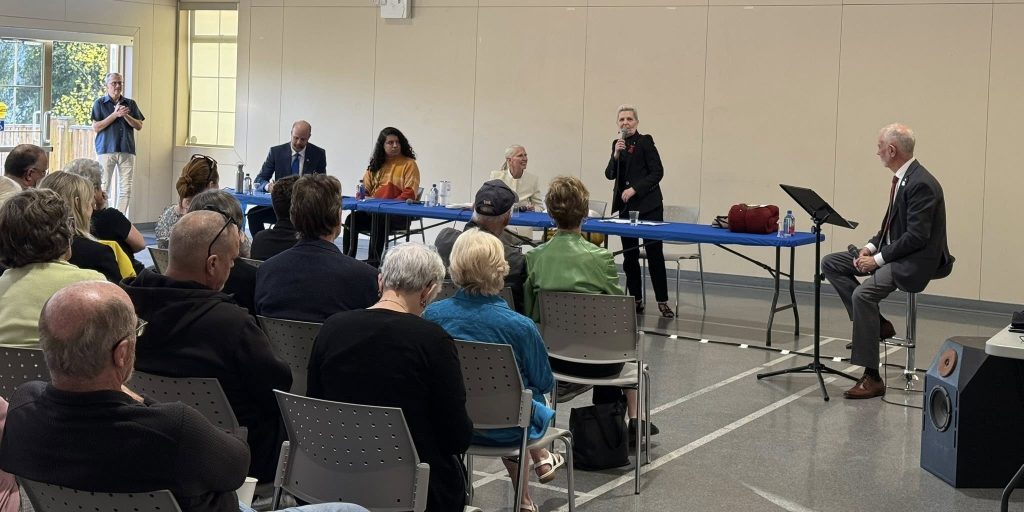
Candidates vying for the Port Moody–Coquitlam seat in the upcoming federal election laid out their visions on housing, budgets and spending, infrastructure and Canada-U.S. relations during last week’s spirited debate.
Incumbent NDP MP Bonita Zarrillo was joined by Conservative Paul Lambert, Liberal candidate Zoe Royer, and Green Party candidate Nash Milani in a packed Old Orchard Hall on April 17.
The Port Moody–Coquitlam riding is one of the most hotly contested seats in the country, and the candidates were frequently attacking or defending their respective platforms, leaders and records.
Local news that matters to you
No one covers the Tri-Cities like we do. But we need your help to keep our community journalism sustainable.
The event was hosted by the The Residents of Pleasantside Ioco Communities Association (TROPICA), who posted the second half of the debate online.
Housing
Lambert accused local governments of poor planning, and criticized the shift to community plan-based development, citing the demolition of older, affordable housing in areas like Burquitlam Plaza.
“Fifteen years ago, it was one of the most affordable housing areas in the riding,” Lambert said. “Now, it’s gone.”
Lambert said he would use federal housing funds to force municipalities to “play ball” and preserve existing affordable stock. “We need to zone non-residential land for residential use and stop tearing down what little affordable housing we have left.”
Zarrillo, running for re-election under the NDP banner, emphasized federal land as an untapped resource for housing. She cited 45 Mary Street, a Canada Post site, as an example she pushed to have earmarked for residential development. She also took aim at corporate consolidation of rental housing: “Brookfield is buying up older rentals and draining money from healthcare and education.”
She also criticized successive Liberal and Conservative governments for taking a “40-year break” from investing in building co-op and purpose-built rentals.
Liberal candidate and former Port Moody city councillor Zoe Royer promoted the party’s new federal agency, Build Canada Homes, promising $60 billion to build affordable homes, including units for seniors, Indigenous people, and low-income households.
She emphasized the use of engineered timber and prefab construction to accelerate delivery at lower cost. “We can build homes 50 percent faster and 20 percent cheaper,” she said, citing local school upgrades as proof of concept.
Green Party candidate Milani took a more scathing tone, alleging “open corruption” on some city councils. “We’re building towers that aren’t helping the community,” he said, also advocating for sustainable, wood-frame housing instead of highrise development.
Fiscal Plans
When asked whether their party platforms were fiscally responsible and how they would address the growing national deficit, candidates split along ideological lines.
Lambert criticized the delayed releases of full-costed plans across all major parties, but stressed that economic growth – not cuts –was the Conservative solution. “We won’t get out of debt with more taxes . . . but by unleashing the economy,” he said.
Zarrillo challenged that premise, accusing Liberals and Conservatives of decades of corporate tax leniency. “You’re carrying the tax burden,” she said. “We’re going to stop the free ride.”
Milani, whose Green Party had already released its platform, proposed eliminating federal income tax for those earning under $40,000 and ending billions of dollars in federal fossil fuel subsidies.
Royer defended her party’s record by invoking the new prime minister’s past economic leadership: “When it comes to finances, I trust Mark Carney,” she said, pledging sustainable economic development.
Infrastructure
All candidates agreed that infrastructure was lagging behind population growth.
Lambert blamed Liberal immigration policy for outpacing infrastructure investment, promising “compassionate but significant immigration reform.”
“We’ve had such a high rate of population growth the past 10 years that our infrastructure cannot keep up.” He added, “We’re the only party offering significant . . . immigration reform.”
Zarrillo, who is also the NDP’s infrastructure critic, pointed to projects like Westwood Rail Pass and community amenities such as libraries and pools, critizing the lack of federal funding.
“The needs of municipalities are misunderstood in Ottawa,” she said.
Royer criticized the “download” effect of one-time federal funding, calling for sustained partnerships.
Milani, meanwhile, criticized municipal policies that he said prioritize luxury towers over transportation planning, while also endorsing the province’s dormant light rail corridor for renewed federal support.
Truth and Reconciliation
The question of reconciliation revealed stark philosophical divides.
Lambert advocated for “economic reconciliation,” pointing to resource development as a path to prosperity for Indigenous communities.
“We will not force projects on communities that say no,” he added, referencing Conservative Party leader Pierre Poilievre’s outreach to Indigenous leaders.
Zarrillo pushed back strongly. Wearing a red dress in honour of Missing and Murdered Indigenous Women and Girls, she warned of exploitation tied to resource extraction.
“Indigenous women and girls are being killed. The Conservatives do not believe in Indigenous rights.”
Royer highlighted her municipal experience working with local First Nations on education and dialogue initiatives, while Milani accused Canada’s political system of being rooted in colonialism. “We should not expect Indigenous people to sell us their land,” he said.
Sovereignty and the Trump Question
One of the final questions asked how Canada should respond to rising U.S. protectionism under Donald Trump and safeguard its sovereignty.
Zarrillo warned against importing “Trump-style politics,” and linked the trucker convoy to foreign interference. “We don’t want American-style health care. We don’t want American-style politics.”
“Donald Trump has threatened who we are as Canadians.” She added. “The Conservatives are the closest thing to that in Ottawa.”
Lambert defended his party, saying, “Canadian conservatives are not like American Republicans. Pierre Poilievre is not like Trump.” He added, “We are the only party that will secure our sovereignty structurally, and grow our economy.”
He stressed military investment—especially in the Arctic—and targeted tariff retaliation dollar-for-dollar.
Royer emphasized diplomacy, asserting that Mark Carney had already stood up to Trump. “You shore up allies,” she said. “We are Canada strong.”
Milani agreed Canada must strengthen global partnerships beyond the U.S., calling isolationism a threat.
The election takes place on April 28.
Author

Related Articles
‘Sideswiped by history’ A closer look at incumbent Bonita Zarrillo’s loss in Port Moody-Coquitlam and the fall of the NDP
Bonita Zarrillo, NDP candidate and incumbent for Port Moody-Coquitlam, was one of the many in the party who lost their seat in the 2025 election