Letterbox: 2026 election is an opportunity to refresh Coquitlam council
As a Coquitlam resident, if you are like me, you likely go to work every day, raise your kids, engage in the community in various ways, vote when elections come, and let the city be run by your elected officials – it is, after all, their job to run the city in the best interests of its residents and for the greater public good.
And then one day you wake up and discover that the beautiful neighbourhoods of Burquitlam and Oakdale are essentially heat islands, bereft of trees, a forest of towers and impermeable surfaces, very little park space and not exactly what one would call walkable neighbourhoods. Today these neighbourhoods have been transformed with thousands of unaffordable, tiny “units” (not homes), with more “units” on the way, hundreds of empty condos, and a lawsuit filed by condo owners.
How did we get here? Long before the provincial government introduced its infamous Housing Bills 47 and 44 in 2023 mandating density around transit, Coquitlam had moved proactively to build along the Evergreen Line.
Local news that matters to you
No one covers the Tri-Cities like we do. But we need your help to keep our community journalism sustainable.
However, whose interests were uppermost in making those development decisions and transforming these neighbourhoods? Coquitlam today is likely one of the most developer friendly municipalities and simultaneously the one with some of the poorest environmental safeguards, be it the Zero Carbon Step Code, urban forest management strategy, tree protection bylaws or streamside protection and enhancement area (SPEA).
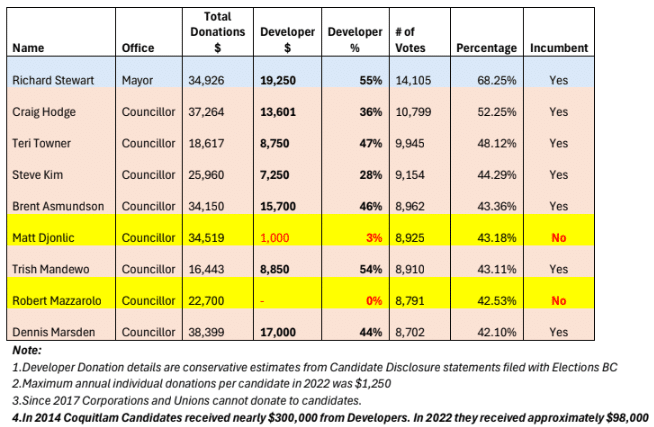
It is enlightening to look at the composition of the outgoing council:
Strangely, Coquitlam has one of the lowest voter turnouts in Local Elections, well below the Provincial Average and well below our neighbouring municipalities.
(Editor’s note: In 2022, approximately 20 percent of eligible Coquitlam voters cast a ballot. For comparison, turnout was 31.3 percent in Port Moody, 18.3 percent in Port Coquitlam, 19.3 percent in Burnaby, and 27.2 percent in New Westminster.)
One of the reasons for this very low turnout is likely the way Coquitlam Council operates. Unlike neighbouring municipalities, Coquitlam Council has developed an ingenious system to essentially keep residents away from the council chambers. See my letter here.
The culture at City Hall needs to change. Coquitlam is blessed with exceptional staff, but an oversight body (council) must exercise oversight with transparency and visibility. We cannot have this strange relationship at city hall that has resulted in unacceptable behaviour at the highest levels with no consequences or accountability, except a “graceful” retirement! Is that the culture that permeates down to staff? Is this how governance works?
There is now a unique opportunity in 2026 to change the composition of council. There are many talented people who have stepped up to run as candidates. So, let’s get out and vote!
We need people on council who are willing to put the time and rigorous effort required to serve the residents for the greater good of the city and residents. Not people whose interests are elsewhere or beholden to other interests and treat civic governance as a part-time gig. Analysis and understanding of issues must be evidenced by deliberations at council. Voting decisions must be explained. Representation is not photo ops at community events or rubber-stamping of staff reports.
We need to promote and build our civic democracy and build a city that works for all.
Get out and vote – and vote wisely, Coquitlam!
And thereafter hold your elected representatives, accountable during their term!
Sebastian Thomas