Student safety drives Port Moody’s unanimous vote for Noons Creek traffic-calming pilot
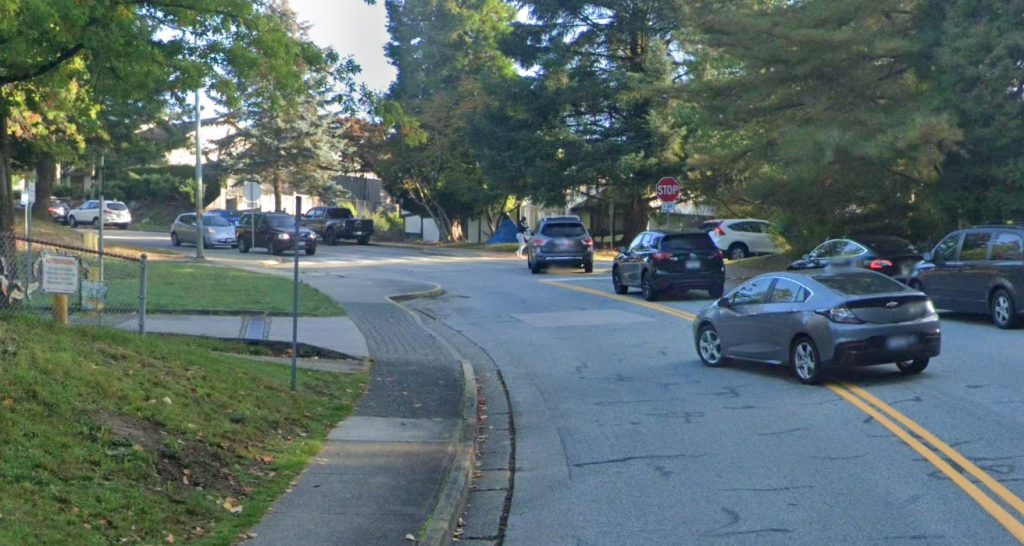
With student safety in mind, Port Moody has unanimously endorsed a traffic-calming pilot project along Upper Noons Creek Drive.
On Sept. 16, council unanimously approved $140,000 for the one-year pilot, which will test a raft of measures including pedestrian-activated flashing beacons, lane narrowings, flexible post delineators, and a speed-reader board.
Mayor Meghan Lahti thanked the neighbourhood for their patience, noting they have been lobbying for significant improvements to the corridor for some time.
Local news that matters to you
No one covers the Tri-Cities like we do. But we need your help to keep our community journalism sustainable.
“I think this is an important part of safety in this area, especially as it’s adjacent to an elementary school, and it’s really important we move on to some solution.”
Upper Noons Creek Drive has long been a trouble spot for residents, with concerns about speeding, blind corners, and congestion around school drop-off times.
As a steep collector road connecting Port Moody’s Inlet Centre neighbourhood to Coquitlam’s Westwood Plateau, Noons Creek Drive funnels thousands of vehicles past Mountain Meadows Elementary on a daily basis.
The city has investigated ways to calm traffic along the corridor since the 2000s, and a pilot project was recommended as part of the 2017 Master Transportation Plan.
Coun. Diana Dilworth, who lived in the area for decades, said the neighbourhood was never designed for its current traffic loads.
“Noons Creek never used to go through to anywhere, it just stopped,” Dilworth said. “When that opening occurred (to David Avenue), so much more traffic was coming across and coming down.”
While the posted speed limit is just 30 kilometres per hour, staff said 85 percent of the approximately 3,250 daily drivers travel at 50 kilometres an hour on both sides of the street – and 40 kilometres an hour in front of the school.
Survey results from last fall show how contentious the corridor has become for some local residents. Out of more than 127 responses, there were:
- 168 mentions of problems with vehicles, including 78 reports of speeding and 57 complaints of drivers failing to stop at signs
- 57 comments about pedestrian safety, with 33 specific to unsafe crossings and 18 focused on kids’ safety near the school.
- 35 mentions of drivers themselves feeling unsafe, citing 15 cases of poor visibility at intersections and 13 tied to school traffic narrowing the road
What the pilot includes
The pilot design emphasizes pedestrian safety while adapting to the corridor’s geography.
Because of steep grades above 8 percent, traditional speed humps and raised crosswalks were ruled out. Instead, the plan relies on visual aids and alterations to the crossings:
- Intersection redesign at Noons Creek Drive and Alpine Place: converting the three-way stop to a one-way stop, along with a marked crosswalk and rectangular rapid flashing beacons (RRFBs). The existing streetlight will also be converted to LED for better visibility.
- Additional RRFBs at Cypress Place/Campion Lane and Hemlock Place/Heather Place due for their bus stop locations and sightlines.
- Lane narrowings and flexible posts near crosswalks and bus stops, with painted curb extensions to slow drivers.
- Other measures include new transverse pavement bars, “SCHOOL” markings, and a speed reader board
Nearly half of the budget is devoted to the beacons, which cost about $45,000 to supply and install.
Council comments
Coun. Callan Morrison emphasized both the “passionate” engagement levels and the creative funding solution, noting that unspent allocations from 2023 and 2024 traffic calming budgets are being pulled forward to cover the pilot.
“The feedback . . . is significant for this area, considering you had 160 to 170 responses, and that’s sometimes what we get when we ask the entire city to respond on something,”
Coun. Amy Lubik agreed, highlighting the strong neighbourhood “buy-in” and enthusiasm from the Transportation Committee.
Dilworth supported the flashing beacons, new crosswalks, and even the proposed art piece outside the school to help drivers slow down. But she warned that removing the existing three-way stop could create confusion, suggesting a heavy focus on public education.
“While there’s no longer a three way stop here, that doesn’t mean you get to blare through,” she said.
Coun. Samantha Agtarap agreed, stating that council should look at the pilot as a “continuous improvement project.”
“I think this is an important part of safety in this area, especially as it’s adjacent to an elementary school, and it’s really important we move on to some solution,” she said.
Construction is expected to cost $100,000 plus a 40 percent contingency, funded from $30,000 remaining in the 2023 traffic calming program, $60,000 from 2024, and $50,000 from 2025.
Staff will report back after one year with before-and-after traffic data and community feedback.
Author