Man convicted of Rumours murder dies in prison
Nearly a decade after the killing, Anthony Lowe confessed to an undercover cop who was posing as a crime boss
Thirty years after murdering a business partner in a Port Coquitlam nightclub, Anthony David Lowe has died.
Lowe ran the Rumours nightclub in Port Coquitlam alongside owner William Rudy in the early 1990s.
The two met in the late-1970s when Lowe and his wife became regulars at the Cat and Fiddle, which was owned by Rudy, according to court documents.
Local news that matters to you
No one covers the Tri-Cities like we do. But we need your help to keep our community journalism sustainable.
Lowe, who was in the sound and lighting business, did a few jobs for Rudy and the two established a business relationship.
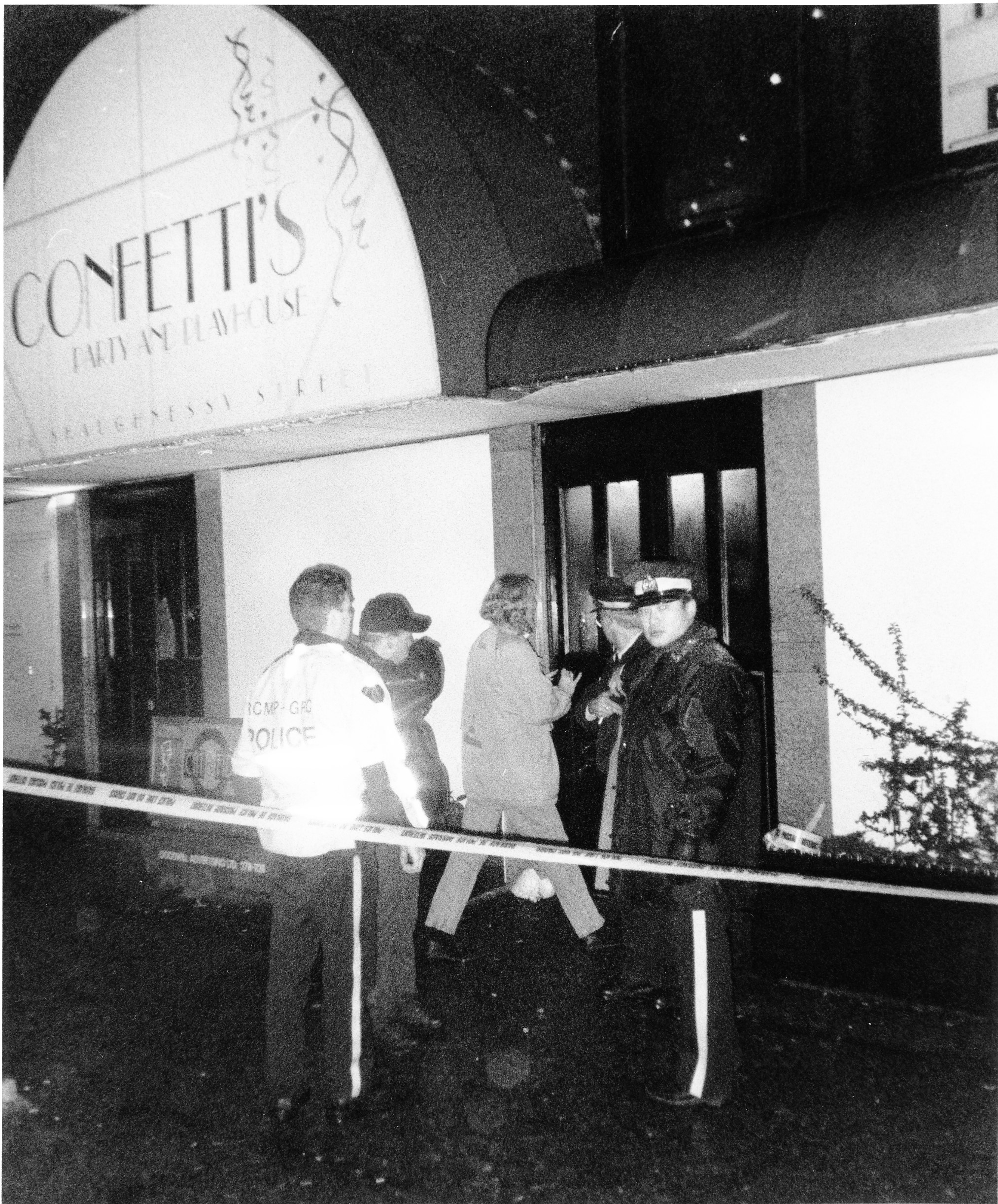
In the 1980s Rudy bought a movie theatre on Shaughnessy Street and hired Lowe and another man to install and sound and lighting system and to run the nightclub, which soon became Rumours.
In the early 1990s revelers packed the club. Lowe was being paid $3,000 a month and Rudy made a total of around $500,000, according to court documents.
Rudy ran the club through Poco Properties Ltd., which owned the building, and Poco Cabaret Ltd., which held the liquor licence.
In January 1993, Lowe had become the sole shareholder and director of both those companies, holding Poco Properties in trust for Rudy.
Rudy said he put the Rumours building under Lowe’s name to hide it from his wife, according to witness Janet Bignell.
Bignell worked as a residential real estate agent in the same office as her then-husband, who was one of the listing agents for the property.
Bignell and Rudy eventually started a romantic relationship. The two got engaged in November 1993, approximately three months before Rudy was murdered.
The couple planned to settle in Kelowna, according to Bignell, who told the court Rudy was planning to sell Rumours, Miller’s Landing pub in Nanaimo, as well as his two houses. He listed the two houses with Bignell.
By February 1994, Rudy was increasingly exasperated with Lowe, according to Kevin Smetaniuk, a commercial real estate agent who worked in the same office as Bignell.
Besides not wanting a business partner, Rudy didn’t want to babysit, Smetaniuk testified.
“Every time I go there, I get a song and dance and I just — I’m supposed to collect money and I only get part of my money,” he recalled Rudy saying. “Time for me to put my foot down.”
Rudy had plans to buy a pub and a beer and wine store in the Interior, Smetaniuk testified.
In February, Rudy told Bignell he was set to sell his Nanaimo pub and that all he had to worry about was Rumours, according to the court transcript.
The next day, Rudy disappeared.
Because he had cashed in some assets and because his van was found parked at YVR, the matter was initially considered a missing person case.
10 aliases
“Rudy was not a person who could be taken at his word,” stated Justice C.L. Smith.
Besides using at least 10 aliases, Rudy put his property in other people’s names and used sham mortgages and sham business records when they benefitted his interests. According to one account, he brought $550,000 in cash stuffed in paper bags to his real estate agent’s office over a few months.
Rudy also checked into a hotel under an alias when he found out a revenue Canada Special Investigations Unit was looking for him, according to the court transcript.
Two years after he went missing, Rudy’s body was found.
In early fall 1996, Norman Moore was timber cruising in a forest by Sandpiper Golf Course near Agassiz when he saw a shoe and a partial human skull.
The end of Rumours
About six months after Rudy went missing, the nightclub was renamed Confetti’s.
The club failed to catch on and closed in 1998.
Lowe declared bankruptcy. He was once caught shoplifting for food, the justice noted.
The former nightclub manager eventually took a job as a car salesman. However, the little money he made was garnished.
“Anyone in such a position would have been eager for the opportunity to make money,” Smith stated.
Toward the end of 2001, Lowe became the target of an RCMP undercover operation.
Over a four-month period, he was paid about $9,000, as well as money to help deal with an impaired driving charge.
Besides the cash, Lowe was given meals, drinks, a cellphone, a leather jacket and a business suit while an undercover officer fed him a line about a “big deal” in the offing, something that could pay for Lowe’s retirement.
However, Lowe was also told the criminal organization was considering other prospects. He was in competition for the job, according to court documents.
Lowe’s main contact, who went by the name Jason, told him not everyone could handle this kind of thing. He also told a story that emphasized how much Jason needed someone who could stand the sight of blood.
In the spring of 2002, Jason and Lowe drove to Edmonton, Alta., and headed to a restaurant where they were supposed to meet major players in the criminal organization.
“Lowe was snubbed; in fact, he was sent to sit in the bar and wait while the others had a lengthy dinner,” Justice Smith observed.
Later that night, after telling Lowe that major players only deal with people they trust, Jason asked Lowe about the worst thing he did.
Lowe told him he’d done the worst thing a person can do.
Jason deliberately misunderstood, asking if he was talking about sexually abusing children.
Lowe told the officer no, he’d “whacked a guy,” according to the court transcript.
Meeting Mr. Big
A little more than one month later, a meeting was arranged between Lowe and Mr. B, an officer posing as the boss of the criminal organization.
The boss asked about “a guy who went missing.” Lowe initially said he had nothing to do with him.
Asked the question repeatedly, Lowe said he killed Rudy.
“He was trying to screw me and I wasn’t going to let that happen,” Lowe said, according to a recording.
Over the course of the 105-minute meeting, Lowe recounted the murder in detail.
He said he’d stashed a sledgehammer and hit Rudy. He’d planned to attack his former partner behind the bar where the floor is designed to run into a drain.
Lowe also described putting Rudy’s body in a large vehicle and taking it to the forest near Harrison Hot Springs.
After being asked repeatedly asked about what he did with the murder weapon, Lowe at first said it was in the river before telling the purported crime boss he’d tossed the sledgehammer in a dumpster behind a drycleaner in the north end of Port Coquitlam.
He also said he’d taken Rudy’s van and parked it at the airport.
A note on Mr. Big stings
Generally, a Mr. Big sting involves police officers posting as members of a criminal organization in an effort to dupe a suspect into confessing to a crime, typically a homicide, according to a University of Saskatchewan study.
The sting has been employed in more than 350 investigations, according to reporting from CTV News.
In 2019, an out-of-court settlement was reached in the case of Kyle Unger.
Unger, by his own account was naïve and desperate for money, told undercover officers he’d killed a teenage girl during a Mr. Big sting.
Unger spent 14 years in jail before being acquitted of the murder.
Lowe’s defence
In court, Lowe said he was scared of Jason and concerned for his and his family’s safety.
He also said it was clear to him that, in the criminal organization, someone who could kill was special and that if he wanted to advance he needed to say he was capable of violence.
“One of the carrots dangled in front of him was that he would soon take Jason’s place, running the West Coast operation,” Justice Smith noted.
The justice acknowledged that statements made during an undercover sting “must be viewed as inherently unreliable.”
However, Lowe’s descriptions to the “crime boss” in the hotel room were consistent with how the murder occurred, the disposal of the body, “and with the limited physical evidence,” Smith stated.
The justice also emphasized the rapid exchanges between Lowe and the crime boss.
“It would be a remarkable feat of mental gymnastics to tell a truthful story about the murder and disposal of the body while lying about other parts of the story so as to claim falsely that the murder was planned,” Smith concluded.
Lowe’s 2009 appeal was dismissed.
Lowe’s death was due to “apparent natural causes,” according to a release from Correctional Service Canada
CSC will review the circumstances as is standard in the death of an inmate.
Author