Owner of reptile rescue claims organization unfairly maligned during Port Moody council’s discussion on mobile-petting zoo ban
This article has been amended to provide additional context.
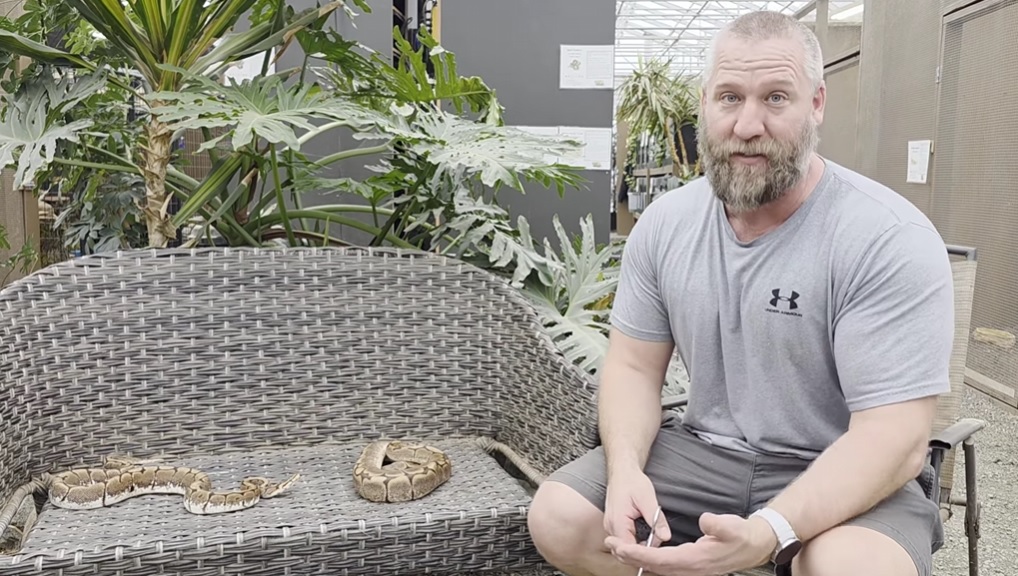
The owner of a reptile rescue is pushing back against Port Moody’s recent move to ban mobile petting zoos, claiming his organization was slandered during council’s discussion on the issue.
Mike Hopcraft of Wild Education told the Dispatch council’s decision was based on misinformation, and that he was denied a chance to refute one councillor’s claim that his rescue was “exploitative.”
Local news that matters to you
No one covers the Tri-Cities like we do. But we need your help to keep our community journalism sustainable.
“When you are sitting up there and outright lying about what we do, it really pisses me off,” Hopcraft said. “It’s kind of hard to not feel targeted when the only examples they are using are of us and our animals.”
Port Moody council recently directed staff to develop a policy barring all live animal events and performances within city limits.
A delegation from BC SPCA criticized these programs for mistreatment of the animals’ psychological and physical welfare, transportation and housing, breeding practices, and their use as entertainment. The programs could also spread zoonotic disease, encourage the exotic pet trade, and lacked any education value, council heard.
Coun. Kyla Knowles, who introduced the motion pushing for the ban, said she became motivated to do so after hearing community complaints and seeing Wild Education’s exhibit at Port Moody’s Fingerling Festival.
Knowles claimed lethargic animals were being handled by children for hours, and packed into boxes and shipped between multiple events. She recalled being “heartbroken” after seeing a turtle crawling across the floor in danger of being stepped on.
Knowles did not refer to Wild Education by name. During the Jan. 14 council meeting, she described a vendor as an “exploitative petting zoo.”
Wild Education is the largest reptile rescue in Western Canada and relies exclusively on its live-animal exhibits to raise funds. Hopcraft vehemently rejected how his organization was being characterized.
He said reptiles are lethargic by nature to conserve energy, his animals are given constant breaks, always in a guest-limited enclosure, and constantly monitored by staff and volunteers who strictly enforce sanitization.
The turtle that Knowles referred to was in fact a 100 pound tortoise with an armoured shell that can withstand lion attacks in the wild, according to Hopcraft. “One person saw one thing that they didn’t like, or take the time to understand,” he said.
Furthermore, Hopcraft said nearly every photo used BC SPCA’s presentation to council were of animals at Wild Education events.
Hopcraft told the Dispatch he thought these direct and indirect references to Wild Education while discussing this broader mistreatment of animals was unfair, and that the rescue advocates against keeping exotic pets and in favour of responsible pet ownership.
In an email to the Dispatch, the BC SPCA acknowledged two of the photos used were sourced from Wild Education, but were cropped to remove identifying features such as logos or branded signage.
“Our team took special care . . . to ensure that this presentation did not point to any specific organization,” the BC SPCA stated.
The BC SPCA and Wild Education have an antagonistic relationship, according to Hopcraft.
Hopcraft was charged with animal cruelty and violating the Veterinarians Act in 2018 after he performed an enema on a constipated snake, but he said these charges were later dropped after veterinarians across the country intervened in his defence, and the procedure saved the snake’s life. In 2015, the BC SPCA seized dozens of reptiles from Hopcraft claiming they were in distress, but no charges were ever laid.
Hopcraft said the BC SPCA does not support keeping exotic animals in captivity, regardless of the circumstances, and sees his organization as nothing more than a “roadside zoo.”
He said his organization would not exist if not for an uncontrolled pet trade, and the BC SPCA should focus more on B.C. breeders and expos selling thousands of animals every year.
“There’s nothing we can do that will change their mind,” Hopcraft said. “We’ve been battling with them for years, and they would love to see us go.”
He further criticized the city for not allowing him to directly address these issues during his own delegation to council on March 11.
Hopcraft’s primary concern is a potential ban in Port Moody spreading to other municipalities, which he says would decimate Wild Education’s ability to fundraise. He noted the BC SPCA has publicized council’s decision in an effort to encourage other cities to take similar measures.
With the loss of exhibits at schools and events in Port Moody, Hopcraft estimated they will lose around $20,000 a year.
Wild Education took in 153 animals in 2024, most of which have been surrendered or were rescued from neglectful owners, Hopcraft said, adding only one other smaller rescue accepts reptiles in B.C.
“There is nowhere else for them to go,” he said. “If we don’t take these animals in, they will be put down, or released into the wild.”
Hopcraft also took issue with the claim these programs have no educational value. He brought 50 letters of support, which included messages from teachers and principals.
During the delegation, councillors commended his passion for caring for his animals, but held by their decision to locally ban the mobile petting zoos.
Knowles said comments from council and the SPCA were not directed at Wild Education specifically, but about mobile live animal programs generally.
She said the problem is a lack of provincial regulations around minimum standards of care for animals for these programs, regardless of training, knowledge or capacity.
Knowles also pointed to other animal rescues in the region which are able to secure sponsors and grants for long-term support.
“They do not take their animals on the road to raise money,” she said. “Perhaps this is something you can explore.”
Mayor Meghan Lahti and Couns. Amy Lubik and Haven Lurbiecki said council needs to advocate at the Union of BC Municipalities and the Lower Mainland Local Government Association for more funding to rescues like Wild Education.
“There needs to be a way forward where you can be funded to do the good work that you do in a different way,” Lahti said.
Hopcraft told the Dispatch that Wild Education has tried numerous forms of fundraisers and sought out sponsors and provincial grants in the past, but has never been very successful.
He said securing donations for reptiles is more difficult as people do not empathize with a sick or injured snake the same way they would a kitten or puppy.
‘It is funny to me how every councillor that spoke says, ‘We need this rescue. We don’t want to see this rescue shut down . . . but make your money another way,’” Hopcraft said. “In 25 years, do you think we haven’t tried?”
Author