Homelessness in Tri-Cities rises 86% in three years, report shows
The latest snapshot of homelessness in the Tri-Cities illustrates a worsening situation in terms of both multitude and severity.
Conducted last March, Greater Vancouver’s 2023 Point-in-Time Homeless Count found homelessness in the Tri-Cities to be at an all-time high based on seven homeless counts taken over the past 18 years.
Volunteers counted 160 homeless people in the Tri-Cities, 74 more people than in 2020. That figure includes people staying in shelters and emergency weather beds.
Local news that matters to you
No one covers the Tri-Cities like we do. But we need your help to keep our community journalism sustainable.
In the 2005 homeless count, volunteers found 40 homeless people in the Tri-Cities.
The Tri-Cities situation is emblematic of what is an increasingly regional issue, according to Tri-Cities Homelessness and Housing Task Group co-chair Keir MacDonald.
Homelessness is not just a Downtown Eastside or even just a Vancouver problem, Macdonald said, adding that the report “knocks you over the head with that information.”
Overall, the report documented a 32 percent increase in the number of homeless people compared to 2020. Homelessness was worsening in all 11 communities surveyed.
While Vancouver saw a 16 percent increase in homelessness, New Westminster, Burnaby and Surrey each saw increases greater than 60 percent. The Tri-Cities recorded an 86 percent increase while Delta saw the largest increase with a 159 percent jump since 2020.
Counters found 62 people sleeping rough in the Tri-Cities, compared to 24 in 2020.
“These are people who don’t even have a shelter bed or somewhere that’s somewhat safe to stay,” Macdonald said.
The total number of people experiencing homelessness is “always an undercount,” the report stipulated.’
‘Chronic’ problem
Besides finding more homeless people than before, the count also noted an increase in “chronic homelessness,” Macdonald noted.
Interviewers asked street people how long they’d been experiencing homelessness.
Among those who answered the question, 69 percent – a total of 1,597 people – said they’d been homeless for one year or more.
In 2020, 810 people – 45 percent of those who answered the question – said they’d been homeless for a year or more.
“I worry about the pressure that’s putting on the shelter system,” Maconald said.
The longer someone is living outside, the more rapidly their health tends to deteriorate, Maconald noted.
“What that represents is the corresponding and the compounding impacts of homelessness which is the likelihood that someone is now suffering from mental illness, the likelihood that someone is now using substances,” he said.
The report also found that 30 percent of homeless people reported suffering a brain injury.
The combination of health problems, addiction issues, and mental health problems can all put pressure on services that are in place to offer support, Macdonald said.
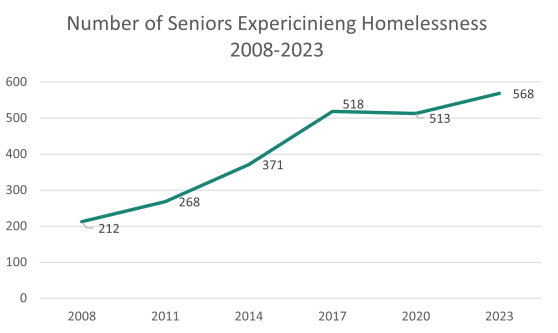
The report also showed a sharp rise in the number of homeless seniors.
Losing housing
Asked why they lost their housing most recently, the most common answer – given by 35 percent of respondents – was not enough income.
Other common reasons included addiction or substance use (24 percent), conflict with a landlord (16 percent), mental health issue (16 percent), conflict with a spouse or partner (15 percent) or a physical health issue (12 percent).
Part of the challenge in the Tri-Cities is, instead of appealing directly to one local government, homelessness advocates need to advocate to three municipalities.
“There’s not that direct accountability,” Macdonald said. “We often get caught in this part and parcel situation in the Tri-Cities where everyone is looking to everyone else to act. What this tells me is everyone needs to act.”
About the count
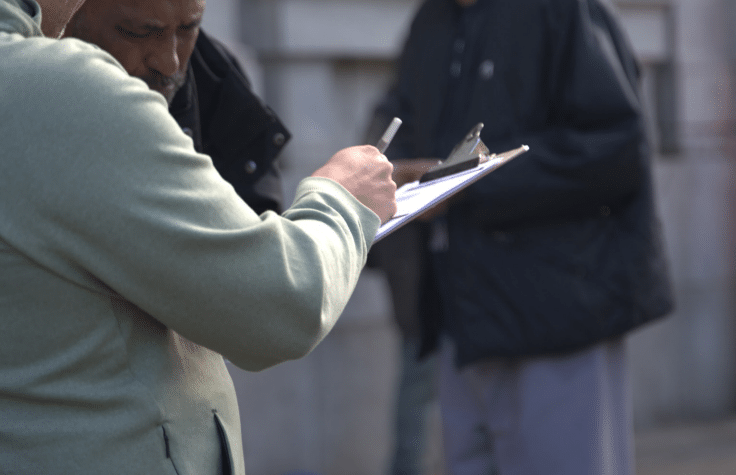
The count was conducted on March 7 and March 8 at shelters, transition houses, safe houses, hospitals, and police holding cells.
The final count represents the “absolute minimum number of people who are experiencing homelessness on the specific day of the count.”
Small gifts, such as cookies, were given to people experiencing homelessness to help start the conversation.
Author