Port Moody council approves $2-million project to link up bike lanes to Guildford Way Greenway, despite traffic concerns
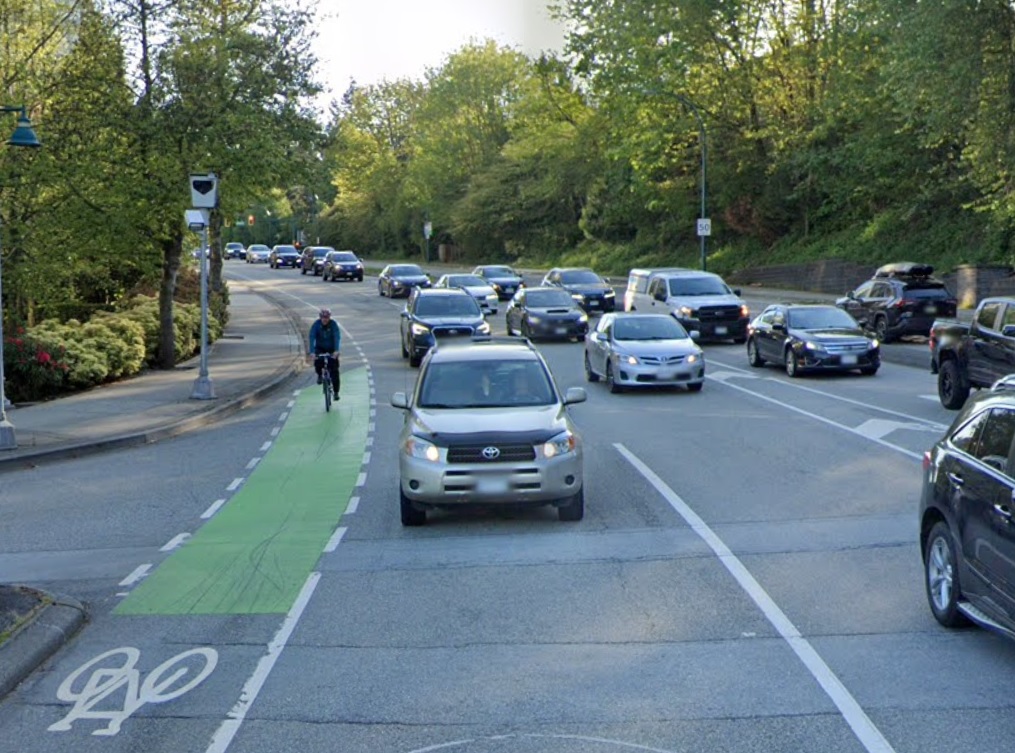
A major shakeup is coming to Port Moody’s busiest intersection.
Port Moody council has voted to move ahead with a long-debated plan to install protected bike lanes along Guildford Way, approving staff’s recommendation on Sept. 9 to advance the project into detailed design.
The decision will close a major gap in the regional cycling network by linking Port Moody’s section of Guildford Way with Coquitlam’s newly built Guildford Greenway. It also authorizes a pilot on Murray Street to relocate bi-directional bike lanes onto the road, removing a vehicle lane to address pedestrian–cyclist conflicts near the CP Rail crossing.
Local news that matters to you
No one covers the Tri-Cities like we do. But we need your help to keep our community journalism sustainable.
The plan is projected to significantly increase delays, raising concerns over wait times, queuing, and public backlash.
“There will be some growing pains,” said Mayor Meghan Lahti. “For us, the main objective for this needs to be safety. . . . We’ve been shown this intersection is very dangerous for pedestrians and cyclists.”
The city originally intended to approve the plan in November 2024, but decided to hold off on greenlighting the project until the changes could be tested through a detailed traffic micro-simulation.
Traffic impacts and modelling
The report showed that all four left-turn movements at the Guildford Way, Murray Street and Ioco Road intersection – which are to be re-timed and signalized – will see increased delays once the bike lanes are installed:
- Eastbound traffic turning left is projected to face an additional 35 seconds during the morning rush
- Westbound traffic turning left could see delays up to 40 second during morning and evening peaks
- Southbound traffic turning left will be slowed by up to 60 seconds during the morning, and up to 40 seconds in the afternoon
- Northbound traffic turning left is expected to experience the steepest increase, with an extra 70 seconds in the morning peak, though the delay drops to just 10 seconds in the afternoon
The removal of the channelized right-turn lane from Murray Street onto Ioco Road is also expected to cause significant delays. Wait times are expected to increase from around seven seconds to two minutes during peak evening hours, with queues potentially back up all the way to Capilano Road.
One of the most significant changes from the original proposal is the retention of Ioco’s southbound right-turn slip, as the simulation showed that removing it could cause traffic to queue up past Newport Drive.
Jeff Moi, general manager of engineering and operations acknowledged the trade-offs, but said the city receives frequent complaints about near-misses involving pedestrians.
“Unfortunately, there’s always trade-offs,” he said. “What we’ve sort of brought back is a bit of a compromise with trying to still maximize those main movements, but unfortunately, there are going to be some impacts.”
Support rooted in safety
For several councillors, safety tipped the balance.
According to ICBC crash statistics, the intersection is the second most dangerous in the city; between 2016 and 2022, more than 200 collisions resulted in 81 injuries.
Coun. Haven Lurbiecki said the dangers of the intersection needs to be addressed, stating she has witnessed “near misses almost weekly” at the intersection.
“When you balance it out with the safety piece, and you see all the data in front of you, it really doesn’t feel like a choice here,” she said.
She added that broader growth pressures from development – such as 2,800 new parking stalls at the Coronation Park development –mean traffic concerns need to be addressed at a systemic level.
“If we’re so concerned about traffic in our city that I don’t get our plans to double our population,” Lurbiecki said. “We need to make different decisions around growth and development in our city to really get to the root causes.”
Coun. Amy Lubik said a summer trip to the Netherlands underscored the importance of separated infrastructure.
She said the academic literature consistently shows that having protected bike lanes protects not only cyclists, but pedestrians and car users.
“We are seeing (transportation) mode shifts in Port Moody, and to really expedite that and make people feel safe is a priority for council,” Lubik said. “I know we get a lot of complaints about traffic in Port Moody, but the more we can get people out of their cars, the less people are in traffic.”
Coun. Samantha Agtarap said the move supports the city’s climate and sustainability goals, noting that vehicles are one of the top two sources of emissions regionally.
Mayor Meghan Lahti agreed, emphasizing the project as part of a wider shift toward multimodal transportation.
“These expanded bike lanes are going to promote cycling,” she said. “No, people aren’t necessarily going to get out of their cars to go commute to Vancouver, but it’s going to create opportunities for a decrease in the reliance on vehicles, and a safe way for people to get around.”
Coun. Diana Dilworth said vehicular wait times cannot take precedence over pedestrian and cyclist safety.
She warned about the “awkward transition” for cyclists at the Coquitlam boundary, noting that three of the bike-lane dividers have already been flattened by vehicles.
Dilworth also added that council has supported legalization of e-scooters and e-bikes, and now must support the required infrastructure.
“It’s not enough to put those out in the community and say, figure it out for yourself,” she said. “So people driving have to wait longer. Well, guess what? That doesn’t mean we leave cyclists and pedestrians in unsafe positions, or we prioritize vehicular traffic over pedestrians.”
Reservations over delays
Other councillors voiced stronger reservations.
Coun. Kyla Knowles said she appreciated the improved modelling but questioned its limited scope, warning that delays at Ioco could ripple into intersections at Barnet Highway.
Though she eventually supported the changes due to safety considerations, she noted the resulting impacts to wait times are worse than those predicted in Coronation Park’s traffic study.
“We’re looking at some service levels that are dropping from an A to F (grade) . . . I honestly wish that what was being proposed tonight was a pilot,” Knowles said. “I actually think these changes may be more devastating to traffic in our city than any development.”
Coun. Callan Morrison, the sole vote against the project, argued the projected wait times were unacceptable, and will affect other key intersections in the city.
He noted that the removal of the Murray Street’s eastbound slip lane onto Ioco Road will increase delays at peak times by 1,500 percent.
“Our residents have said time and time again that traffic is one of, if not the top, grievances that they have with the city,” he said. “At what point does the endeavor to increase safety actually decrease it?”
Morrison argued that the city had not looked at all potential solutions. He later told the Dispatch that the scope of the report didn’t consider connecting the bike lane to Guildford via Ungless Way, which would have added 250 metres to its total length, but would have been an easier transition.
“Staff didn’t find out that the road wasn’t wide enough until after they came back with the first report, which forced them to do a bi-directional lane,” he said. “People now have to cross the road in order to be able to merge back into those two uni-directional lanes in Coquitlam.
“Avid cyclists aren’t going to wait at an intersection to cross the street. They are just going to continue on the road because the delay doesn’t make sense.”
Next steps
Council’s approval allows staff to proceed with final design work. The project has $1 million in city funding and a $1.059 million TransLink grant, with further grant applications expected.
Several councillors said the city needs to have a robust communication campaign before changes are made, which emphasizes the safety benefits that will result.
“We can’t just have our residents wake up one morning, get in their cars, get down to the intersection and go ‘Whoa!’” Dilworth said.
Author