Province, Tri-Cities, clash over supportive housing ‘quagmire’ as pressure mounts on 3030 Gordon shelter
‘It’s really nice for Port Moody to send me letters to say that I should declare housing as a human right, but there’s an onus on the local government that writes that letter to also treat it as a human right.’
A political stalemate over supportive housing has emerged between the province and the Tri-Cities.
Neither Port Moody nor Port Coquitlam appear interested in offering municipal land to the province to open new facilities and relieve the pressure on Coquitlam’s troubled 3030 Gordon Ave. facility, according to Minister of Housing and Municipal Affairs Ravi Kahlon.
“We have a quagmire,” Kahlon said. “We’re in a situation where everybody wants to complain that there’s homeless folks, but nobody wants to step forward and be a part of the solution.”
Local news that matters to you
No one covers the Tri-Cities like we do. But we need your help to keep our community journalism sustainable.
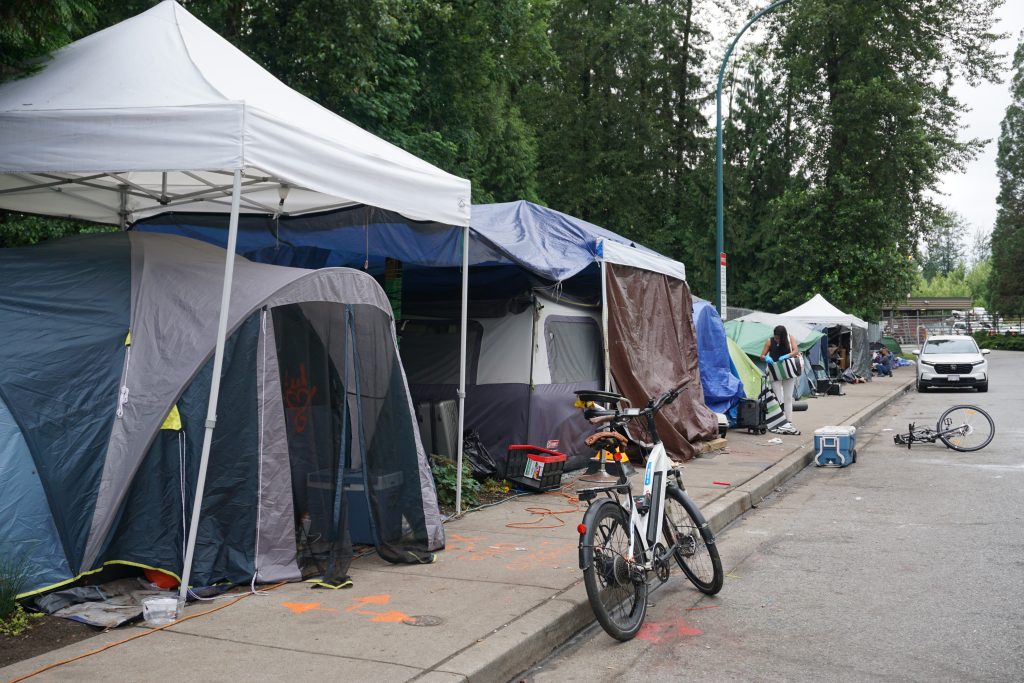
Coquitlam’s facility – the only supportive housing facility in the Tri-Cities – opened more than a decade ago and is well beyond capacity, surrounded by a homeless encampment and plagued by well-documented safety issues.
The city released an independent review of the facility in 2024, which described frequent drug use, vandalism, threats, frequent staff turnover and declining public confidence. Police officers and firefighters were called to the site more than 800 times in 2024, and city councillors have regularly criticized the province for the state of the facility.
Last week, local bylaw officers were ordered to begin dispersing the encampment during daylight hours, an action that led to criticism by some advocacy groups.
Kahlon said the main issues at the site stem from the encampment, which is a direct result of capacity issues. The solution, he said, is getting more supportive housing built.
But despite the province having money and resources ready to commit to new projects, he said both Port Moody and Port Coquitlam have failed to identify viable locations.
Kahlon described the impasse a “frustrating experience.”
“Until we get people with a roof over their heads, we’re not going to be able to address the challenges that we have in the area and the region, quite frankly,” he said. “If you’ve got people that are sleeping in tents and outdoors, it’s hard to give them the supports that they need.”
Port Moody council has frequently voiced support for housing first policies during discussions on homelessness and the toxic drug crisis. Just last month, council unanimously voted to send a letter to Kahlon, urging him to declare housing a human right.
But in recent months, council rejected a proposal to build a 40 to 50-unit supportive housing facility adjacent to the Port Moody Police station on St. Johns Street.
“It’s really nice for Port Moody to send me letters to say that I should declare housing as a human right, but there’s an onus on the local government that writes that letter to also treat it as a human right,” Kahlon said.
Kahlon noted that negotiations with the Port Coquitlam council are also “going nowhere,” and that Coquitlam has no interest in any more supportive housing until neighbouring municipalities step up.
He said that until there is some consensus among Tri-Cities mayors, it will be hard to move forward with a solution. “Everyone’s happy to point fingers,” Kahlon said.
Two letters penned by Kahlon to Port Moody council urging them to reconsider their rejection were recently released by council to the public on June 24.
Coun. Kyla Knowles was outspoken in her opposition, and laid out the council’s decision in a statement, which she later posted to social media following the meeting.
“I’m not sure why then, in these letters, that Minister Kahlon persists in telling us that we’re not doing enough,” She said. “We are already doing our part and have clearly informed his office that the answer is no.”
Knowles cited affordable housing that has already been approved through private development, including 60 units of women’s transition housing; strong opposition from the Port Moody Police Department; limited public land needed to facilitate future growth; close proximity of an incoming daycare facility; and the ongoing difficulties at the 3030 Gordon Ave. facility.
Similar arguments have been made by other Tri-Cities municipalities.
Coquitlam Mayor Richard Stewart chimed in on the councillor’s post, stating the province had failed to live up to its service commitments at the 3030 Gordon Ave. facility, and that he regretted supporting its approval.
“It’s hard to blame (Port Moody),” Stewart later told the Dispatch. “If the province could demonstrate that it will keep its commitment this time, then it might be different. Perhaps the province has burned that bridge.”
Knowles, Stewart, and Mayor Brad West of Port Coquitlam have also all taken issue with the provincial housing model, which requires municipalities give up public land in order to facilitate construction of new supportive housing facilities.
They said the province is the largest public landholder in their jurisdictions. Meanwhile, municipalities are facing fiscal challenges and their inventories of public land are extremely limited.
For instance, Knowles pointed to approximately 20 acres of provincially owned land adjacent to Eagle Ridge Hospital. While she acknowledges the hospital needs to grow, she said the Port Moody Police Department faces the same issue and has much less space.
West noted the largest municipal land holding in Port Coquitlam, the South Shaughnessy lands, is subject to a land claim and litigation. Apart from that, he said all the city has to offer are “incredibly small, basically orphaned lots.”
“If they were really interested in moving forward on this, they would utilize provincial land,” West said. “One of the hesitations that municipalities have in handing land over to the province, undoubtedly, is there’s not a very good track record for operating that type of housing.”
Stewart and West both suggested the 244 acres of provincially held land available at the site of the former Riverview hospital is the prime location for supportive housing.
The former vice president of Riverview wrote a report to council more than a decade ago suggesting one of its facilities be used for treating addiction and mental health, according to Stewart. “That would be hundreds of beds right now,” he said.
He fundamentally disagreed that local governments should provide land for housing. It’s a model he characterized as essentially subsidizing the provincial delivery of healthcare services.
“We need to accept mental illness and addictions as medical issues,” Stewart said. “Local government doesn’t deliver medical services – that’s a provincial responsibility.”
Kahlon, however, disputed the notion local governments have no land to offer, stating provincial staff have canvassed their inventories at length.
It’s a matter of political will, according to Kahlon, who said other cities with homelessness and encampment issues have taken action to get supportive housing built. He cited the City of Kelowna building more than 160 units within a year, Prince George built 180 units, and Nanaimo has 154 units all opening this month.
Kahlon also took issue with Knowles’ comments on Bills 13 and 15 – two recently passed pieces of provincial legislation – which she warned were “a direct threat to municipal autonomy” in her social media post.
She, along with some housing experts and former policy makers, have claimed the new legislation could be used to usurp municipal control over land-use decisions.
“Will this municipality be forced to accept a permanent supportive housing development on one of our sole remaining undeveloped pieces of public land?” Knowles said. “Heads up, Port Moody. We should be very worried.”
Kahlon dismissed these concerns, stating the bills have nothing to do with supportive housing and are intended to fast track critical infrastructure like hospitals and schools.
“Coun. Knowles is either purposely trying to mislead the public or has grossly misunderstood what those bills are,” he said. “I certainly hope it’s just being misinformed.”
The minister added that the province is asking Port Moody to reconsider the St. Johns Street proposal as it’s the only viable option put forward to date. He said the council’s only other suggestion has been to provide land for seniors housing.
“If it’s not that location, I’m open to any location they want,” he said. “Tell us where, because we need to do something.”
The Tri-Cities homeless population has grew by 86 percent between 2020 and 2023, according to Greater Vancouver’s 2023 Point-in-Time Homeless Count.
Author