Coquitlam cracks down on 3030 Gordon Ave campers, orders them to disperse during daylight hours
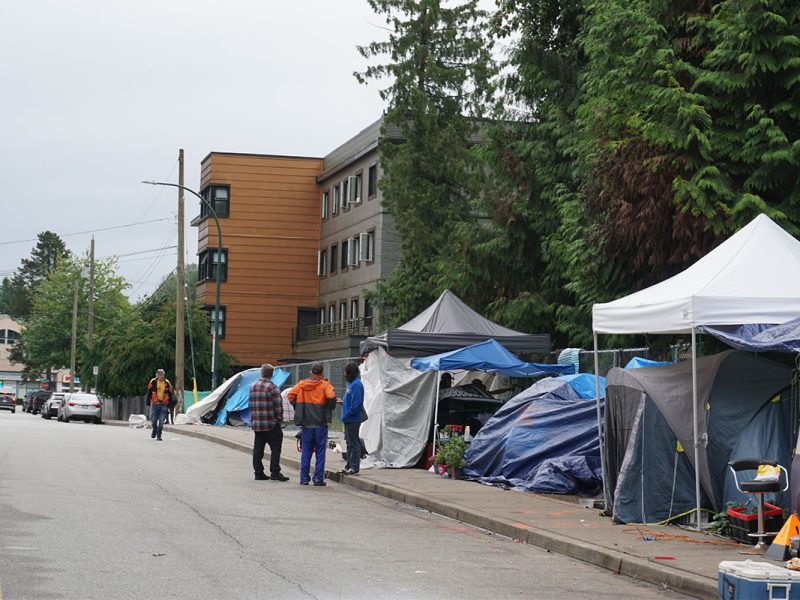
The City of Coquitlam wants its largest homeless encampment to be invisible – at least during the day.
Coming into effect Thursday, a new enforcement order expects that every morning, the 20 or so unhoused residents camped outside the supportive housing facility at 3030 Gordon Ave. will dismantle their tents, pack up their personal belongings by 8 a.m. and not return until 9 p.m.
The order, which was distributed to camp residents a week ago, is being enforced by municipal bylaw officers, with support from the Coquitlam RCMP.
Local news that matters to you
No one covers the Tri-Cities like we do. But we need your help to keep our community journalism sustainable.
One long-time resident, Maggie Moudatsos, said she can’t leave because of her health difficulties. She said residents risk having their possessions thrown away if they do not comply, but she said she will refuse to leave.
“Where are we supposed to go? There’s not anywhere else for us,” Moudatsos said. “I don’t want to be like this anymore. I want to find rental housing. No one will rent to me.”
The enforcement crackdown is meant to address ongoing and serious safety concerns at the site, including fires, unsanitary conditions, violence and drug-related incidents.
Issues at the supportive housing facility, run by RainCity, have been well documented, and were chronicled in an independent review released by the city in 2024.
Coquitlam’s police and fire departments responded to over 800 calls at the location in 2024, draining city resources and hampering other services
City council has frequently voiced frustrations with the province for its lack of action towards providing wrap-around services at the facility.
Mayor Richard Stewart recently stated on social media that the province committed to provide such services to ensure encampments and street-level disorder would not occur.
He said he now regrets his support for approving the shelter.
“I have repeatedly urged the province to keep its commitments, so that 3030 Gordon doesn’t lose community support, or become the ‘bad example’ that other cities cite,” Stewart said. “Unfortunately, the province has not kept those commitments.”
Stewart added that what municipalities need are on-demand treatment for addictions and mental illness – both of which would fall under the province’s health-care responsibilities.
“After years of the province downloading more and more services on local governments without providing the needed resources, government has to stop asking cities to subsidize the delivery of provincial services like health care.”
The RainCity facility, opened in 2015, has 30 emergency shelter beds and 30 transitional supportive housing units. But local demand has outgrown its capacity, and Coquitlam has even fewer resources than it used to.
The number of people living on the street in the Tri-Cities is at an all time high, growing by 86 percent in the three-year period, according to Greater Vancouver’s 2023 Point-in-Time Homeless Count.
During the same period, a temporary shelter closed resulting in a loss of 30 beds, and funding cuts have resulted in the loss of outreach workers.
Regardless, some advocacy groups are raising serious concerns.
One local organization, Food Not Bombs Tri-Cities, has initiated an email-writing campaign calling for the city to halt the enforcement. Over 500 emails have been sent to the city, and a number of city councillors have been contacted directly.
The group argued the increased enforcement will put the vulnerable residents at greater risk of harm, including overdose, violence, and health crises.
“The only way to end homelessness is to provide homes,” said Benjamin Perry, Food Not Bombs member. “Unhoused residents told us this sweep will endanger their safety by isolating them in the margins and make them vulnerable to crime and continued evictions.
They can’t just pack up their home every morning at 8 am. ”
The group further criticized the city, claiming that it has not taken “any real steps” to increase shelter space.
Aaron Hilgerdenaar, Coquitlam’s senior manager of bylaw services, said the city is taking a “trauma-informed” approach, and they anticipate overnight sheltering will continue at the facility.
He said bylaws staff will be working directly with individuals to help with packing, moving, or safely storing their possessions during the day.
“This approach is gradual, respectful, and focused on support rather than strict enforcement,” Hilgerdenaar said. “Our intent is to reduce encampments and their associated safety risks. However, without expanded provincial shelter capacity and mental health supports, there is a risk of displacement to other areas.”
Hilgerdenaar added the city is working with BC Housing, RainCity Housing, Fraser Health, and other outreach providers to find available shelter spaces and support, but acknowledged that local shelter capacity remains “extremely limited.”
Moudatsos said she doubted the enforcement will lead to desirable results for the city, and homelessness will likely become even more visible.
“I know there are bylaw officers, police officers and (RainCity) employees who do not want to see us disbanded because of the consequences,” she said. “There will be more garbage all over town, more people seeing us all over town. We’re not here sitting on the curb with needles hanging out of our arms – we’re discrete.”
While not all the encampment’s residents are addicts, she said those who do use will lose their support systems, further increasing the risk of a fatal overdose.
“We help each other out when someone drops, we don’t just step over each other.”
Perry noted many of the encampment residents he’s spoken to have said they have been trying to get into housing, but that all the shelters are full.
He said that by building a concentrated camp close to services, they have created some stability in their lives.
“When they are camping alone, they get moved along by law enforcement or private landowners even more often,” Perry said. “So their lives are even more transient.”
Author