Port Moody council seeks pedestrian-friendly changes to Moody Centre’s design guidelines
Recalling design headaches at Suter Brook Village, some Port Moody councillors said Spring Street could be turned into a one-way street when it is redeveloped.
Design guidelines for the Moody Centre transit oriented area (TOA) were received by Port Moody council on Jan. 14, providing a vision for the streetscape in the rapidly densifying neighbourhood.
Council, however, sent the proposed plan back to the developer-funded team of architects and consultants to explore some pedestrian-friendly alterations.
Local news that matters to you
No one covers the Tri-Cities like we do. But we need your help to keep our community journalism sustainable.
Coun. Callan Morrison said he thought a two-way street would constrict the pedestrian experience, noting that council was trying to prioritize people over vehicle traffic.
“When you feel like you’re being shoved against the wall to walk down the sidewalk. . . . That’s a challenge for me,” he said.
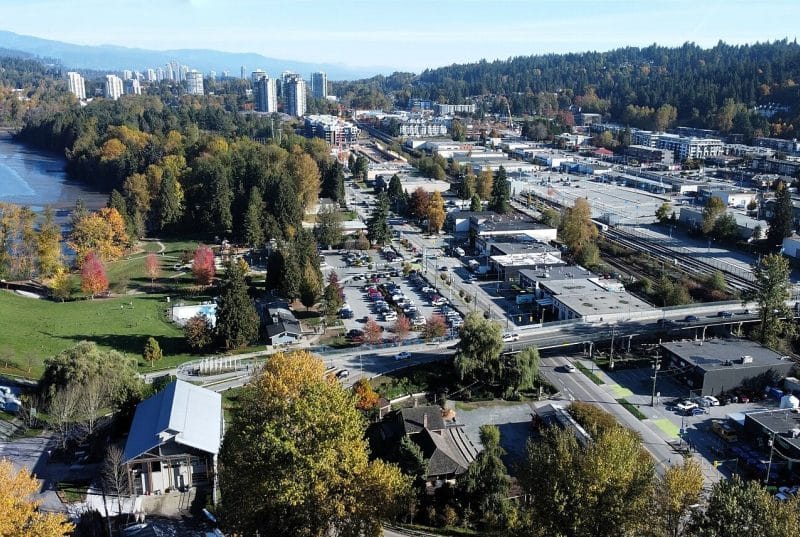
Moody Centre’ design guidelines are a component of the larger TOA framework passed in December 2023, setting out the city’s expectations for the area.
Its overarching goal is to create a pedestrian-centred public realm around the mixed-use developments planned at Moody Centre, giving each block its own identity while maintaining a cohesive design through common elements.
At the centre will be Spring Street, revamped as a prominent east-west corridor through the neighbourhood.
“It’s sort of like a series of gallery spaces,” said Cillian Collins, associate at design firm Perkins&Will. “The plaza will have a more urban character; the riparian areas will have a more recreation and ecological identity; the east and west side, it’s more of a family-friendly character.”
One highlight of the plan is to integrate greenspace with private lots, giving Spring Street the feel of a continuous park, according to Collins.
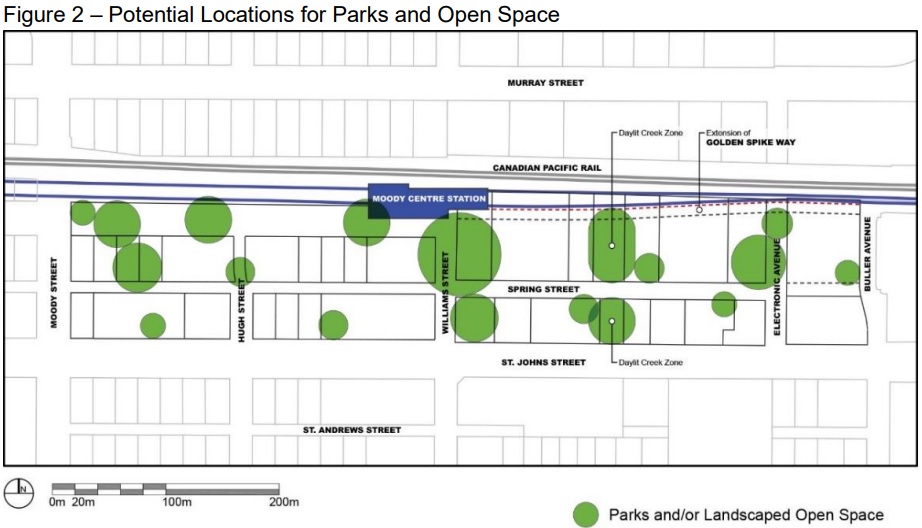
In response to Morrison’s suggestion, Jim McIntyre, a Port Moody consultant, agreed the road’s right-away width had been a challenge. He said there had been debates among planners over a potential Spring Street one-way, noting one-ways have been recommended in other sections.
But McIntyre said the space will still be cramped due to the amount of elements planners are trying to juggle, such as utilities and transit access.
“There’s a lot of forces that we’re sort of counterbalancing,” McIntyre said. “We don’t want to create a concrete canyon. We wanted to create something that’s livable and attractive down there, but there’s a lot happening in that 15-meter cross section.”
Morrison, however, pointed towards Suter Brook Village, which has had improved traffic flow and safety following its change to a one-way street.
Coun. Kyla Knowles agreed, stating that while she understood there are limitations, Port Moody needs to avoid a repeat of Suter Brook’s traffic management woes.
“I think it’s important that we learn from our mistakes,” she said. “We have this vision of almost like a Gastown with cobbled streets and one-way traffic. . . . So I hope we see something closer to that going forward.”
McIntyre warned that it would be a dramatic change to their approach, forcing the design team to rejig engineering and streetscape guidelines, which might come with added costs to the city.
Morrison said he was okay with additional expense “as long as we get it right,” noting the TOA had a 40 to 50 year build-out timeline.
Mayor Meghan Lahti agreed.
“The alternative is to do what we did farther west, and build a two-way street and then turn it into a one-way street after the community comes in an uproar and demands that something be done,” she said.
However, Lahti also cautioned against giving direction around engineering items, stating staff need to be given time to investigate whether a one-way is even feasible.
Other alterations council requested include adding public washrooms, mitigation of urban heat island effects, stepped back tower podiums, larger trees and green roofs, dementia friendly guidelines, and the removal of hostile street architectural features.
Coun. Amy Lubik said council has been discussing the lack of public washrooms in Moody Centre for years, arguing the language in the design guidelines were not strong enough.
“I always get nervous when we say that they’re suggested instead of saying we require them,” she said.
While Lubik was generally supportive of the guidelines, she raised concerns over benches that would prevent a person from lying down. She noted the 2021 Housing Task Force Report recommended no hostile architecture features be allowed in the city.
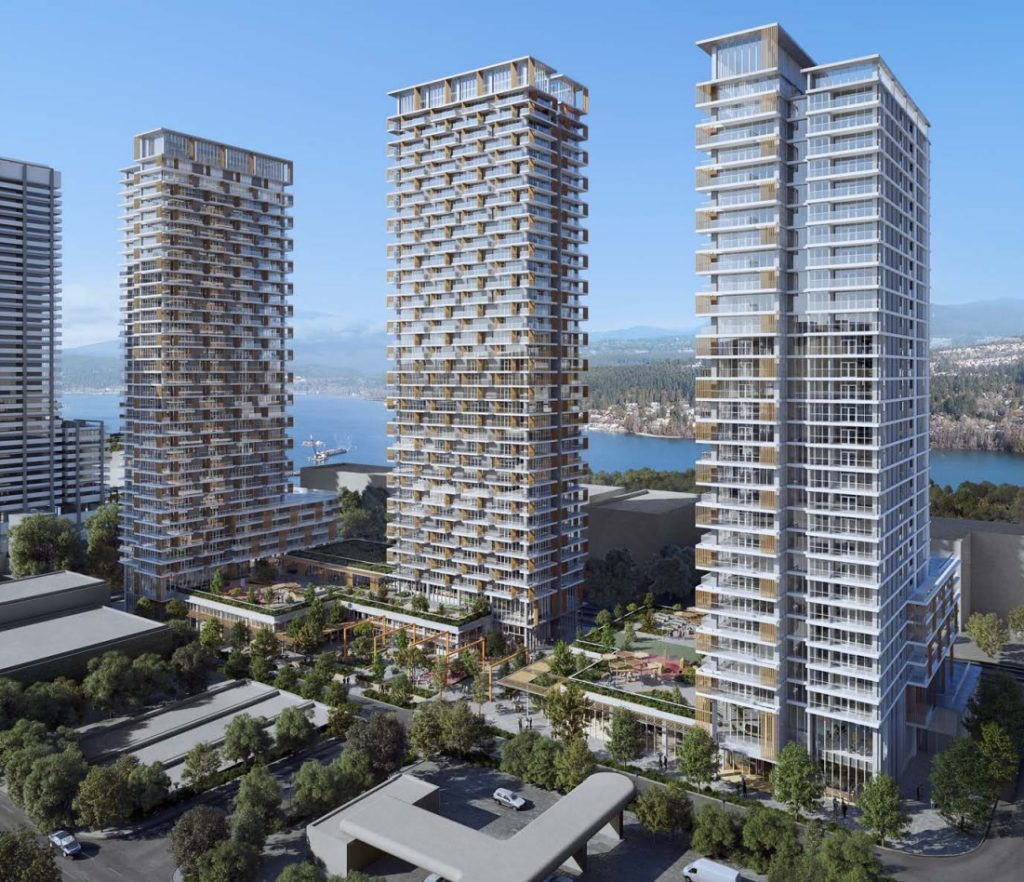
The first two applications for Moody Centre – five towers from PCI Developments and Beedie Living – are headed to a public hearing in early 2025.
Lahti said it was “absolutely imperative” for the city had the guidelines in place to ensure “consistency, continuity and a cohesive identity.”
Author