Coquitlam mulls future of childcare after losing best tool in the box; province says city faces ‘no impediments’
In 2021, Coquitlam council enthusiastically endorsed the city’s new childcare strategy.
When paying the city extra cash for height and density, developers would also be tasked with either providing childcare or paying into the city’s childcare fund.
“The framework is there. We can hit developers over the head,” Coun. Brent Asmundson said at the time.
Local news that matters to you
No one covers the Tri-Cities like we do. But we need your help to keep our community journalism sustainable.
On Monday, council was contemplating what they can hit developers with now that the former framework has been altered by the province.
“We have relied so heavily on the development community,” noted Coun. Craig Hodge.
Going forward, it will be a major challenge to approve new housing without a mechanism to provide childcare, Hodge noted.
“It would not be too concerning to me if we slowed down the development for a while,” he said. “The last thing I want to see is to build a whole lot of housing without . . . the childcare that’s needed to go with it.”

The city generally granted developers an extra three square metres of residential density in exchange for one square metre of childcare space, explained Coquitlam’s general manager of planning and development Andrew Merrill.
“We may need to reconstitute what an incentive looks like,” Merrill said.
The province has essentially, “taken away the tool we could’ve used, which is bonus density,” said Mayor Richard Stewart.
Coquitlam will be able to pay for childcare through Amenity Cost Charges, a new tool included in recent housing legislation, according to a message from the Ministry of Housing to the Dispatch.
Money collected through ACCs can pay for a variety of municipal needs, including not-for-profit childcares. The cash can also support private childcares so long as they have a partnering agreement with the city, according to the ministry.
That emphasis on not-for-profit childcare could complicate matters for the city, according to Coun. Robert Mazzarolo.
“We just want the spaces, where it appears that the province is more concerned about the ideology on how you deliver the spaces,” Mazzarolo said.
“The expansion of [$10-a-day childcare] and the delivery of it is not going to keep up with the demand,” added Coun. Dennis Marsden. “Let’s not shut out a portion of the marketplace that has done a good job for decades.”
New provincial housing rules mandate that cities allow dense development in the 800-metre radius around SkyTrain stations and other rapid transit hubs. The buildings closest to the hub can be at least 20 storeys with building heights tapering to eight storeys on the outskirts of the radius.
The province is planning to update the rules for those transit-oriented developments. Those updates should help Coquitlam and other municipalities keep using density bonusing while making the transition to ACCs.
“The Ministry has made it clear to Coquitlam that there are no impediments to them to continue to approve housing projects and fund amenities,” according to the ministry.
But while large development applications could be leveraged to create childcare, there’s no similar mechanism for smaller projects, Mayor Stewart noted.
The new provincial legislation allows for between three and six units on most single-family lots, depending on the size of the lot and its proximity to transit.
“Our main tool is new development that’s large enough,” Stewart said. “Obviously, the small-scale new development that the province has proposed could end up making this worse.”
In the last few years, four new development projects contributed 280 new childcare spaces.
The majority of developers opted to pay into the city’s childcare fund as opposed to provide space. A total of 14 developments included a cash contribution, which added up to approximately $1.2 million added to the city’s childcare fund.
“The $1.2 million that we have now in that fund, that doesn’t go a long way to leveraging us childcare spaces,” noted Coun. Brent Asmundson.
Serving geography
The city’s development pipeline includes six developments set to supply a combined 574 childcare spots. Approximately 1,942 children are expected to live in those six developments.
With the exception of one project near the Coquitlam Crunch, the developments are generally grouped around Burquitlam and Coquitlam’s City Centre.
As Burke Mountain grows, getting enough childcare could be a challenge, noted Asmundson.
“How do we get childcare spaces into mid-rise, particularly townhouse developments?” he asked on Monday.
Among neighbourhoods, access rates tend to be the lowest for school-aged children. The rates range from a high of 21.6 per 100 children in Central Coquitlam to lows of zero in Hockaday Nestor and 8.6 in City Centre.
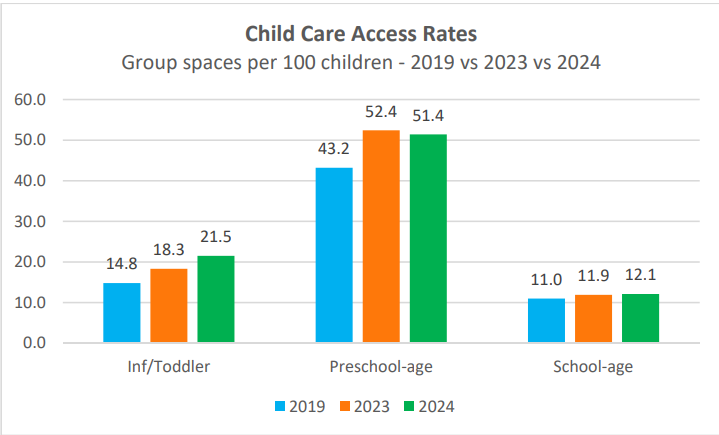
“There’s still a lot of issues of trying to find childcare spaces in that infant/toddler range,” Asmundson said.
According to the most recent data – which includes Census 2021 population figures and current childcare numbers – the city has 5,185 childcare spots for 18,900 children.
Coquitlam has added 486 childcare spaces since 2019.
- For children three and younger, there are 19 spots for 100 children.
- For preschool-aged children: 55.3 spots for 100 children.
- For school-aged children: 12.5 spaces for 100 children.
City staff is set to draft a letter to the province outlining the city’s childcare concerns for council’s approval.
Author