Greater Vancouver real estate sales 17 per cent lower than last year
August housing sales in Greater Vancouver dipped by nearly a fifth, compared to the same time last year.
This could be because of higher mortgage rates (and therefore higher borrowing costs) said Andrew Lis, the director of economics and data analytics for the Real Estate Board of Greater Vancouver.
“It’s really been kind of a quieter summer than we’ve normally seen,” Lis told the Dispatch in an interview.
Local news that matters to you
No one covers the Tri-Cities like we do. But we need your help to keep our community journalism sustainable.
But he added that the Bank of Canada — which has cut its interest rate a few times in the past months — has signaled that it wants to continue lowering it.
“And that means affordability, in the form of borrowing costs, is likely to improve over the next year or two.”
Lis said that there has been increased inventory in Greater Vancouver, including the Tri-Cities, “To actually what I would describe as fairly healthy levels.”
This is because sales are slower than what they’d normally be, which has allowed inventory to grow.
While the sales numbers didn’t fluctuate as dramatically in the Tri-Cities — Port Coquitlam saw a zero per cent change year-over-year, Port Moody a 5.3 per cent increase and Coquitlam a 1 per cent increase — Lis said it is due to the smaller sample size.
“As a market total, when you aggregate all these things up, like add them all up, a much bigger sample, and so the data is a little less noisy when you have a large sample” he said.
For example, Port Moody sold six detached homes in August.
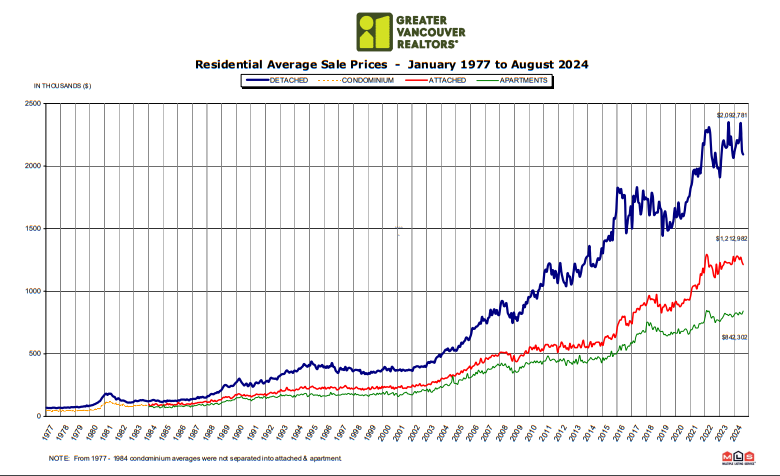
Housing prices have skyrocketed in the last decade. Port Coquitlam has seen a 155 per cent increase in price for a single family detached home; Port Moody 147 per cent; Coquitlam 138 per cent.
Lis said this is a very complex story, but that the “really simple cole notes version is there just aren’t enough houses for sale, relative to the number of people who want them.”