Métis craftsman carves his own path, with some help from his ancestors
Métis artist Pat Calihou will be teaching the historical significance of carving at the Coquitlam library’s Poirier branch this weekend
Inside his makeshift workspace, a tent large enough to hold a boat, Pat Calihou needed some answers from his great-great grandparents.
Skylight filtered through holes in the tent, casting a light on the giant wooden structure that looked like it was coming to life. Beige and cherry-brown sawdust collected in piles on the concrete floor. There was a stack of wood on the outskirts of the tent.
Roughly four years ago, Calihou, a Métis craftsman now based in Maple Ridge, built a York boat replica by hand to honour his ancestral heritage at the Fort Langley National Historic Site.
Local news that matters to you
No one covers the Tri-Cities like we do. But we need your help to keep our community journalism sustainable.
York boats, a flat-bottomed bottom vessel featuring a sail and canoe-like points at each end, were traditionally used to transport goods during the fur trade.
Throughout the building process, however, Calihou questioned his ability to build the boat by hand, just like his ancestors did hundreds of years ago. Pieces of wood snapped when he tried to bend them into place and he lost confidence in his carpentry abilities.
But every time he questioned his expertise, Calihou stepped outside the tent and looked towards the sky, imagining that his ancestors were listening to him.
“It’s not working!” He shouted. “Help me, I know you did this, it worked.”
And inevitably, Calihou would find an answer.
“My ancestors were amazing. When I was building the boat, screaming their names out, they’d be like ‘just dump boiling water on it,’” Calihou said. “I’d be like, ‘all right!’”
Carving and working with wood has given Calihou a special connection to his ancestors.
Growing up, he felt a disconnect with his Métis past. His grandmother attended a residential school, and by the time she left, she didn’t teach Calihou’s father any lessons about their nation’s history — never speaking the language or reading books to him — which caused a gap in their family’s knowledge.
As Calihou grew up, about 20 twenty years ago, he found a steady income as a tire man, someone who inspected and fixed semi-truck tires every single day.
However, he felt no purpose in that job. And then seven years ago, he came across a video of a man who made a cedar canoe.
Calihou was hooked.
Through carving, he was able to learn more about his family’s Indigenous history, and create relics that could teach future generations about the knowledge he sought as a kid.
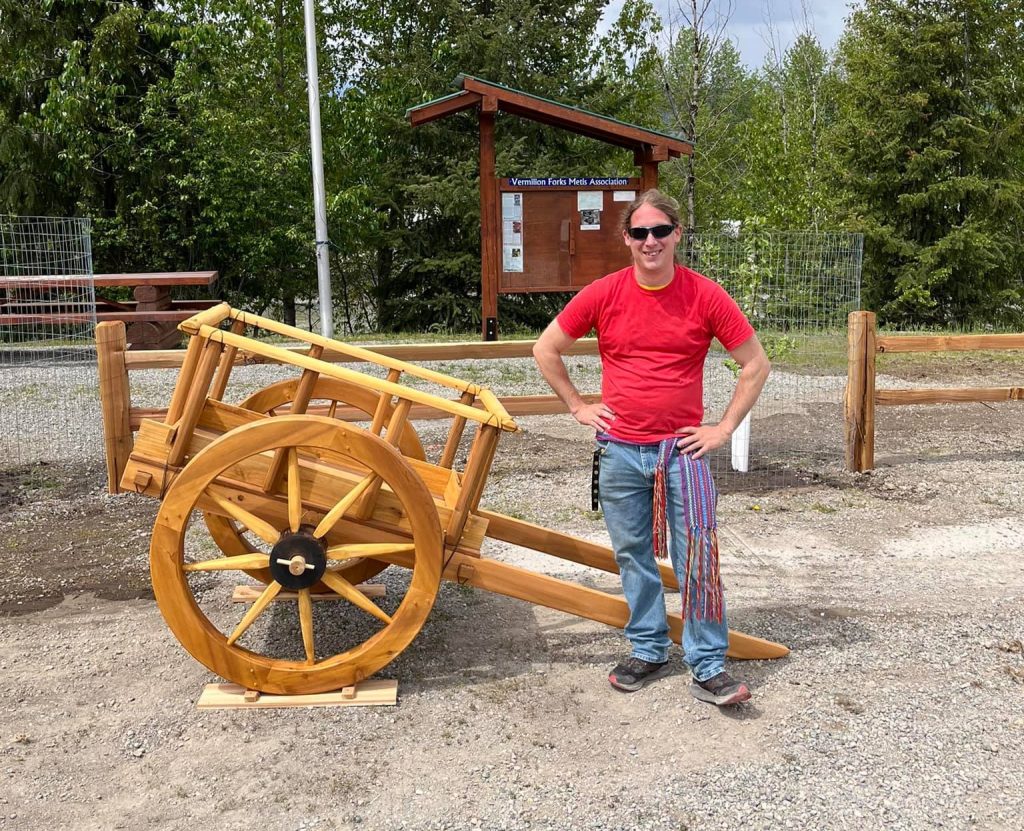
“In our lifetime, I don’t know how many York boats or red river carts are going to be built. Having things made by hand is special,” Calihou said. “I realized that if I just forgot [that knowledge] then it would totally be gone with me.”
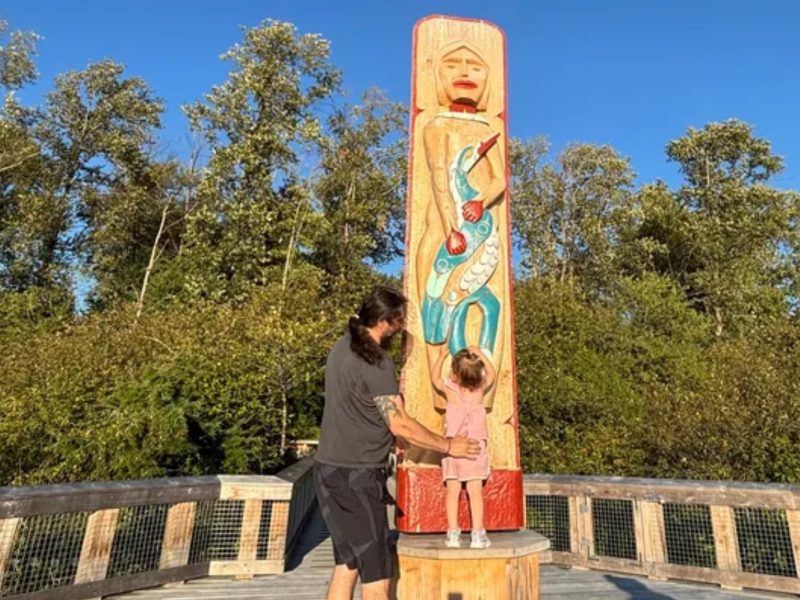
In nearly a decade, he’s carved paddles, carts and play pieces for children. The play piece, specifically, creates an organic way for Métis children to learn about their history, he said.
“Instead of saying, ‘In 1860 this happened,’ the kid can go ‘what does this mean’ by looking at a shape,” Calihou said.
He’s also held carving workshops at schools, prisons and universities.
This weekend, Calihou is hosting his latest session at the Coquitlam Public Library, Carving as Connection, where he will bring some pieces of artwork, talk about what inspired him to get into woodworking and the importance of his heritage.
As he shows his art, whether it’s a paddle or cart, Calihou said he hopes it will spark a larger conversation about the importance of culture and lineage — potentially inspiring folks to do some more research into their own family tree.
“I wouldn’t have known about a York boat until I read a book about my family,” Calihou said. “That was the biggest thing I could have made to memorialize them.”
The session is scheduled for 1:00 p.m. on Feb. 10 at the Coquitlam Public Library’s Poirier Branch.
Author