How human-made rock dams and pools can harm aquatic ecosystems
At the end of a workday, Port Coquitlam resident Laura Ellis often walks to the Coquitlam River to decompress and watch the wildlife — from fish, to beavers, to otters.
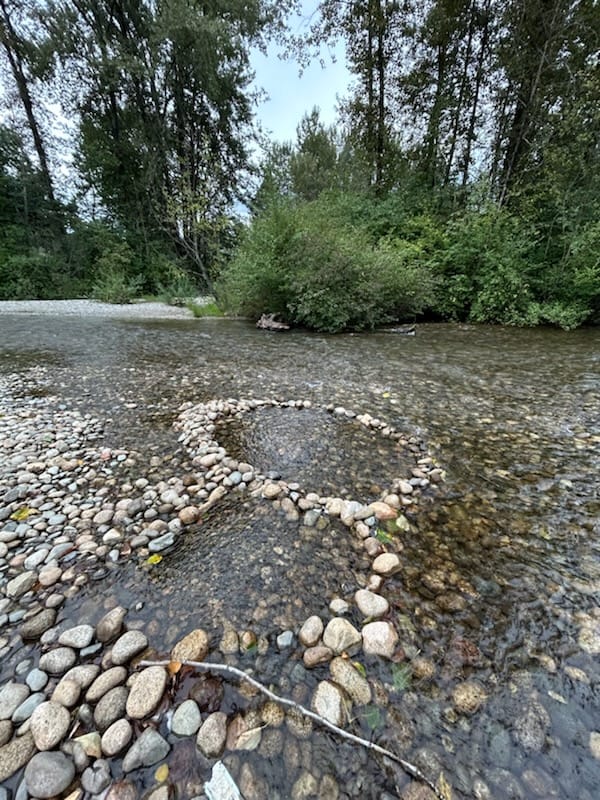
Lately, however, she’s been feeling irritated, not calm. For the past several weeks, she has come across human-made dams and ponds that fellow river visitors might have built for entertainment or aesthetic reasons.
No matter how pretty — or fun of activity — they might be, Ellis knows it disrupts the local ecosystem and salmon runs. She sees fish fry swimming in them, stuck.
Local news that matters to you
No one covers the Tri-Cities like we do. But we need your help to keep our community journalism sustainable.
Ellis has observed this trend over the past few years.
“During the pandemic, it got a lot worse, because everyone was down there [at the river]. But I would say this year, it’s been really bad,” she said.
“Especially in the downtown core area of the river.”
The impacts on the river
It is an issue that arises every summer, especially in urban areas like Port Coquitlam, according to Murray Manson, the section head of the Restoration Centre of Expertise for the feds Department Fisheries and Ocean.
Rivers and creeks are aquatic ecosystems. Algae, aquatic insects and other organisms live on the river bottom, providing food for fish and birds and up the food chain, he explained
“When you’re disturbing the rocks on the bottom, you can expose those organisms and disrupt their life processes,” he said.
This means that the river is less productive and healthy for fish.
Human-made structures could also impede migrating fish — an area that is a nice swimming pool in the summer might “suddenly become a barrier to fish migration,” Manson said.
These dams spread out water flow and create small steps that fish may not be able to pass.
Further, slowing down the water can also warm it up. If this happens all over the section of a stream, it can change its temperature.
“Salmon are very sensitive to water temperature, and they’re definitely cold water loving fish, so the less impact we can have on water temperatures, the better.”
Finally, salmon spawn in gravel. Depending where people build a structure, they might be impacting spawning habitat.
While the Fisheries Act has habitat-protection provisions that prohibit someone from making a harmful alteration, disruption or destruction of fish habitat, Manson says it would be hard to charge someone successfully for hand-moving rocks.
“The difficulty is sort of proving the extent of that harm.”
He encourages people who are concerned to call the DFO’s observe, record and report line.
Manson says there’s a place for local stewardship and taking care of the river. If people are familiar with a section of stream, and notice rocks have been moved, “I wouldn’t object to them reconfiguring it to the way that was,” he said
But he advises those unfamiliar with a stream section to leave it be and call the DFO line, as they could make it worse.
Local stewardship
Back at the Coquitlam River, Ellis and her husband have decided to take matters into their own hands: each day, they’ve been spending around an hour dismantling the rock dams and pools.
“I’m down here. I can take care of this,” she said.
They’ve noticed that people seem to take a lot of the rocks taken from the riverside, so they try and put them back where they belong.
She said she hopes that with education, people will realize the impacts that these structures have on the river.
“I love to be able to go down and see the beavers coming through, and watch the fish running when they do, and just the thought that something as small as someone building a rock dam could have such a massive impact on the future of that — it’s just such a simple thing not to do,” she said.
“Go enjoy nature, but don’t change it.”