Port Moody whittles down 2024 property tax increase to 6.6%
Port Moody council has managed to whittle down this year’s property tax increase by nearly two percent.
The average household will be paying 6.6 percent more in property taxes in 2024, down from the 8.37 percent increase proposed in December, 2023.
Council voted unanimously in favour of the new budget recommendations on March 5, which are scheduled to be officially approved in April.
Local news that matters to you
No one covers the Tri-Cities like we do. But we need your help to keep our community journalism sustainable.
“We have heard from our residents and business owners that the tax rate increase proposed at the beginning of our budget consultation process was too high,” stated Mayor Meghan Lahti in a March 7 press release. “We understand the economic pressures that people are facing, and so we want to do what we can to keep the increase as low as possible while maintaining service levels that help ensure our community is a vibrant and livable place for everyone.”
Port Moody property owners are facing the second straight year of significant tax increases, having absorbed a 9.29 percent increase in the 2023 budget.
In order to balance the budget, Port Moody will be collecting $58 million ($5.1 million more than last year) from its residents and businesses.
For the average household, it works out to approximately $188 more in 2024; including utility fees, property owners can expect to pay around $4,600 in total.
Paul Rockwood, general manager of finance, has said there were “unique challenges” this year associated with the increasing costs of inflation, transportation, construction, insurance, contractors and hired services.
Labor costs for salaries and wages, along with employee benefits have also increased, totaling $1.8 million for the year, which represents 3.46 percent of the total budget increase.
In addition, the city is transferring over $1 million annually to its reserves used to replace its critical infrastructure assets and implement its Climate Action Plan.
Some of the new funding requirements for the year include $75,000 towards the Mayor’s Arts and Business Coalition Task Force, nearly $124,000 to reinstate the Car Free Day event, and just over $86,000 to hire a new public art coordinator.
In addition, the Port Moody Police Department and Fire Rescue Service were both asking for around $270,000 in additional funding.
Reductions
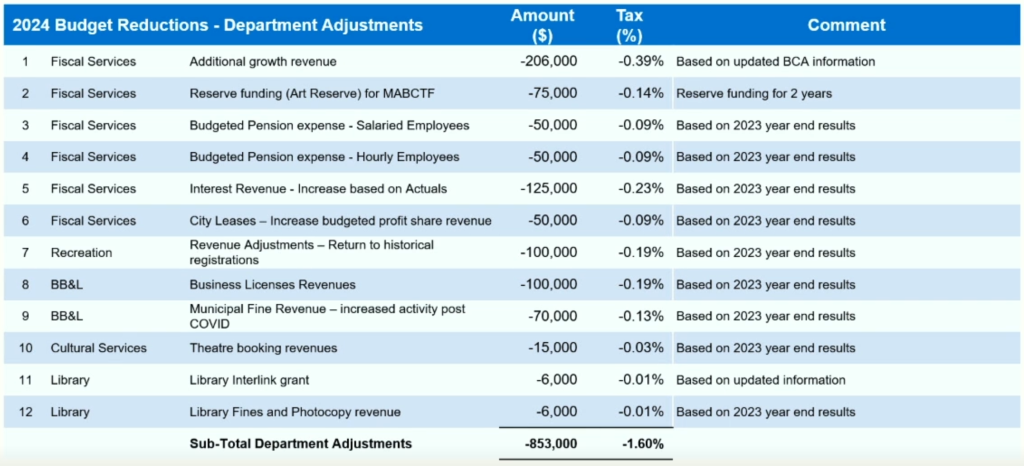

The 1.77 percent tax reduction was largely achieved through re-evaluation of year-end revenue projections by the finance department.
Rockwood said that staff review the city’s financial statements at the end of the year to see how revenues and accounts are performing, which resulted in significant saving of almost $1 million from the budget.
Fiscal services is realizing $206,000 more in growth revenue, $100,000 from pension expenses, $125,000 from its investment portfolio, and $75,000 from city property being leased in profit sharing schemes.
Following the recovery from COVID, the city’s recreational revenues are also performing better than expected, leading to another $100,000 to city coffers; it also anticipates seeing another $170,000 from business licensing and fines in 2024.
In city services budget, the annual Port Moody Community Fair is being folded into the Car Free Day event to shave $14,000 from the budget, while the Port Moody Police Board has also been asked to slash another $112,000 from its budget.
Lastly, funding for the Mayor’s Arts and Business Coalition Task Force has been shifted to reserves for its first two years of operations.
During deliberations, council unanimously voted to cut support for its pilot program permitting alcohol consumption in public parks.
Slashing the program will save the city around $36,000, which would have been used to fund additional staff hours to clean up significant waste left behind by residents.
Coun. Haven Lurbiecki first broached the idea, stating it was too much money to be spending considering the number of drinking establishments already located in the city.
While the pilot program was started with the best intentions, there have been “unintended negative consequences,” according to Coun. Diana Dilworth. “Unfortunately, some people will take a small allowance and make it quite large,” she said.
Mayor Meghan Lahti agreed, stating the program was initially started to stop people from gathering indoors during COVID, and it is not longer needed.
Closing comments
Dilworth said the Port Moody’s tax spikes over the last two budget cycles are the result of austerity budgets passed in 2020 and 2021.
She said recreational revenues were reduced, and a large number of events were shelved, noting she and Lahti continually warned about the costs of reintroducing events like Car Free Day.
“Every time you remove something from the budget, it’s going to come forward later,” she said. “Next year is going to be lower, it will not be as high as last year or this year.”
Lurbiecki, however, disagreed, stating that taxes will get worse if the city does not grow its industrial and business tax base and continues to rely on residential taxes to pay for services.
“We are tearing down those spaces to build luxury condos with the floor retail stores,” she said. “I fear that tax increases will become a norm over time.”
Lahti said that despite public surveys results which recommended cutting funding to cultural services, the city cannot undervalue the role it plays. “It just creates a real vibrant, livable city,” she said.
Lahti said the city will re-evaluate the art and business task force after its first two years.
She agreed Port Moody needs to diversify its tax base, specifically pointing to the Burrard Generating Station at the end of Ioco Road, which shut down in 2016.
“We really need to be pushing to bring something into that site that’s going to bring some tax dollars that are not residential,” Lahti said. “We need to be ensuring that development that comes in is providing those types of jobs and those types of spaces.”
Author