Coquitlam calls for better communication as water main work moves forward
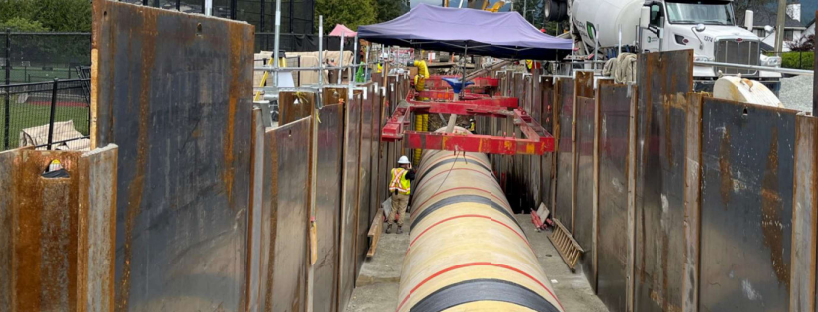
With another seven years of work on the docket, Coquitlam council urged Metro Vancouver to facilitate better communication with residents inconvenienced by water main construction.
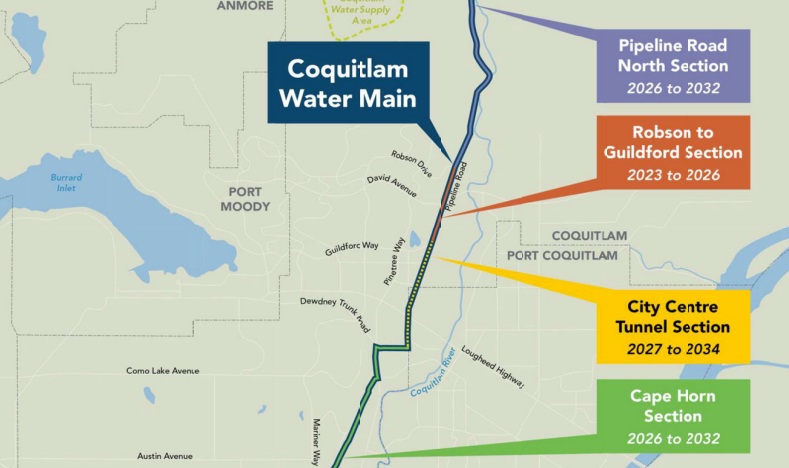
With the Robson to Guildford is set to be largely complete by end of the year, crews still need to snake the main farther north on Pipeline Road and under Coquitlam’s City Centre neighbourhood to Cape Horn. The entire project is tentatively set to wrap up in 2032.
While the worst effects seem to be in the rearview mirror, Coun. Matt Djonlic was critical of Metro Vancouver for the impacts on Coquitlam residents.
Local news that matters to you
No one covers the Tri-Cities like we do. But we need your help to keep our community journalism sustainable.
“We shouldn’t have been here in the first place. This is not Metro’s first capital project,” he said. “We cannot go through this again.”
In his opening remarks to council, Metro Vancouver’s director of major projects bob Cheng acknowledged the inconvenience.
“We know recent road closures and other traffic measures along Pipeline Road have been very impactful,” he said. “We’re making improvements to further reduce impacts to the community.”
Those improvements include weekly emails, web updates, emailed newsletters as well as a variety of “lessons learned” including minimizing road closures but maximizing construction during those closures.
Noting the community outcry associated with drilling and blasting, Coun. Trish Mandewo asked if there could be a specific advisory before that type of work takes place.
If there’s work with substantial vibration, “we do notify the residents,” Cheng said.
“I’ve never received one,” Mandewo replied.
The water main is a significant project, “and with it comes significant disruption,” said Coun. Craig Hodge.
A group of neighbours previously asked for a direct phone number, Hodge noded.
“Do we now have a direct number, as opposed to a general Metro Vancouver push 1, push 3, push 5?” he asked.
There is a direct number which is shared after that initial call, Cheng explained.
Hodge asked if that number was posted on workplace signs.
“We’ll look into it,” Cheng answered.
Responding to questions on the same topic later in the meeting, Metro Vancouver representative Cheryl Nelms said they are working to speed things up.
“The phone tree aspect is something that we’ve improved,” she said.
Both Hodge and Marsden discussed the importance of regular public meetings so residents can express their concerns directly to Metro Vancouver and the appropriate contractor.
Metro Vancouver handles the plans, but when, “excuse the pun, the rubber hits the road, it’s the contractor,” Marsden said.
A representative for the contractor will be present at those meetings, Nelms confirmed.
Discussing the issue earlier this year, Mayor Richard Stewart called for Metro Vancouver to work with their contractor to minimize rat-running.
However, Stewart acknowledged that Coquitlam was the bull’s eye in the region’s infrastructure dartboard.
“We recognize and embrace the reality of being pretty much in the centre of gravity of Greater Vancouver,” Stewart said.
Coinciding with the water main, Metro Vancouver is also planning to double the amount of water drawn from Coquitlam Lake.
The lake currently supplies about 370 million litres of water per day – about one-third of the drinking water needed by the region’s 2.7 million residents, according to Metro Vancouver. The expansion is set to be complete in the late 2030s.
Author