Port Moody to gauge ways to improve traffic on St. Johns Street as staff plans redesign
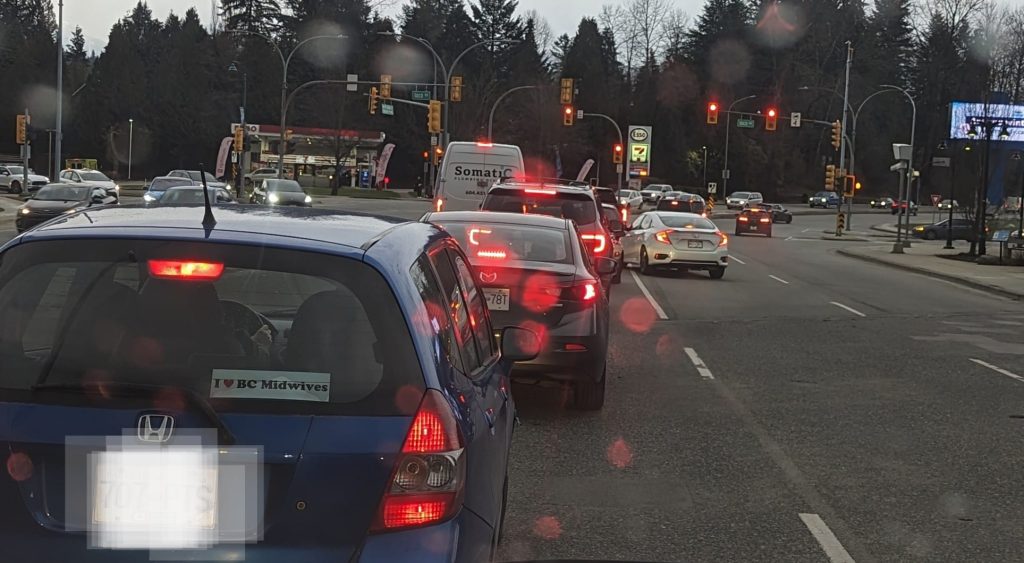
Port Moody will be gauging ways to improve traffic flow along St. Johns Street as they plan a redesign of the city’s overburdened main corridor.
Coun. Callan Morrison introduced a motion on Tuesday, March 12, requesting staff make additional considerations as improvements are planned for Barnet Highway, Dewdney Trunk Road and Ioco Road intersections.
“Our council has heard loud and clear,” Morrison said. “We need to ensure that we are doing everything we can to move traffic efficiently through our city, and that we go well beyond signal optimization and timing.”
Local news that matters to you
No one covers the Tri-Cities like we do. But we need your help to keep our community journalism sustainable.
Council passed the motion unanimously, though no one appeared confident that substantial improvements would result from the road design.
Traffic congestion has been a major complaint for many residents in the community, specifically, St. Johns Street’s eastbound lanes during rush hours.
Morrison said the issue has been stressed frequently by the public in emails to council, adding the issue was also a major theme during Port Moody’s recent budget survey, where respondents asked council to prioritize investments for improving traffic.
The motion coincides with city staff planning active transportation routes, multi-use paths, and safety improvements within the St. Johns Street Redesign Phase 2 Project.
There are further opportunities for traffic flow improvements from Moody Street to Ioco Road alongside this redesign, according to Morrison’s motion.
Morrison said that while the city does not have control over regional growth, provincial pressure to densify, or the number of vehicles travelling on St. Johns Street, it needs to do as much as possible to ease traffic when road improvements are considered.
Since the redesign project is slated for discussion at the city’s transportation committee this July, additional improvements could be integrated into staff’s work plan, Morrison said.
Staff confirmed the request was compatible with ongoing projects, including the update to the city’s Master Transportation Plan (MTP), and could be added at little expense.
No magic pill
Morrison cautioned, however, that any potential improvements would not be a “magic pill” for the city’s traffic woes.
He said the current MTP notes more road capacity simply attracts more traffic, as drivers look for the route of least resistance.
“Any improvements we do, whether it’s lane adds or whichever, they will eventually fill up over time as growth happens and we’ll be in the same situation,” Morrison said.
Couns. Samantha Agtarap and Amy Lubik both said road improvements won’t fix the issue, stating the solution is prioritizing transit and active transportation routes to get more cars off the road.
“Traffic isn’t like water, traffic is like a gas. If you add more room, water dissipates, but gas fills the space to take it up,” Lubik said.
Agtarap referenced Metro Vancouver data from 2022 showing there were 20 million monthly trips on transit. She said if half of those trips were made by vehicles, the traffic would be even worse.
Mayor Meghan Lahti agreed, stating that people need to transition away from using single occupancy vehicles.
“If you’re sitting in traffic, you’re the problem,” she said. “If you have an opportunity to take transit, you should. We have two SkyTrain stations and a West Coast Express.”
Although supportive of the motion, Coun. Haven Lurbiecki took issue with framing the city’s congestion issue solely with regional growth and provincial pressure.
She said council has made development decisions which will add pressure to local roadways, specifically referencing the approval of 2,800 parking spaces at the Coronation Park site.
Combined with upcoming developments in the transit oriented development area and Flavelle Mill site, she said “tens of thousands” of vehicles will likely be added to the road network.
“We can talk about the timing of certain signals and the alignment of our lanes all day long, but it won’t matter,” she said. “It’s just tinkering at the edges, when St. John Street is at a point of total breakage.”
Lahti said the whole purpose of ‘smart growth’ is building communities near transit, so as to make residents less car dependent.
“You can’t not move development forward, because you’re worried about traffic. You need to create opportunities for people to use alternate modes of transportation,” she said.
The mayor closed by stating that the province needs to be funding transit to a greater level so services can be expanded, noting its been a growing challenge for TransLink.
Author