Robinson apologizes but won’t resign following ‘crappy piece of land’ comment
After making statements that some observers described as empowering colonial exploits, Coquitlam-Maillardville MLA Selina Robinson will remain in office.
Robinson has drawn criticism for saying Israel was founded on a: “crappy piece of land with nothing on it.”
More than a dozen B.C. mosques and Islamic associations have called for Robinson to resign, according to reporting by CBC.
Local news that matters to you
No one covers the Tri-Cities like we do. But we need your help to keep our community journalism sustainable.
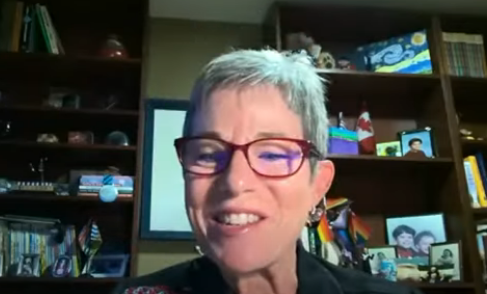
Speaking from her Coquitlam office at a recent B’nai Brith Canada discussion featuring several Jewish public officials, Robinson talked about her work as Minister of Post-Secondary Education following the October 7 Hamas attack.
“As a Jewish minister, to have this file . . . it’s a damn good thing that I’m here, because I understand what’s happening better than any of my colleagues would,” she said.
As the conversation moved to Holocaust education, Robinson said she’d encountered alarming levels of ignorance among people between the ages of 18 and 34.
“We have a whole generation . . . that have no idea about the Holocaust. They don’t even think it happened,” she said.
There is also a lack of understanding about the founding of Israel, Robinson continued.
“They don’t understand that it was a crappy piece of land with nothing on it,” she said. “There were several hundred thousand people but other than that it didn’t produce an economy.”
Robinson described the land as arid.
“It couldn’t grow things. It didn’t have anything on it,” she said. “We know the history. Most of the world does not know that history.”
The event was intended to introduce Jewish public officials to a wider audience and to highlight the work of fighting anti-Semitism.
MLA Robinson also likened the Israel Gaza war to a dispute between Indigenous nations.
“If there was a conflict between the Tsleil-Waututh and the Squamish nations over a piece of land, would we weigh in?” she asked. “The answer is ‘no.’ It’s between these nations, the Indigenous nations.”
Robinson’s suggestion that Israel was founded on a “crappy piece of land” is: “a racist idea that empowered colonial exploits for hundreds of years,” according to Green Party Saanich North and the Islands MLA Adam Olsen.
“Whether she meant it or not, by linking ‘several hundred thousand people’ with the previous phrase ‘crappy piece of land with nothing on it’ she reduces the ‘several hundred thousand people’ to irrelevance,” Olsen wrote on his blog.
Premier David Eby has set a dangerous example “by allowing harmful behaviour from Minister Robinson to stand with no consequences,” Olsen concluded.
According to reporting from CityNews, Eby did not say if Robinson had offered her resignation.
Robinson subsequently apologized for what she referred to as her “disrespectful comments.”
“I was referring to the fact that the land has limited natural resources. I understand that this flippant comment has caused pain and that it diminishes the connection Palestinians also have to the land,” she wrote on X, formerly Twitter.
Speaking to Postmedia News, Robinson admitted she said “awful things” but added she wouldn’t resign.
“I’m saddened there’s no room for someone to apologize for things that they said that hurt people,” Robinson said.
Criticism also came from Harvard University law professor Heidi Matthews, who wrote that Robinson’s comments erase the Indigenous Palestinians living there before 1948 and impose: “western capitalist ‘civilization’ as the normative benchmark against which the value of human activity is to be measured for colonial purposes.”
The Federation of Post-Secondary Educators of BC also renewed its calls for Robinson’s resignation, charging that the MLA: “inappropriately intervened in the termination of a Langara College employee [Natalie Knight] for controversial remarks on the war in Gaza.”
Knight was recorded at a rally praising Hamas’ Oct. 7 attack. Approximately 1,139 people were killed, most of whom were civilians. About 240 people were taken as captives, according to reporting by Al Jazeera.
Knight was recorded at a rally describing the attack as an: “amazing, brilliant offensive.”
The statement was a: “horrendous outburst,” Robinson said.
“She went out of her way to be vitriolic and celebrate the massacre,” Robinson said during the B’nai Brith Canada discussion. “She decided to go out and celebrate yet again that you can say what you want and there’ll be no consequences.”
Knight should be free to express her comments, according to Federation of Post-Secondary Educators of BC executive director Michael Conlon.
“The notion that a minister would intervene directly with a college and call for the termination of a tenured faculty member is highly inappropriate and unprecedented,” Conlon stated in a press release.
During a prior discussion, Robinson noted the line between free speech and hate speech.
“While I hate what they have to say, they also have a right to say it. Within limits,” Robinson added.
Agriculture
Agriculture in the West Bank was reshaped after the 1967 occupation, according to a study by McGill University ecological economist and activist Leah Temper.
Israel exercised direct and indirect control of: “labour, land and access to water so as to complement and discourage competition,” Temper wrote.
Those mechanisms can be defined as: “environmental racism or environmental injustice,” Temper wrote, stating that valuable ecological resources were transferred to Israel, while “pollution from the settlements are externalized onto the occupied territories.”
The land’s agricultural history includes growing grains such as wheat and barley, as well as chickpeas, olives, grapes, cotton and oranges, according to Temper.
Author