Port Coquitlam has backlog of nearly $120-million assets needing replacement
Port Coquitlam should be spending and saving more than twice what it currently does on replacing its municipal assets.
The city currently reinvests an average of $18.5 million into its assets annually, but a draft of the new asset management plan targets $42.5 million to be spent or transferred to reserves.
Staff presented the draft to council on July 11, the result of four years of work following the completion of a broader asset management strategy in 2019.
Local news that matters to you
No one covers the Tri-Cities like we do. But we need your help to keep our community journalism sustainable.
Mayor Brad West said there was an expectation of “doom and gloom” around the details in this plan, but added the city has been heading in the right direction.
Now decisions can be well-informed and backed up by data, he said.
“It’s really important for the residents to be able to have confidence that the city is being incredibly responsible and attentive to this,” West said. “Now it’s a question of … our funding strategy.”
Most of the city’s largest expenditures on its infrastructure were made during periods of growth in the 1960s and 1990s.
Approximately $1.9 billion worth of assets are owned by the city, categorized into eight portfolios: transportation, drainage, water, sanitary, facilities, parks, vehicle fleet and equipment, and information services.
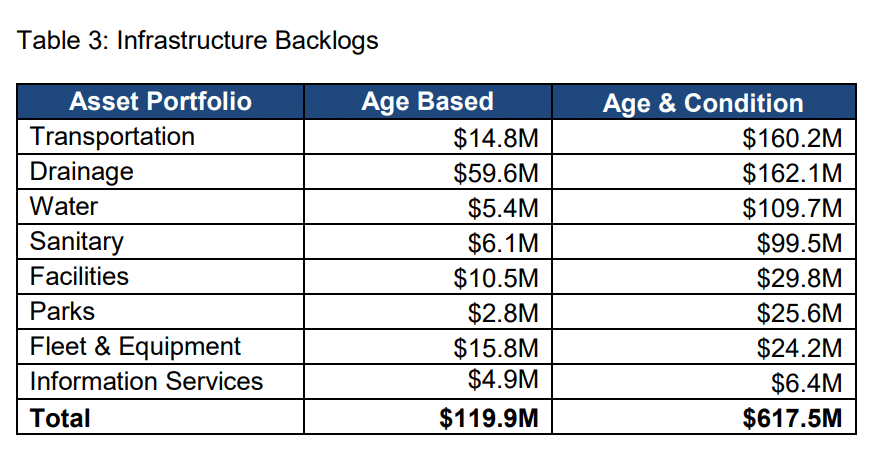
There is a backlog of approximately $119.9 million worth of assets that need to be replaced, but that total jumps to $617.5 million when considering assets in poor condition with less than 40 percent of their service life remaining.
The plan calls for a multi-decade view on financial planning around infrastructure replacement.
It notes the city is currently experiencing a “large replacement spike,” and a second spike is expected between 2050 and 2060.
Staff said the city needs to increase spending and reserve allocations keep up with asset replacements.
“What we’re really trying to avoid is any large financial adjustments in any given year,” staff said. “Time is of the essence, the longer we wait, the larger the gap grows, and the harder it is for us to catch up.”
Assets like roadways and sewage systems need constant maintenance and repair to ensure they can continually service the community.
One of a city’s main responsibilities is the operation and replacement of these assets when they become old and at risk of failure.
New infrastructure is often funded through levies on development or by developers themselves. But municipal taxes pay for that asset’s upkeep and eventual replacement– a price far outweighing the initial cost.
Accordingly, funding the replacement cost of these assets is a substantial challenge for most local governments across Canada, according to staff’s report.
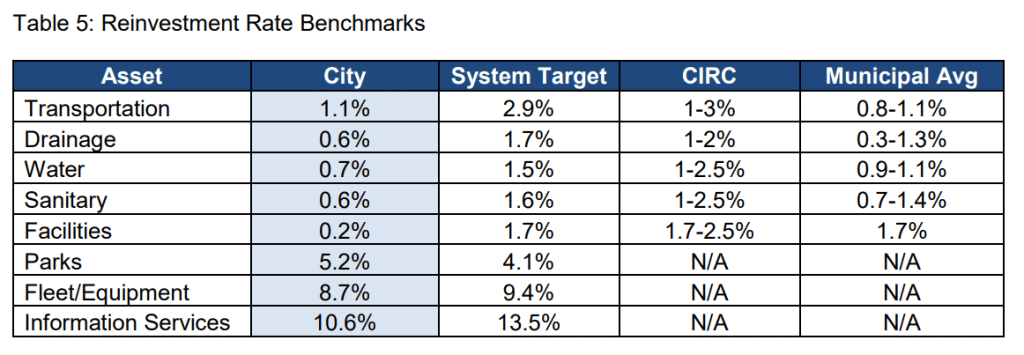
While there is no exact science for how much money a city should spend or transfer to reserves related to replacing assets, the city’s plan follows standards recommended by the 2016 Canadian Infrastructure Report Card (CIRC).
Those standards set a benchmark for an average reinvestment rate of 1 to 3 percent for each major infrastructure portfolios such as roads, facilities, water, sanitary, and drainage systems.
Across Canada, most municipal reinvestment rates average well below the CIRC targets. And Port Coquitlam falls just below the municipal average.
Following an in-depth inventory of approximately 88,000 assets across all its portfolios, Port Coquitlam established its own system targets.
According to these targets, the city is underfunding all asset categories except parks, which is actually overfunded.
Funding of transportation, sanitary and drainage asset replacement are at less than 40 percent of the system targets, while funding of facilities assets are at less than 13 percent.
Reinvestment into fleet and equipment assets, along with information service assets, are also slightly underfunded.
While replacement spending will vary widely from year to year, without proper saving the city runs the risk of the replacement projects being deferred, or “extreme fluctuations in user fees and tax rates,” according to the report.
The city should be taking a risk-based approach to replacing its old infrastructure, the report says.
This means prioritizing capital spending based on the probability the assets will fail, and the economic, social, environmental, regulatory, health and safety, and strategic consequences of any failure.
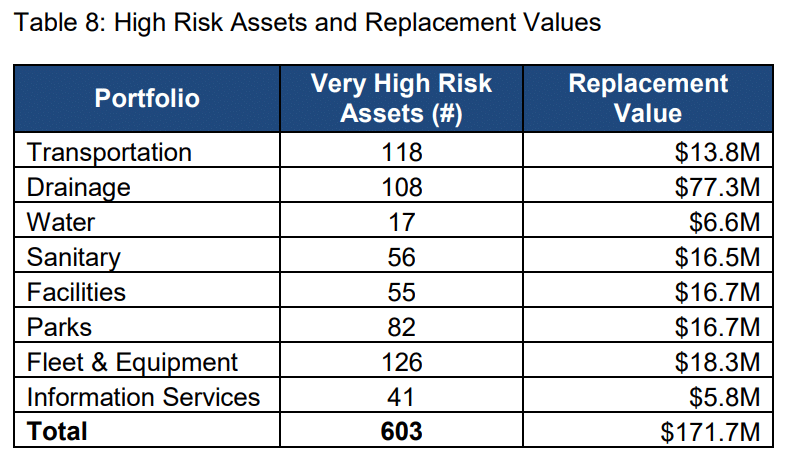
Across the city, there are 603 assets that have been given a “very high” risk rating, which have a replacement cost totalling $171.7 million.
One major asset is the Eastbound Lougheed Highway bridge, which was given an “almost certain” failure probability rating, with “major consequences.”
It has a replacement cost of approximately $11.6 million.
The good news, according to staff, is the city has been making substantial capital investments into replacement over the last seven to eight years.
For instance, staff said the city has been putting one percent of capital expenditures into its long-term reserves, and has focused on replacing existing assets rather than new asset acquisitions.
Staff said there is justification to spend reserve funds on replacements now, but saving for future replacements will still be needed.
“We’re gonna get some big sticker shocks in some years as we get big replacements,” staff said.
A funding strategy is currently being developed with the city’s finance staff to present options for closing the funding gaps for each asset group.
Staff say the asset management plan has set a good foundation, but closing these gaps will be a “long-term, incremental endeavour.”
The plan calls for developing a 10-to-20-year capital plan for each asset category, updating the asset register, training staff on asset software, regular review of asset lifecycle activities and service levels, and the consideration of natural assets and climate change.
Coun. Darrell Penner said the plan can make the city spend its money smarter, but he doubts it will dramatically change how much money will be spent annually.
“(If) something’s gonna fall down tomorrow, we have to deal with it,” Penner said. “But in general terms … It’s going to be that balance.”
Author