Pay Parking model to be implemented in Port Moody by summer
Pay Parking is coming to Port Moody.
On Tuesday, Oct. 17, council voted 6-1 in favour of introducing a pay parking model into the city, which is expected to be implemented before summer 2024.
“This is not a pilot project, this is the beginning of pay parking in our community,” said Coun. Diana Dilworth. “That’s going to be a challenge for many of our residents to grapple with.”
Local news that matters to you
No one covers the Tri-Cities like we do. But we need your help to keep our community journalism sustainable.
Port Moody has been weighing whether to charge vehicle users to park at certain locations for two decades, with studies and strategies on the books dating back to 2003.
With considerations around clogged parking lots and traffic, environmental goals and potential cash to city coffers, council has finally given its green light.
Back in May, Coun. Kyla Knowles introduced a motion for a one-year pilot parking project, but staff and council said they need more time for analysis.
After some delay, staff have returned with a proposed parking strategy, opting to forgo any experimental trial and implement a more permanent system.
The strategy will encourage parking turnover in the warmer seasons, get people using alternative modes of transportation, and generate revenue to maintain the city’s infrastructure, according to staff.
Mayor Meghan Lahti said the main issue is traffic congestion around Rocky Point Park, and by introducing charges, it will discourage unnecessary vehicle travel.
However, she said the city cannot understate the value of the strategy for pushing towards the city’s climate goals.
“I think it is imperative that we put our money where our mouth is,” Lahti said. “There are costs to doing this, but it’s not dissimilar to the Climate Action Plan, we understand that there’s also a necessity.”
Coun. Callan Morrison agreed, noting the city has committed $5.9 million to lower emissions by 2030, and potential $11.7 million by 2040.
He said the costs to implement the parking strategy would be “very small” in comparison.
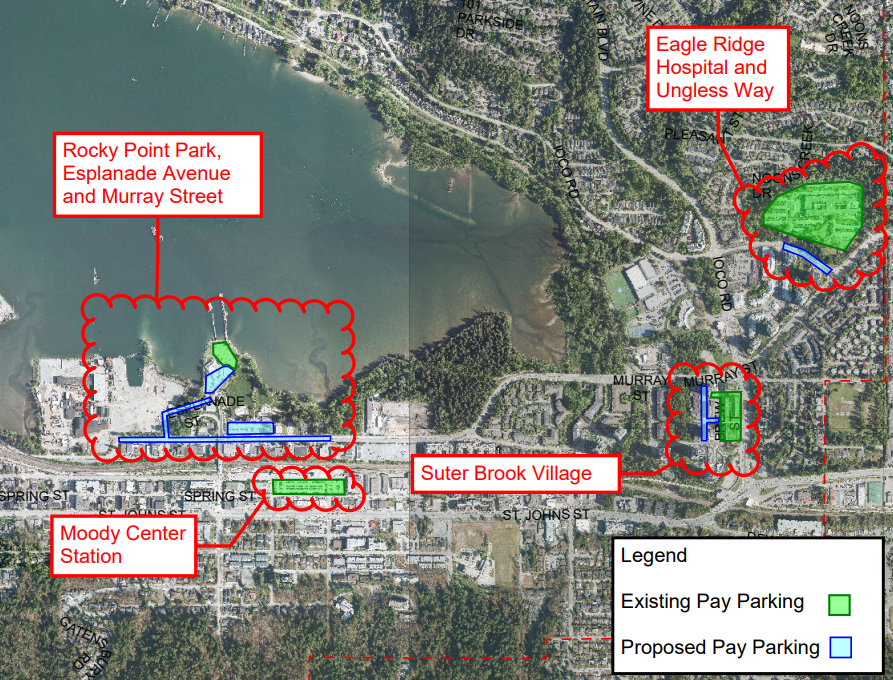
Currently, only certain properties not owned by the city have paid parking, such as the Moody Centre SkyTrain Station, Eagle Ridge Hospital, the Rocky Point Boat Launch and Suter Brook Village.
The city has its sights set on charging residents and visitors to park at five locations (so far), which have been identified as consistently having high-parking occupancy.
These include Rocky Point Park, Esplanade Avenue from Rocky Point Park to Murray Street, Murray Street from Columbia Street to Williams Street (not including off-leash dog park), commercial parking on Morrisey Street and Suter Brook Way and Ungless Way from Noons Creek Drive to Guildford Way.
There was some debate on council regarding the inclusion of Ungless Way, as hospital staff frequently park on the street to avoid have to pay during their shifts.
Knowles said most municipalities in Metro Vancouver have introduced pay parking, and Port Moody is just catching up to its neighbours.
She said Port Moody’s Brewers Row has become a destination site for many in the greater region, and users should have to “pay to play” if they choose not to travel by more environmentally friendly modes.
“We’re left with a parade of vehicles circling the Rocky Point Park” Knowles said, noting there is $3-a-day parking at the Moody Centre station. “With free parking, turnover suffers. People stay all day.”
Once the new system is established, the strategy recommends expanding the target areas based on a monitoring of locations around the city.
Future consideration for pay stalls should be given to Port Moody Recreation Centre, Knowle Street and Ioco Road near Newport Village, according to the strategy.
Staff said the target, according to best practices, is to have 15 percent of parking stalls available during peak daytime hours.
The cash generated from the new system will be slow at first, staff said, noting the first goal of the proposed framework should be parking management, and revenue generation second.
The strategy calls for implementation in a “consistent, equitable, and fair” manner that focuses on achieving the desired parking management outcomes.
Port Moody residents will be subject to the same rates as everyone else, with the possible exception of handicapped users and special needs groups.
Rates are yet to be determined, but generally will be more expensive in the busiest locations during the busiest hours.
Jeff Moi, general manager of engineering and operations, referenced the City of Vancouver’s pricing-demand model, where charges range from 50 cents to $6 per hour.
He added the rates will be subject to change as further monitoring occurs, but he would prefer to start on the lower end of the scale.
The purpose is to cause as much turnover as possible and keep stalls used for their designated users not spilling over onto other lots, according to Moi.
“We want to try to make that as efficient as we can,” Moi said. “If it’s business parking, we want it to be providing the parking for customers.”
Coun. Samantha Agtarap supported using the pricing-demand model, stating the city needs revenue to help pay parking and car infrastructure costs, which she described as “significant.”
She noted the City of Coquitlam has pay parking at some of its community centres and downtown locations, and Rocky Point Park is already very accessible.
“I’m supportive of anything that is working on a cost-recovery model,” Agtarap said. “There’s lots of lessons that we can learn from other municipalities around the region.”
While the new system will be able to operate at no cost, there will be an upfront cost relating to new infrastructure, maintenance, equipment, upgrades, and staff for enforcement, support and customer service.
In order to make the system effective, staff recommend hiring of an additional bylaw officer to patrol locations, as well as a part-time parking technician position.
The only councillor against approving the strategy was Coun. Haven Lurbiecki, who was skeptical over the proposed benefits.
While she said she understood the conceptual goals, the strategy has not offered enough hard evidence regarding turnover rates and revenue expectations.
“I’m not seeing the numbers … Are you telling me the day we put in the (pay) parking, I’m gonna’ go down to Rocky Point, and find a spot at 1 p.m. on a Saturday?” Lurbiecki said.
Moi responded that staff will be returning to council early next year with more analysis.
But the larger issue for Lurbiecki was keeping parks as accessible as possible for all users, and she argued the plan would just pass costs onto users in the midst of an affordability crisis.
She said she would be more supportive if there were some form of resident passes.
Lurbiecki added the breweries are responsible for putting pressure on the park parking, and “now park users are literally having to pay the price.”
Staff will next be developing a new corporate policy based on the proposed framework and locations, reviewing their enforcement tools, and tendering out proposals for infrastructure installations and pay apps.
They will also be starting public engagement to notify businesses and the public.
Dilworth said the city needs to be open and honest about their rationale behind the strategy. “You guys are all complaining about parking, this is one tool to look at addressing that problem,” she said.
Knowles said that some businesses formerly opposed the changes are starting to realize that higher parking turnover translates to more customers.
She said the lack of available stalls are causing businesses and developers to pass their costs onto the public, or cut wages for employees.
“With current inflation and interest rates, not to mention the housing crisis, the cost of living right now is tough. And this goes for local businesses, too,” Knowles said.
Author