Parkland expansion in Moody Centre to be focus of future Port Moody town hall event
Port Moody will be hosting a town hall meeting on parkland expansion in Moody Centre as the city grapples with anticipated population growth in the area.
Council voted unanimously to hold the event after receiving an update on its parkland strategy on Nov. 19, which detailed how the city’s parkland per capita ratio would dwindle by 2050 without more acquisitions.
While Mayor Meghan Lahti said the expansion of Rocky Point Park is a priority, she noted council needs to explore expanding its smaller neighbourhood parks as well.
Local news that matters to you
No one covers the Tri-Cities like we do. But we need your help to keep our community journalism sustainable.
“Moody Centre is an area where we need to be making strategic decisions regarding the provision of more parkland,” Lahti said. “Our efforts cannot be solely limited to that park.”
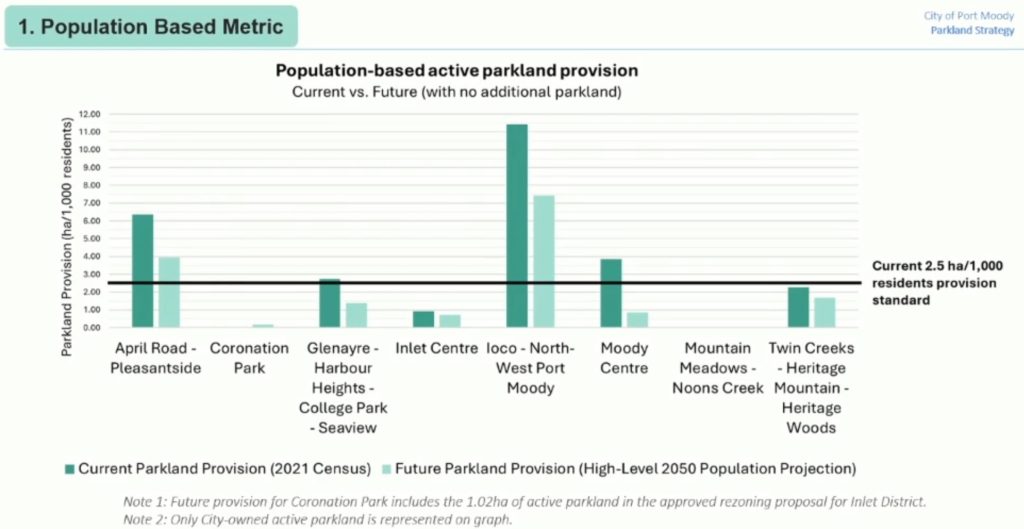
Port Moody’s parkland strategy maintains the lofty goal of maintaining 2.5 hectares of parkland per 1,000 people, which was originally set as a target in the city’s 2015 parks master plan.
As the city’s population is expected to balloon to 71,800 people in the next 25 years, that per capita ratio will fall to 1.2 hectares without additional park purchases.
Moody Centre – where the majority of Port Moody’s densification is occurring – would be hit particularly hard, with the ratio of city owned parkland per 1,000 people decreasing by 80 percent.
Glenayre, Harbour Heights, College Park and Seaview would also collectively see their parkland per population ratio decrease by around half.
Expanding parkland is a challenge for many municipalities across Canadian, said Ding Yu, the city’s project manager for parks planning, citing a 2023 Park People report stating 85 percent have been struggling to meet growth demands.
Yu said Port Moody itself is facing rapid growth, limited land availability, rising costs and limited funding problems.
However, when compared to other Lower Mainland municipalities, Port Moody currently is “well above average” in terms of the amount of park space it provides, she said.
The city is home to 40 parks, totalling 380 hectares, including 22 designated as active parkland with recreational features. Beyond the city’s parks, 10 school sites also contribute recreational amenities. When combined with Belcarra Regional Park, parkland accounts for 35 percent of Port Moody’s total land base, though only 3 percent is active and owned by the city.
Staff are taking a multifaceted approach to the issue, Yu said, moving beyond population metrics as the sole criteria to include proximity, amenity distribution, active transportation, connectivity and urban forest canopy into its analysis.
She said Moody Centre, Glenayre and Coronation Park are expected to see the highest population growth by 2050, and will require the most new parkland to maintain current service levels.
When the strategy is complete, it will identify priority areas for expansion, details around costs, as well as policy and planning tools.
Coun. Callan Morrison said meeting the target ratio will require a substantial number of expensive parkland acquisitions, noting recent provincial housing legislation limits municipalities’ tools for using density transfers.
“There may not be space or the ability, financially, to do it,” he said, adding the city should also be counting improvements within public parks to gauge overall need.
Coun. Diana Dilworth suggested the 2015 per capita ratio was close to a decade old, and may need to be reworked. She requested a comparison with other municipalities’ targets be included in the next update.
“That number wasn’t based on a comprehensive analysis of what other municipalities are doing,” Dilworth said. “It might be interesting to see where our peers are at.”
Dilworth also took issue with Bert Flinn Park not being defined as active park space in the analysis. Staff responded that since the report was based on the 2015 master plan, and a number of changes since still need to be updated.
While other councillors stressed the importance of neighbourhood parks, Coun. Haven Lurbiecki emphasized the need for expanding Rocky Point Park.
Earlier this month, council discussed their $43-million plan to upgrade Rocky Point Park, which was attended by a local group demanding it be expanded to the west.
“If we don’t do something, it’s five times more people sitting around you on a busy day in the summer,” Lurbiecki said. “This tells us that we significantly need to expand that park, and there’s just no question about it.”
Lurbiecki added council should not back off its parkland per capita goals, unless it wants to rethink its rate of development.
At the close of the discussion, Mayor Lahti introduced a motion requesting a community town hall be organized to specifically discuss Moody Centre, with the results being incorporated into the parkland strategy and draft official community plan.
“This community dialogue can and should touch on all issues related to park expansion, including expropriation and purchase negotiation,” she said. “I think that it will provide the community with an opportunity to provide their input in a meaningful, constructive way.”
Author