No winter shelters for unhoused folks in the Tri-Cities this year
The churches that provided a winter shelter for unhoused folks are no longer participating
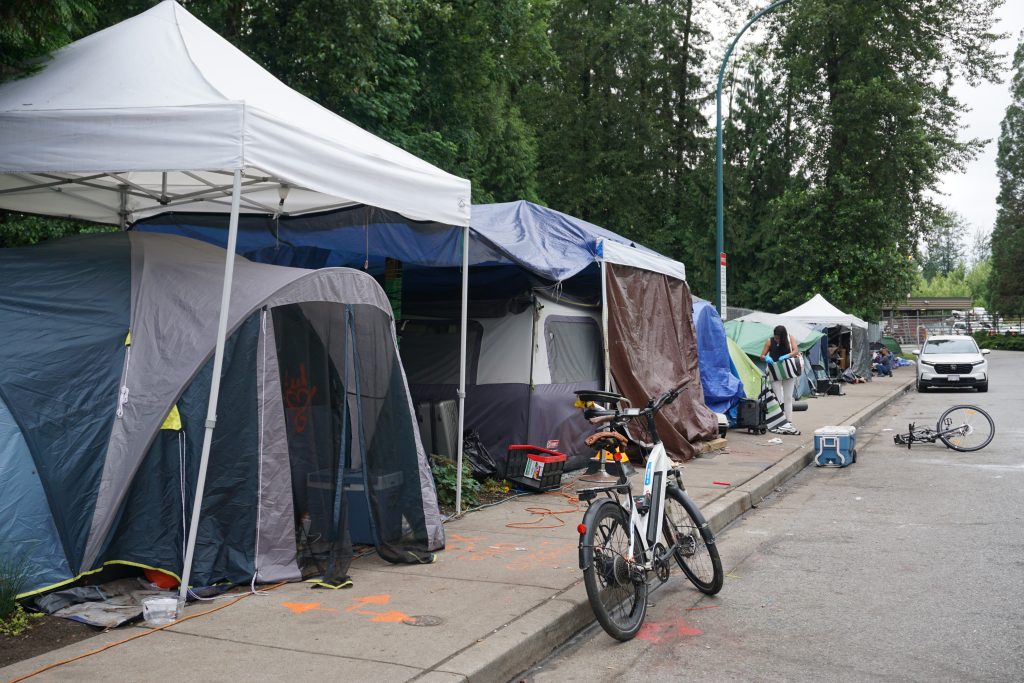
On a snowy day last winter, Macarthy Whyzel was doing outreach in the homeless encampment outside of 3030 Gordon, when he came across a man in a tent. The man’s lips and fingers were turning blue.
Whyzel, who is the founder of the volunteer-run TheUpliftingGroup, dragged him out of his tent and warmed him up in his car. He connected the man with the Tri-Cities winter shelter program so he’d have a warm place to sleep.
“He spent many, many nights off the streets thanks to that winter shelter,” Whyzel said.
Local news that matters to you
No one covers the Tri-Cities like we do. But we need your help to keep our community journalism sustainable.
Last season, Progressive Housing Society ran that program for its fourth consecutive year, providing shelter for 188 individuals over the winter months.
It won’t be running this winter. Nor will there be any extreme weather response shelter opening up during severely cold or rainy days.
“We have people that are unsheltered, that are in severe weather during the winter, and they’re at risk,” said Ryan McCormick, the co-director of community programs for the Progressive Housing Society.
How did we get here?
Since January 2022, several churches participated in the winter shelter program, each taking a one-month turn to open their doors at night to provide shelter for the unhoused population over the winter.
Progressive Housing would pick people up at a few designated spots around the Tri-Cities and drive them to participating churches to sleep. In the mornings, they’d drive them back to the same spot and drop them off.
“It was really only ever a temporary model, like those communities stepping up to fill the gap,” said McCormick.
There’s a number of reasons the participating churches backed out, he explained, including church capacity, zoning issues, and community concerns.
Towards the end of last season, he said “it was becoming clear” that the program might have to cease, as two of the three participating churches weren’t able to continue into the next year.
In July, Rev. David Cathcart, the Minister of Trinity United Church, sent a letter to the City of Port Coquitlam, saying they wouldn’t be participating in either winter shelter or extreme weather response programs.
He stated their church had started as an extreme weather response shelter, hosting a half a dozen people for a few nights at a time during bad weather.
But more extreme weather and increased homelessness has meant shelters need to stay open longer. Additionally, the toxic drug supply, “makes a 12 hour stay in a shelter (that is not equipped to be a safe use site), impossible for people who need to use throughout the night.”
“It is the city’s responsibility to provide appropriate space to shelter its residents whether those residents can pay rent or not,” Cathcart wrote, adding that BC Housing had resources it would release if there was a space.
“But Port Coquitlam refuses to consider using city owned property. Port Coquitlam has maintained a practice of “moving people along,” while there is nowhere for them to move to,” he wrote.
No extreme weather shelter in the Tri-Cities
Previously, the Kyle Centre had served as an extreme weather shelter for vulnerable people in the Tri-Cities, opening during severe weather. But Port Moody didn’t run it last year and won’t be doing so this year.
The Dispatch reached out to Port Moody for more information, but City Manager Anna Mathewson said that there is “no information available at present.”
Both Port Coquitlam and Coquitlam told the Dispatch that provincial support is needed for a winter shelter.
Dominic Long, Director of Community Safety and Corporate Services for Port Coquitlam, said they have approached the provincial government, highlighting the lack of shelter in the Tri-Cities.
Long said they need “the resources and skills” to run an extreme weather shelter, due to the “complex health needs” of individuals who might require it.
“And that’s where we need the support of the province,” Long said.
Andrew Merrill, the general manager of planning and development for Coquitlam, said that the city has been communicating with the province and providing BC Housing with lists of various locations for a possible shelter.
“But we haven’t heard anything back from the province in terms of them finding acceptable locations,” he said.
He said it is the province’s responsibility to build an additional shelter in the Tri-Cities.
In an email to the Dispatch, a spokesperson for B.C.’s Ministry of Housing and Municipal Affairs said that they haven’t sent out their annual statement on winter shelters, and can’t confirm anything until it does.
What are people’s options?
The only homeless shelter in the Tri-Cities is 3030 Gordon, which is almost always at capacity and has an encampment outside.
Ryan McCormick said this means unhoused people’s options are limited: they can go to other cities to find shelters, sleep outside, or find temporary arrangements.
“The options are not really good for folks in the Tri-Cities that are unsheltered,” he said.
Still, community members and groups are trying to step up. In anticipation of an increased need, Macarthy Whyzel has put a call out for donations, asking for socks, granola bars, handwarmers, gloves, toques, winter jackets, blankets, sleeping bags, and tents. (People can drop these items off in a bin at the front door of 2986 Forestridge Place in Coquitlam).
He’s also trying to spread the word about the lack of support.
“I think that in the Tri-Cities, there’s so many folks that just assume that, ‘Of course, we have a winter shelter. We’ve had it for years,” Whyzel said.
“There’s been no sort of public acknowledgement that, ‘Hey, it’s not happening this year.’ I think that just telling the community that, ‘Hey, this service is not happening,’ might spark change. If not, at least they’ll spark a simple conversation amongst a larger population.”