Addressing dike issues to help Kwikwetlem First Nation move past historical grievances
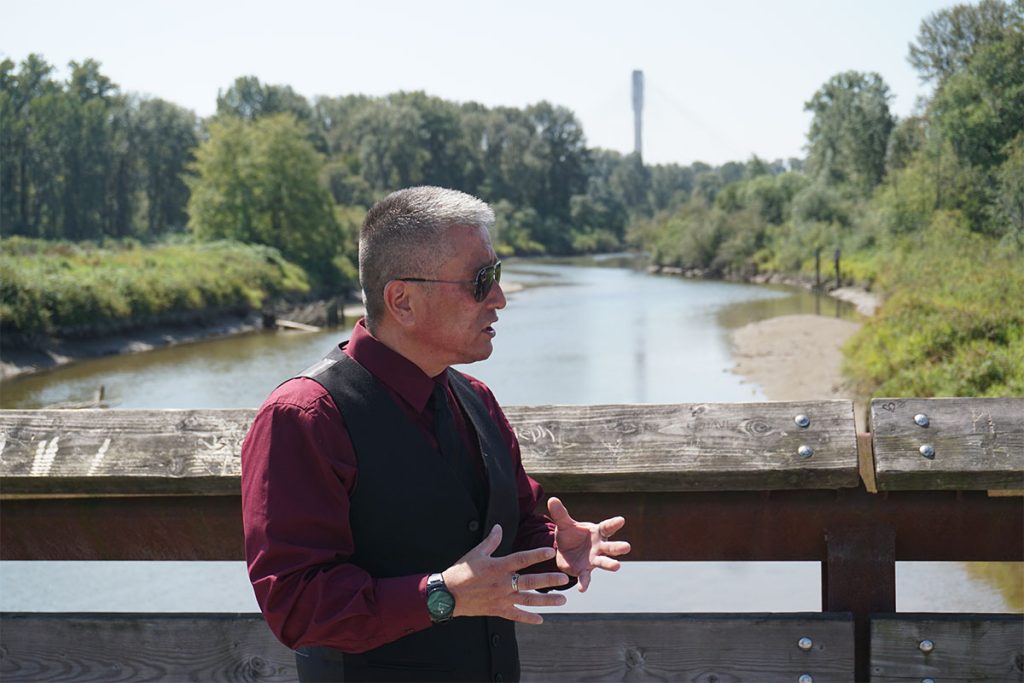
For the Kwikwetlem First Nation, upgrading the dikes along the lower Coquitlam River means much more than protecting its slakəyánc community from flooding.
Band Coun. George Chaffee said its partnership with the City of Coquitlam will help the Nation move past historical colonial grievances, and towards understanding and reconciliation.
Chaffee noted it was the first time in the Nation’s history where they were approached first by another government regarding the flooding issue.
Local news that matters to you
No one covers the Tri-Cities like we do. But we need your help to keep our community journalism sustainable.
“You have to understand how big that is,” he said. “We can’t fix … what’s happened in the past, but we can make it better going into the future.”
On Aug. 15, the federal and provincial governments, City of Coquitlam, and the Nation announced a joint investment of $19.9 million to improve the diking systems along the lower Coquitlam and Fraser rivers.
The announcement took place on ƛ̓éxətəm Regional Park, formerly known as Colony Farm Regional Park, which is immediately adjacent to slakəyánc.
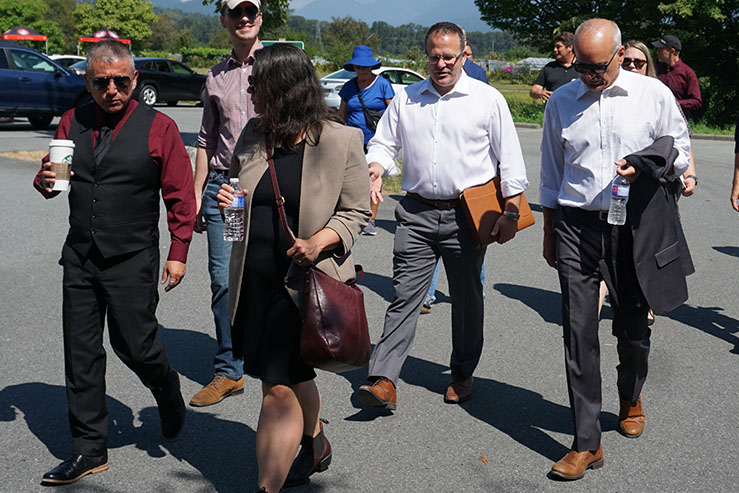
Afterwards, Chaffee led a visual tour around the dikes surrounding the 6.5 acre reserve, speaking on the Nation’s struggles to draw government attention to their flooding woes. Attendance included Coquitlam Mayor Richard Stewart, Coun. Matt Djonlic, and Port Moody MLA Rick Glumac.
The Kwikwetlem First Nation, whose population used to number in the thousands, was devastated by epidemics in the 18th century, and eventually forced into the two small reserves following the Indian Act of 1876.
Chaffee said the Nation was never consulted when their traditional territory was cleared of its food-abundant floodplain by the province in 1905, preceding the development of Colony Farm.
He said they also were never consulted before construction started on the Coquitlam Dam in 1904, which reduced the Coquitlam River’s water flow and destroyed its sockeye salmon run.
In 1899, Kwikwetlem Chief Johnnie wrote a letter to the federal government, urging them to reconsider construction of the dam.
“If the Creek is taken away from us it will be very hard for us. It is like a man (taking) the food out of my cupboard – the creek is like our storehouse,” the letter said.
Not only was the Nation stripped of its food sources, but the dikes and dams changed the hydrology of the Coquitlam River, causing sediment to build up on the banks of the river, thereby reducing the volume of water it can carry before a breach occurs.
Kwikwetlem band Coun. John Peters, who is tasked with emergency management for the Nation, said that sediment build-up is the biggest issue today.
“We only have 20 percent flow of what the river originally had,” Peters said. “It doesn’t flush all that sediment.”
Chaffee said the dikes were only constructed around settler properties, and their placement had the added effect of funneling waters towards the reserve, causing continuous flooding over the years.
Former colonial policies made it illegal for residents to leave the reserve, and Kwikwetlem elders remember residents were shot when they tried to leave during floods, Chaffee said.
Since 1909, slakəyánc has flooded at least 21 times from winter and freshet flood events, according to the Kwikwetlem First Nation.
Peters said there have been several close calls in recently, one being the atmospheric river event a few years ago.
While slakəyánc itself has been raised above the 200-year-floodplain, a major flooding event would submerge Colony Farm Road, according to Peters, noting it is the only access point in and out of the reserve.
Another problem, Peters said, is the low elevation of slakəyánc’s lift station, which pumps out the community’s wastewater.
“If there’s any flooding, then there’s that possibility of an epidemic because of wastewater being in the system,” he said.
For over a century, Chaffee said the Nation’s elders have been very vocal about the dike issues affecting the reserve, but these concerns were never heeded.
Official records of the Kwikwetlem First Nation’s complaints date back to the 1950s, according to Chaffee, but he said their lobbying attempts date back to 1915, when the first dikes were installed around Colony Farm.
He said the only reason slakəyánc sits above the 200-year-floodplain is because his mother, Chief Evelyn Joe – one of Kwikwetlem’s first woman chiefs – defied both the federal and provincial government to start filling the land in the 1990s.
Chaffee said the Nation was threatened with lawsuits if they did not follow environmental and permitting rules.
“My mom said, ‘Go ahead, sue us,’” Chaffee said. “She actually went up on top of the road, and she waited for the RCMP to come while the first trucks came down to fill these lands that you’re sitting on right now.
“She went down in history as one of the greatest women in our community, and a lot of the women in our community want to be like her.”
Chaffee said this is why the city reaching out to Nation first was so important: it displays a level of understanding in an age of reconciliation.
“A lot of people are scared of First Nations. The city took that initiative, and they put down that fear and approached us,” Chaffee said. “In doing so, we’ve come up with this situation where there is understanding there. There is understanding of the story.”
Coquitlam Mayor Richard Stewart said he remembers coming down to slakəyánc during a freshet event with his son over two decades ago to help fill sandbags.
He said today’s issues are a result of how the government had mistreated the Kwikwetlem First Nation in the past, and collaboration is how these issues will be fixed.
“It truly is an indication that that’s how we’re going to get it done,” Stewart said. “That’s how the partnerships are going to work: by bringing levels of government together for common purpose, both in reconciliation, but also in the realities climate change is affecting all of us.”
A Kwikwetlem First Nation representative said they are aiming to start work on the project in 2027 and having it completed in 2029.
Author