Update to Port Moody’s unit size policy on pause for 6 months; softer interim policy adopted in lieu

An official policy update to ensure Port Moody gets larger units out of development projects has been put on hold for at least six months.
A report regarding the policy deferral was presented to council on May 14, and council passed a more relaxed interim update in its stead.
“Staff’s recommendation is to wait until the new housing needs assessment is complete,” explained Liam McLellan, a social planner with the city. “Changes that are coming down the pipeline from the province will be more reflected in the future policy.”
Local news that matters to you
No one covers the Tri-Cities like we do. But we need your help to keep our community journalism sustainable.
Currently, Port Moody’s Family-Friendly Units Policy is not in line with the needs projected in its Housing Action Plan (HAP), which was endorsed in July, 2022.
In February, 2023, council had directed staff to investigate amendments to the policy to close the gaps, but staff said incoming changes from provincial housing legislation had forced them to shelve the update.
Changes from the Local Government Housing Initiatives and the Local Government Act now require the city to complete a new housing needs report before the start of 2025 based on a new provincial methodology.
Staff said they have still not received data from the province regarding the standardized methodology, and any updates to the new policy need to be deferred in the meantime.
Coun. Diana Dilworth expressed frustration about being forced to update Port Moody’s housing assessments, as the previous assessment is less than two-years old
Staff also noted the provincial targets for family sized units fall short of the needs forecasted in the city’s HAP.
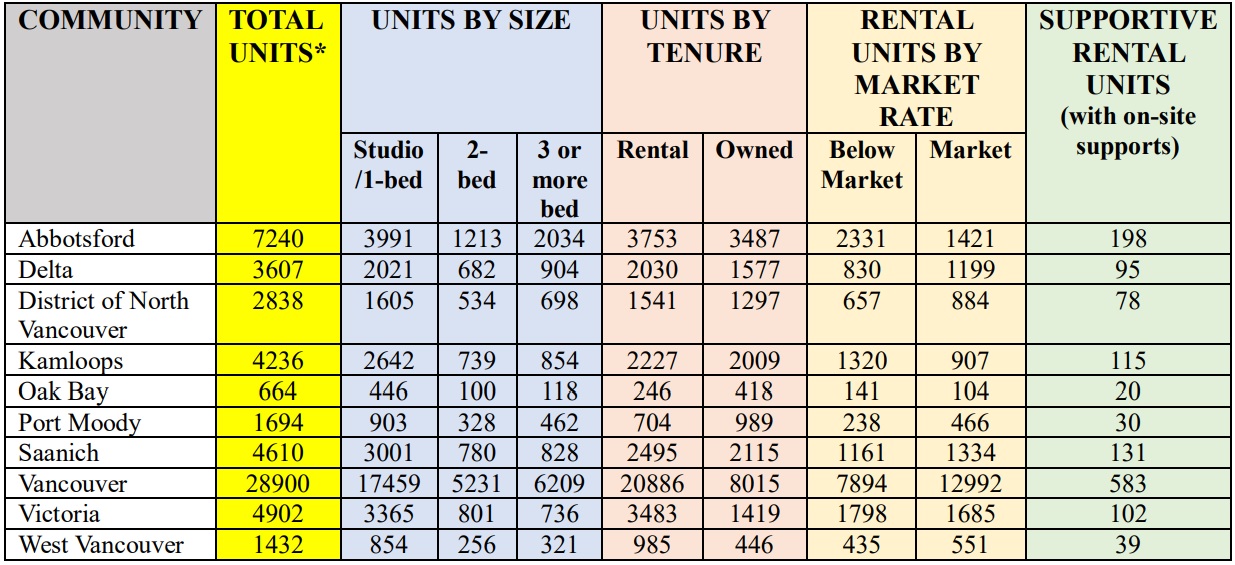
For instance: out of the 1,694 minimum units the city is required to build over the next five years, the province has set a 53 percent target for studio and one-bedroom apartments; the HPA aims for less than half that.
Coun. Callan Morrison said he understood staff wanting more time, but expressed concerns about pushing the update back considering the current policy, and the provincial targets, both fail to meet the community’s actual needs.
“We don’t have any guidance put in place to help development applications that may be coming forward,” Morrison said. “(We should be) at least signalling to the development community that there is going to be changes coming.”
The city’s current Family-Friendly Units Policy has only set 75 percent and 70 percent maximums for studio and one-bedroom units in market rental and strata apartments, respectively.
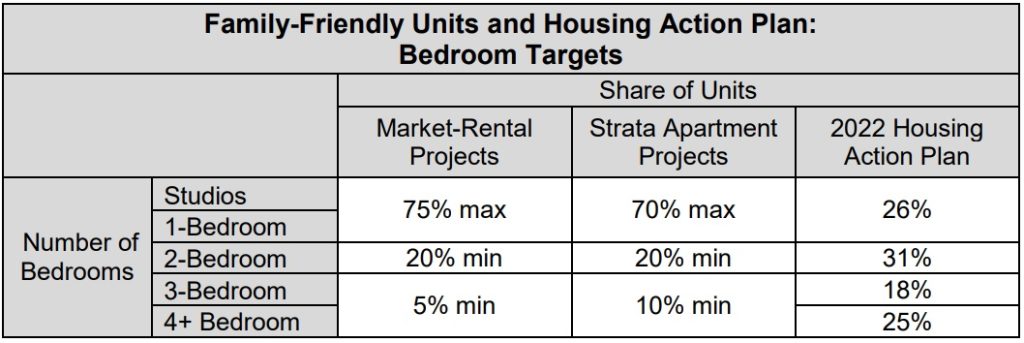
Staff proposed amending the policy to set 42 percent maximums for studio units and 28 percent maximums for one-bedroom units in strata apartments; and 45 percent maximums for studio units and 30 percent maximums for one-bedrooms units in rental buildings.
But for most of the council, staff’s recommendation was not strong enough.
Coun. Haven Lurbiecki agreed with Morrison about the need for a policy update considering the major incoming development applications, but she said she didn’t think the interim policy would help the city actually achieve larger unit sizes.
“What we are basically saying is families are not going to live near transit,” Lurbiecki said. “I’m personally not comfortable at all agreeing to that.”
Dilworth said that while she supported the interim policy, she was not comfortable with it as an “end all be all number.”
Before any policy is officially adopted, Dilworth said she wants a report back about potential impacts regarding protecting in-stream development applications from the changes.
“I trust that between staff, data analysis, and a new housing needs assessment report, we will have that number,” Dilworth said. “I’m not comfortable debating what that number is going to be tonight.”
Couns. Amy Lubik and Samantha Agtarap, however, both said they had concerns about “missed opportunities” regarding some of the applications that are currently in-stream.
Lubik said their HAP is completed, and the interim numbers do not reflect Port Moody’s needs.
“I do think that we need to be really strong on that,” she said. “In a number of applications that we’ve seen in early input … we have said we’d like to see a better (unit) mix.”
Agtarap introduced an amendment to at least bring the interim numbers in line with the provincial target of 53 percent maximums for studio and one-bedroom units, and 19 percent and 27 percent minimums for two and three-bedroom units, respectively.
“Why wouldn’t we be aiming for that as an interim target as well?” she said.
The amendment passed 4-3, with Couns. Morrison, Knowles, and Mayor Meghan Lahti opposed.
Morrison voiced concerns over how the changes could affect multi-family projects currently in stream.
Likewise, Coun. Kyla Knowles said she would have rather discussed any amendments at a committee meeting, stating they should not be making hasty changes without being sure of the impacts.
She added she didn’t think it was appropriate that some councillors wanted to apply the new unit requirements to projects at the pre-application stage.
“Developers have spent years working on pro formas,” Knowles said. “Honestly, I’m kind of shocked to hear councillors suggest we have the right to pull the rug out from under them.”
Knowles introduced a motion to refer the changes to committee which passed by 6-1 vote, with Lurbiecki voting against.
Author