Toxic drug deaths decline but dangerous sedatives turning up in drug supply
According to preliminary data from B.C. Coroners Service, 115 people lost their lives in February 2026 due to unregulated drug toxicity.
There have been 265 unregulated drug deaths in B.C. in the first two months of 2026, compared to 301 in 2025 and 426 in 2024.
Authorities recently tracked an increase in the use of medetomidine. Often called “tranq,” medetomidine is approximately 200 times more potent than the veterinary sedative xylazine, according to information from Fraser Health.
Local news that matters to you
No one covers the Tri-Cities like we do. But we need your help to keep our community journalism sustainable.
Medetomidine was detected in two drug toxicity deaths in July 2025. It was found in 18 cases in January and three in February.
When found in the unregulated drug supply medetomidine is “almost always combined with opioids,” according to Fraser Health. The sedative is also often accompanied by xylazine and benzodiazepines.
“People may not know they have used medetomidine,” according to Fraser Health.
The drug might take effect after a few minutes, sometimes leaving the user unresponsive for several hours.
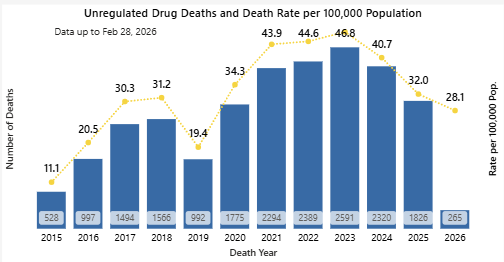
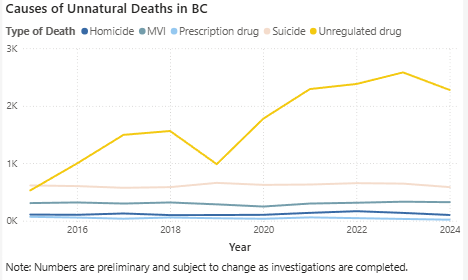
Across the province, there are 4.1 unregulated drug deaths every day in February. Approximately 81 percent of those deaths happen inside at private residences, shelters, and supportive housing.
During the first two months of 2026, there have been 62 drugs deaths in the Fraser Health Authority.
Tracking drug deaths per 100,000 residents, the rate in Fraser Health is 16.4, compared to 28.1 across the province.
The drug toxicity death rate per 100,000 residents is 33.1 in Vancouver Coastal Health.
The rate in the Tri-Cities was 11.5 per 100,000 residents in 2025.
A total of 33 people died in Coquitlam, Port Coquitlam and Port Moody last year – a decline of approximately 21 percent from 2024.
The number of deaths in the Tri-Cities has now fallen roughly 50 percent since 2021, the deadliest year on record locally, when 66 people lost their lives.
Emergency responders in Coquitlam and Port Coquitlam reported about a 40 percent decline in overdose calls by the third quarter of 2025.
“We can’t take credit for that one, but it is a positive sign that those calls are down,” said Coquitlam Fire Rescue deputy chief Blake Clarkson at the time.
The decline in overdose deaths may be related to changes in the drug supply, according to Dr. Kora DeBeck, a scientist with the BC Centre on Substance Use.
DeBeck noted similar drops across North America, despite acutely different drug policies.
“When we look at so many different settings, seeing these similar patterns, I think really the most credible explanation is the drug supply,” she told the Dispatch in 2025.
In 2026, fluorofentanyl has been detected in 68 percent of deaths, while cocaine was found in 57 percent. B.C. Coroners Service also reported finding fentanyl in 56 percent of deaths and methamphetamine in 54 percent.
For information on addiction help, click here.
Author