Coquitlam crime rate dips to ‘historic low;’ mental health calls tick up 10%

The city’s population may be spiking but Coquitlam’s crime rate is flat.
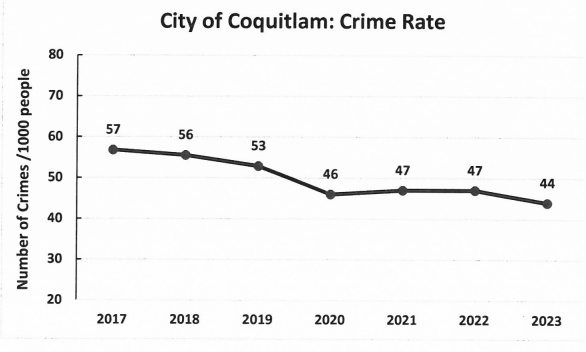
In 2023, there were 44 crimes per 1,000 residents – a “historic low,” noted a report submitted by Coquitlam RCMP Insp. Darren Carr.
“Despite population growth, the amount of crime is staying relatively the same,” Carr stated.
Local news that matters to you
No one covers the Tri-Cities like we do. But we need your help to keep our community journalism sustainable.
Police investigated several murders in 2023.
Karnvir Singh Garcha was shot and killed on the 500 block of Foster Avenue on July 2. In August, police arrested Coquitlam man David Hall for the second-degree murder of Kwikwetlem councillor Stephanie Patterson. In September, Ridge Meadows RCMP Const. Rick O’Brien was shot and killed while executing a search warrant at an apartment near Pinetree Way and Glen Drive.
Speaking to council on Monday, Carr acknowledged consternation in the community.
“We understand the public’s concerns relative to public safety,” he said.
However, those incidents are on the “extreme end” of crime in the community and represent: “a small fraction of the total calls” police attend to, Carr told council.
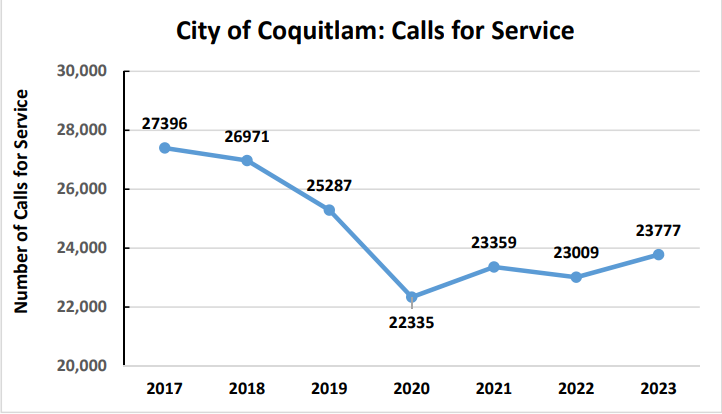
While calls for service inched up by three percent – about 700 more calls – the crime rate continued to tumble, dropping from the previous low of 46 crimes per 1,000 residents in 2020.
Police recorded 1,395 persons crimes in 2023 – exactly the same as the figure recorded in 2022.
Assaults accounted for 44 percent of persons crimes, with threats and harassment making up an additional 38 percent.
Ten percent of persons crimes are sex offences.
The report noted that less than one percent of persons crimes were homicides, kidnappings, or arson.
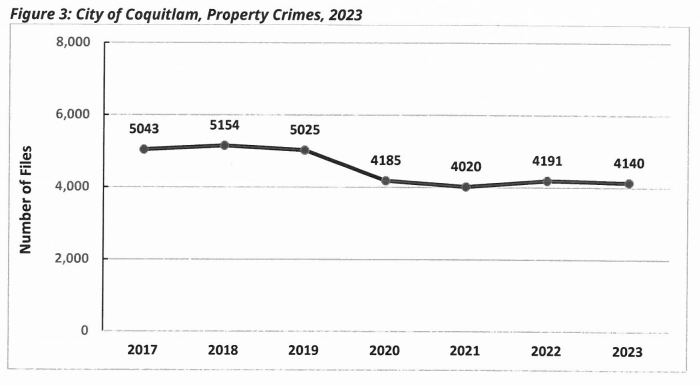
While the rate has declined substantially since 2019, property crimes continued to be the most common offence in Coquitlam.
Fifteen percent of property crimes were frauds, with thefts from vehicles and shoplifting each accounting for 18 percent of Coquitlam property crimes.
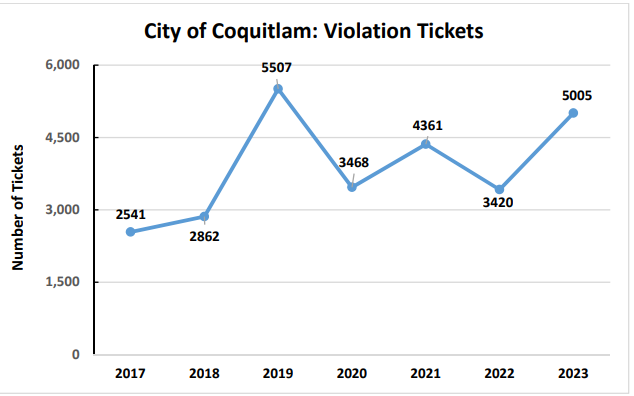
Police handed out 5,000 traffic tickets in 2023 – nearly 50 percent more than in 2022.
However, the number of tickets handed out may dip this year, according to Carr, who explained that the officers who wrote those tickets tend to end up in court, “so there will be less hours available to do enforcement.”
“It’s always going to be a statistic in flux,” he said.

Police received a record-high in terms of mental health related calls in 2023. Coquitlam RCMP frequently conduct missing persons investigation after Red Fish Health Centre patients leave the grounds without permission.
Those are “labour intensive” cases, according to Carr, who noted there were 366 files connected to Red Fish in 2023, a 10 percent increase from 2022.
Speaking to council last October, Coquitlam RCMP Supt. Keith Bramhill underscored the complexity of the issue.
“I am very thankful that we have a 105-bed facility . . . that wants to help the most vulnerable people in our community. In many ways I wish we had more, just not all in the same city because it has had a real impact on police labour and resources,” Bramhill said.
The vast majority of Red Fish patients experienced improved mental health between admission and discharge, according to a representative from the Ministry of Mental Health and Addictions who declined to be identified.
However, the police and Red Fish staff “have seen some successes” in reducing those calls, Carr stated Monday.
The RCMP’s recently-inaugurated mental health unit, which combines an officer with a health care professional, attended more than 150 mental health-related files in its first three months of operation.
Crime severity
The Tri-Cities have seen sizable reductions in both violent and non-violent crime rates from 1998 to 2021, according to data released by Statistics Canada.
Coquitlam’s crime severity index hit a high of 141.73 in 2003. However, the rate has ticked down ever since, falling to 57.50 in 2021.
The crime severity index weighs different crimes based on their relative seriousness to calculate a crime rate per 100,000 residents. Seriousness is derived from sentences handed down by the courts. When the system was first devised, a murder was judged 1,000 times more serious than marijuana possession. The rates are adjusted every five years.
Author