New housing can’t come at the expense of a city’s tree canopy, says Port Moody council
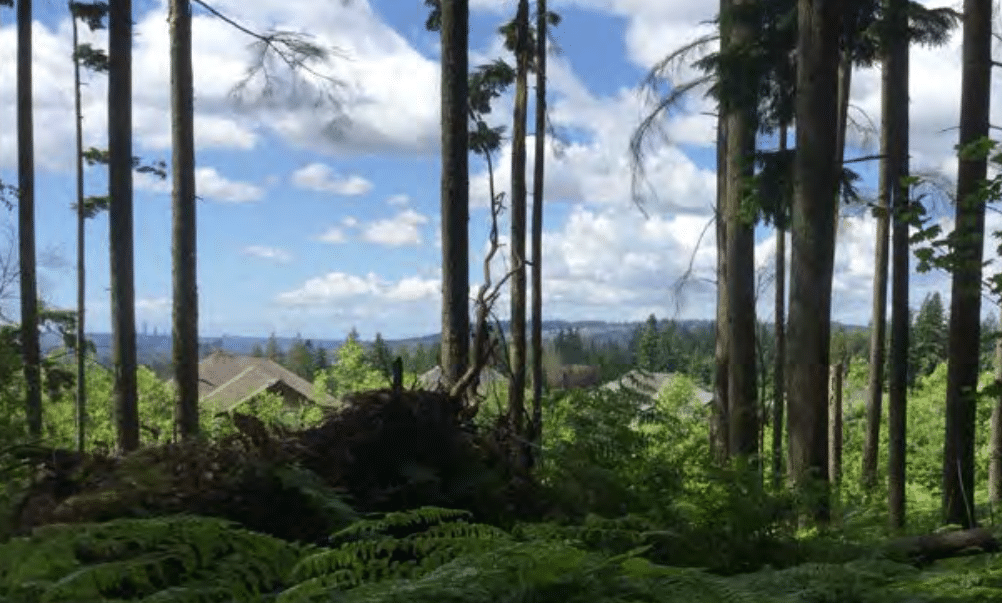
New provincial housing legislation may be forcing changes in the municipal development process while neglecting to protect city trees.
Port Moody will be submitting a resolution to the Lower Mainland Local Government Association and Union of B.C. Municipalities requesting the province integrate canopy protection, expansion and climate resilience into Bill 44 and 47.
Couns. Amy Lubik and Kyla Knowles brought the resolution to council Tuesday, raising concerns that municipalities could lose authority to protect their trees and implement climate action plans.
Local news that matters to you
No one covers the Tri-Cities like we do. But we need your help to keep our community journalism sustainable.
“As we’re trying to build homes for people, it’s important that those homes are safe and livable, that they are amongst connected ecosystems,” Lubik said. “Upcoming legislation from the B.C. government, well intentioned as it is, may mitigate a lot of the work that we’re trying to do.”
Port Moody is currently developing an urban forest strategy, updating its tree bylaw, and trying to implement its Climate Action Plan.
Several other councillors agreed the new provincial legislation comes with many unintended consequences.
The motion, which passed unanimously, states that urban forests are a valuable ecological resource that need to be maintained to help manage climate change and maintain the physical and mental well-being of residents.
The BC Coroner’s Death Panel Review following the 2021 heat dome found people living in greener neighborhoods were better protected.
Permeable surfaces around trees also help prevent flooding during atmospheric rivers.
The motion argues that provincial legislation needs to be amended to allow municipalities control over development requirements around climate and urban forests in residential neeighbourhoods.
Mayor Meghan Lahti agreed, stating local governments have put significant resources into their green infrastructure planning. “This is not just a Port Moody issue. This is a regional, if not provincial issue,” she said.
Questions over green infrastructure are not the only policy problem the province is facing, Coun. Diana Dilworth said.
She said she’s been attending a provincial housing summit, which has been delving into the implementation of new provincial legislation.
“I can tell you that there were dozens and dozens of comments and concerns about the unintended and unrecognized consequences in the rush to bring this legislation forward,” Dilworth said. “We support housing supply, but we’re not going to do so at the expense of the well being of our community.”
Kate Zanon, general manager of community development, said that the new provincial legislation, will not necessarily supersede city policy regarding tree protection.
She said the province is just providing specific parameters around a height and density.
“That doesn’t mean you . . . no longer need to meet other requirements,” Zanon said. “If it doesn’t meet our other requirements, my understanding is that we will be able to reject those applications.”
Coun. Haven Lurbiecki said pitfalls in the province’s “blanket approach” regarding transit oriented development (TOD) areas are becoming “very apparent.”
She agreed the city needs to be advocating for legislation that does not inhibit the growth of its tree canopy.
But Lurbiecki noted the changes won’t matter if council does not negotiate proper tree retention for new developments, referencing the Coronation Park development.
“At the end of the day, we have full control over what we approve, or do not approve, accept or do not accept, within the context of course of following the provincial legislation,” she said. “Sometimes we may have to say no.”
Author